

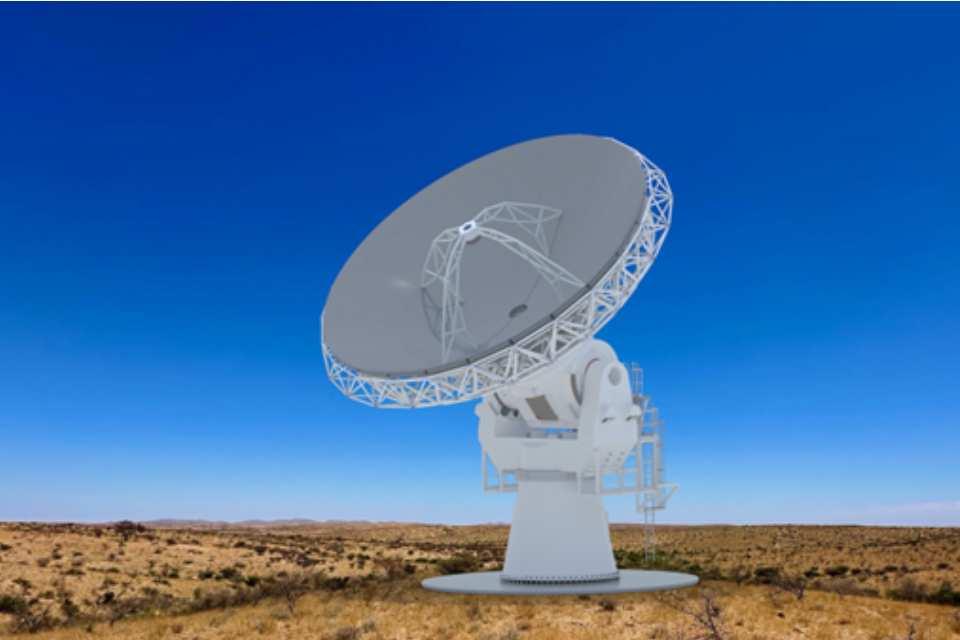
A realistic rendered image of the Africa Millimetre Telescope
The University of Oxford is a founding partner in an international consortium that will build the Africa Millimetre Telescope (AMT) in Namibia. The radio telescope will be the first African node to the global Event Horizon Telescope (EHT) network and will fill a key gap in the array providing better sensitivity to image rapid motions around black holes and to detect explosive astrophysical transients. The consortium is led by Radboud University in The Netherlands.
The EHT is a network of synchronised radio observatories that functions as a virtual Earth-sized telescope. Its resolving power is so high that it is comparable to photographing a poppy seed in Windhoek, Namibia, from Oxford. In 2019, the EHT captured the first-ever image of the shadow of a black hole. With this groundbreaking achievement, it provided direct evidence for the existence of supermassive black holes and demonstrated that Einstein’s theory of general relativity also holds in the most extreme circumstances.
Filling a crucial gap
The AMT will fill a crucial geographical gap in the global network of millimetre-wave telescopes, enhancing the coverage of the EHT and increasing its sensitivity. In addition, long-term monitoring and imaging at multiple wavelengths will enable scientists to go beyond single snapshots to ‘colour’ movies of black holes and their surroundings.
Professor Heino Falcke from Radboud University is chair of the AMT board: ‘The expansion of the EHT network to Africa has been a longstanding dream, which is now becoming reality. Namibia is ideally located for this kind of research. The AMT will play a pioneering role in making the EHT a truly global enterprise and in furthering our quest to better understand the mysteries surrounding black holes.’
Namibia to play a leading role
The new telescope will be built near the High Energy Stereoscopic System (H.E.S.S.) observatory in the Khomas Highland before being placed in situ on Gamsberg Mountain. It will consist of a robotically operated 14-metre dish optimised for 86–350 GHz frequencies and will be able to observe frequencies as low as 8 GHz. The AMT will be integrated into Very Long Baseline Interferometry (VLBI) arrays, including future observations on the African continent, incorporating the Square Kilometre Array (SKA). It will be the first radio telescope in Africa operating at millimetre wavelengths. This will give Namibia a leading role in global millimetre astronomy while stimulating scientific development across the region.
‘From the beginning, it was clear that Namibia would be an excellent location for the AMT,’ comments Professor Michael Backes, Research Chair in Astronomy at the University of Namibia. ‘The country has extensive experience with world-class telescopes such as HESS, and the University of Namibia is currently planning to establish Gamsberg as an astronomical observatory, which shall ultimately host the AMT.’
First dedicated transients programme
Oxford’s involvement in the project is led by Professor Rob Fender, who has been studying black holes for over three decades. As well as participation in the EHT observations, Professor Fender’s group at Oxford will coordinate the AMT’s parallel observing mode: as a single high-frequency radio dish making observations of astrophysical transients such as black holes and exploding stars.
High frequency, rapid-response observations with the AMT will probe up to a hundred times closer to the black hole than allowed by traditional radio telescopes. This will be the first dedicated transients programme at millimetre wavelengths in the world, and the team are anticipating many new discoveries. This transients programme is part of the large, multinational Blackholistic programme.
‘Beyond its vital contribution to the EHT, the programme to rapidly respond to diverse astrophysical transients, which will be led initially by Oxford, will be a world first,’ explains Professor Fender, Oxford lead in the AMT. ‘No other telescope on the globe is dedicated to exploring this exciting new space.’
The AMT consortium comprises Radboud University, University of Oxford, University of Amsterdam, University of Namibia, University of South Africa, and University of Turku as associated member.