

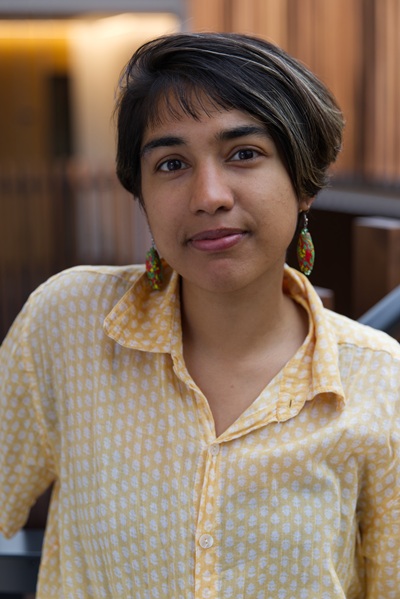
Marking a new partnership, Dr Shruti Nath from the Department of Physics has been appointed Research Lead at the community-driven African research institute, AfriClimate AI. In her role, Dr Nath will be supporting the institute’s work in developing AI weather forecasting systems that have been designed specifically for African operational contexts. The partnership between the University of Oxford and AfriClimate AI brings together expertise in AI weather forecasting, climate science, and operational meteorology.
Founded as a voluntary grassroots initiative, AfriClimate AI was established to bring community-driven AI solutions for weather and climate forecasting to the African continent. Since its founding, the organisation has expanded its work through major research initiatives, including the Google.org-supported Forecast4Africa project, which focuses on improving local weather forecasting capabilities across Africa.
At the centre of this effort is the development of FineCast, an AI-powered forecasting system designed to localise global AI numerical weather prediction models for African operational environments. While global AI weather prediction models have advanced in recent years, they are often developed using global datasets and operate at coarse resolutions that do not always reflect the realities or trusted observational systems used by African meteorological agencies.
'AfriClimate AI was founded around the idea that Africa should not simply consume AI weather technologies developed elsewhere, but actively shape and localise them within African operational settings,' said Dr Nath. 'Our work focuses on building systems that work alongside local meteorological agencies, strengthening local ownership and creating a framework where new AI forecasting models can be objectively evaluated and responsibly implemented.'
Rather than replacing existing forecasting systems, Forecast4Africa aims to lay the runway for emerging AI forecasting models to be suitably assessed against trusted local observational products and localised to operational requirements. The initiative prioritises objective benchmarking, calibration, and downscaling of global AI weather models to ensure forecasts are scientifically robust, locally relevant, and operationally usable.
The University of Oxford has also been involved in strengthening early warning and forecasting systems over the Greater Horn of Africa through the SEWAA (Strengthening Early Warning Systems for Anticipatory Action) project, which works with the United Nations World Food Programme and partners across Kenya, Ethiopia, Uganda and Rwanda. Research within SEWAA focusses on the development of AI-based post-processing systems for rainfall prediction and has highlighted the importance of ensuring that newer AI forecasting systems are carefully evaluated and adapted for local operational use – particularly in early warning and anticipatory action settings. Forecast4Africa builds on similar ideas, with a focus on localising emerging AI weather forecasting models for African meteorological contexts.
Beyond research collaboration, the partnership creates opportunities for ongoing scientific exchange between AfriClimate AI researchers and academics at the University of Oxford. It builds on wider cross-continent collaborations involving the African Institute of Mathematical Sciences where Dr. Nath and Dr. Mbuvha co-supervise projects on localisation of AI NWP products for the African contexts. Through a series of knowledge exchange sessions, researchers will engage on topics including AI short- and long-range weather forecasting, operationalisation of forecasting systems, and forecast evaluation methodologies. As part of the growing collaboration, the partnership is also planning a dedicated workshop at Oxford focused on Forecast4Africa-related research and operational forecasting challenges within African contexts.
'There is a strong intellectual exchange between Oxford and AfriClimate AI,' said Dr Rendani Mbuvha, Director of AfriClimate AI. 'What makes this collaboration particularly meaningful is that it is grounded in strengthening local knowledge and supporting grassroots scientific capacity across the continent. It is not simply about transferring technology, it is about building shared understanding and long-term collaboration between our homegrown team of researchers, leading experts at Oxford and operational communities across Africa and beyond.'
AfriClimate AI’s work forms part of a broader effort to improve weather forecasting accessibility, climate resilience, and early warning systems in regions most vulnerable to climate variability and extreme weather events. Through initiatives such as Forecast4Africa, the organisation aims to support more accurate, locally trusted forecasting systems that can assist sectors including agriculture, disaster risk management, water resources, and energy planning.
As AI continues to transform weather and climate science globally, the University of Oxford is working with AfriClimate AI to ensure African researchers, meteorological agencies, and communities are active participants in shaping the future of operational forecasting technologies.