

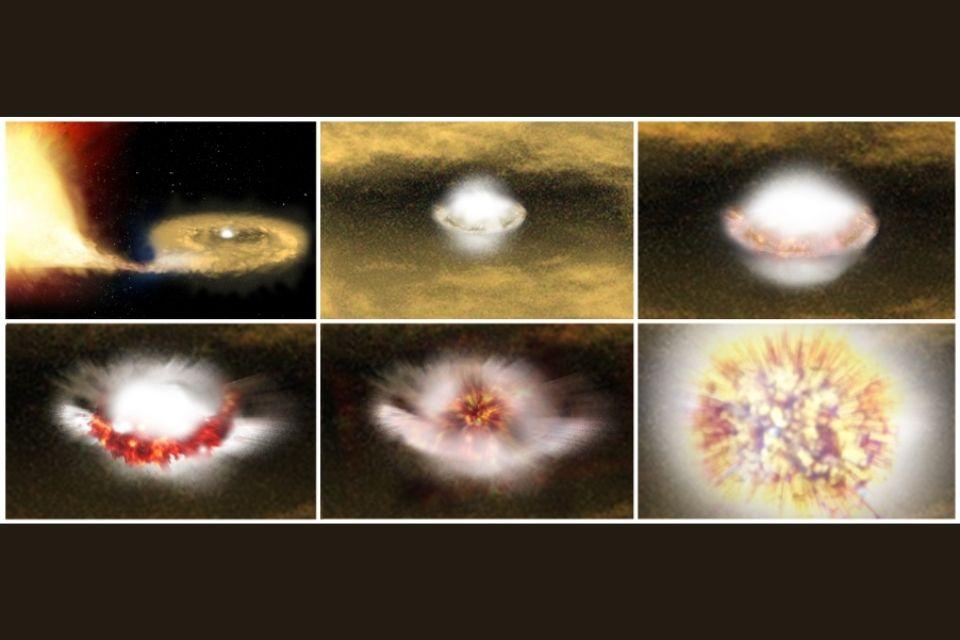
Artist's impression of a Type Ia supernova (based on observations of SN2014J)
Research led by the Tata Institute of Fundamental Research, Mumbai along with Professor Emeritus Subir Sarkar from the University of Oxford, questions the widely accepted argument that the expansion rate of the universe is accelerating and that this is driven by ‘dark energy’ arising from the quantum vacuum. Their letter has been published today in Monthly Notices of the Royal Astronomical Society. In the same journal issue, a paper led by the University of Southampton with Associate Professor Maria Vincenzi from the University of Oxford maintains that evidence points to the universe still accelerating.
In their work, Professor Sarkar of Oxford's Rudolf Peierls Centre for Theoretical Physics, together with Animesh Sah and Mohamed Rameez of the Tata Institute of Fundamental Research in India, revisited one of cosmology's most important observational datasets: the Pantheon+ compilation of more than 1,700 Type Ia supernovae. For more than 25 years, astronomers have used observations of these supernovae – exploding stars – to measure the expansion of the universe. Analysis of such observations led to the groundbreaking discovery that cosmic expansion appears to be accelerating – a finding that won the 2011 Nobel Prize in Physics.
The team analysed the supernovae from the Pantheon+ dataset, one of the most comprehensive catalogues of its kind, and incorporated a recently proposed correction that takes into account the age of the stars that eventually produce these supernova explosions. They also checked whether the inferred acceleration of the expansion rate is indeed the same in every direction, as is assumed in the standard cosmological model.
'There is increasing evidence that the brightness of Type Ia supernovae depends on the age of the stars they come from,' said Professor Sarkar, a co-author of the study. 'If this effect is not accounted for, it can lead to the erroneous conclusion that the expansion rate is accelerating.'
After applying the correction, the researchers found that the data no longer support a picture of a uniformly accelerating universe. Instead, their analysis suggests that cosmic expansion is overall slowing down rather than speeding up.
Professor Sarkar and his colleagues came to their conclusion by considering whether the inferred acceleration may in fact be anisotropic, meaning it exhibits different properties when measured in different directions and therefore deviates from the standard cosmological model. If that were true, they argue that dark energy couldn’t be responsible for driving the acceleration because an effect of the quantum vacuum cannot be anisotropic.
‘We found that the inferred acceleration is directed mainly along the direction that we are
moving locally, as indicated by the hotspot in the cosmic microwave background, and dies away with distance,’ explains Professor Sarkar. ‘This is unaffected by the correction to the supernova brightness – so rejects dark energy independently of whether the correction is applied or not. The correction turns the isotropic component into a deceleration – which again rules out dark energy.’
Looking ahead, Professor Sarkar and his team want to test their findings further using data from the Rubin Observatory’s Legacy Survey of Space and Time (LSST), which will soon measure hundreds of thousands of supernovae.
Pantheon+ supernovae corrected for progenitor age indicate the universe is decelerating, A Sah, M. Rameez & S. Sarkar, Monthly Notices of the Royal Astronomical Society, 11 June 2026