

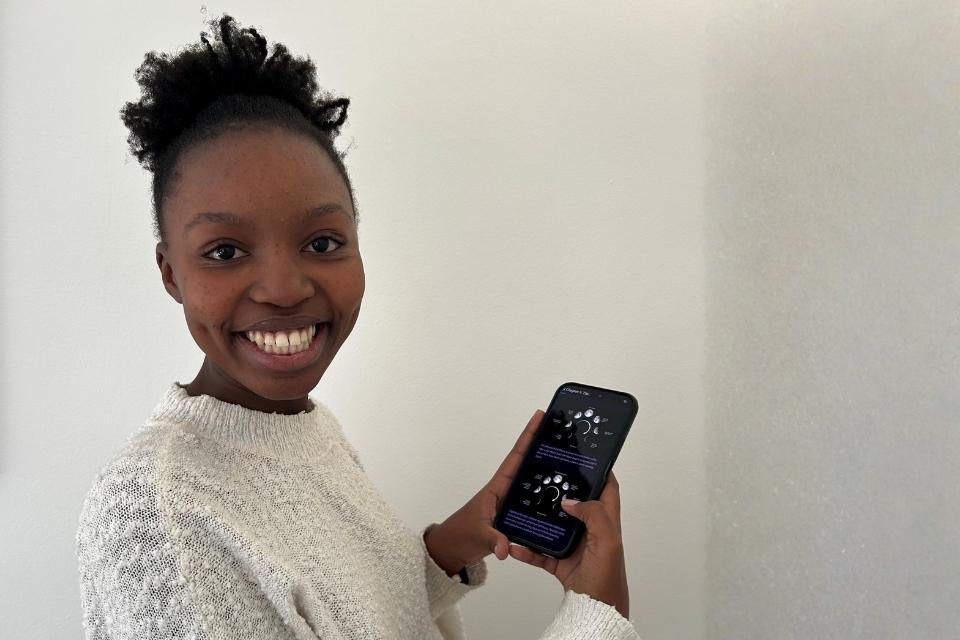
‘A city of stars’. When there isn’t a specific word for ‘galaxy’ in a language, you need to get creative, as Professor Katherine Blundell found out in the realisation of her latest project, STEP into the Cosmos. This online learning resource introduces curious minds to the foundations of astrophysics – all in Xhosa.
Xhosa is South Africa’s second language spoken by some 8 million people in South Africa alone as either a first or second language and further afield such as Lesotho, Zimbabwe and Botswana. However, Xhosa-language scientific resources – for young people and adults alike – aren’t quite so easy to come across.
Professor Blundell is the founder and director of The Global Jet Watch, the premise of which is simple enough: a network of round-the-world telescopes delivering round-the-clock spectroscopy as well as photometry. The observations then inform research into the causes and effects of accretion onto and ejection from near a black hole. What sets this programme apart however is Professor Blundell’s singular objective to bring people along with her on her research journey. Professor Blundell’s Global Jet Watch observatories aren’t located in research institutes or in the middle of nowhere, rather she chose to build four of the five in residential schools so that local school children get to take part in, and learn from, her research.
With this commitment at the core of her work, STEP into the Cosmos is her latest initiative as part of The Global Jet Watch. Working with the school where her South Africa telescope is hosted, it became immediately apparent that there was an enormous appetite to find out more about her work – from the students, their friends and families – and so STEP into the Cosmos was born: Professor Blundell worked with some of her trusted team from the school and in the local community to produce her own Xhosa-language resources to support and inspire local learning.
STEP into the Cosmos’ mobile-optimised webapp launches today with the first three of what will ultimately be 36 ‘chapters’ in total. These opening chapters introduce the solar system, stars and the moon and mark the start of the journey with subsequent chapters being released monthly. Concise paragraphs of explanatory text punctuated by clear annotated images and diagrams make the content engaging and easy to understand but it’s the ability to toggle on a direct translation that makes all the difference. Each short section can be viewed in English with the translation into Xhosa either stacked (on a mobile) or side by side (on a computer).
‘Being able to present information to people in their mother tongue is actually very significant – physics and astrophysics are already daunting to many and I wanted to remove any additional barriers,’ explains Professor Blundell. ‘It is hard not to be moved by the big skies in South Africa and I hope that STEP into the Cosmos will tap into people’s natural curiosity to show that science is for everybody.’
Professor Blundell is already working on translating the chapters into Kannada, one of the languages spoken in southern India where another Global Jet Watch telescope is located.
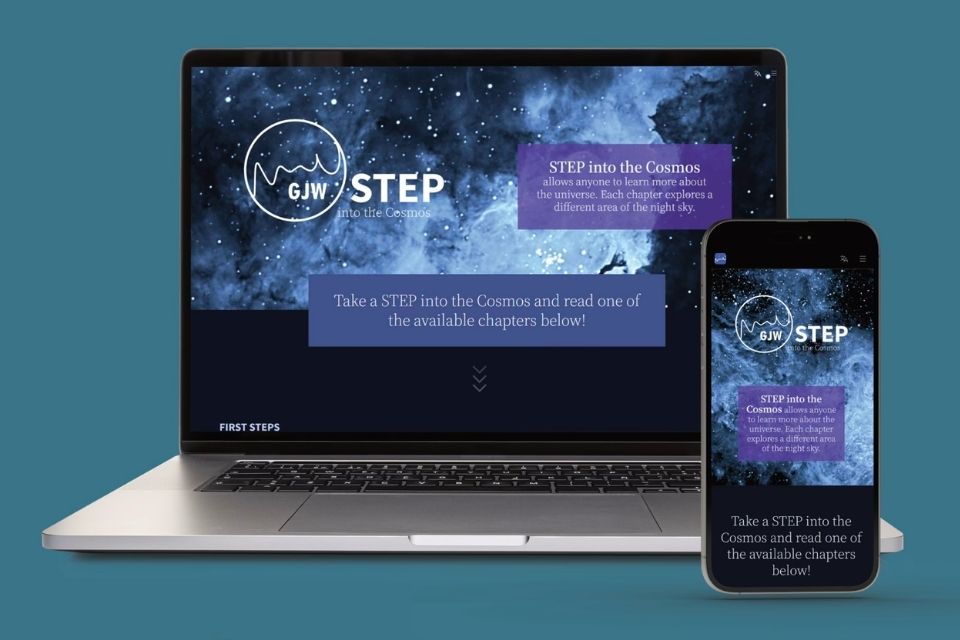
‘I have carefully considered the location of the Global Jet Watch telescopes. First and foremost, they have to work geographically to get comprehensive coverage of the active night sky, of course, but a close second is that I wanted their presence to engage the local community – and particularly girls who may have fewer opportunities. And local-language resources play a key role in this so it was an obvious next step to produce our own. A webapp that people can access easily on their phones brings this knowledge to a much wider audience and it is really exciting to consider what other languages could be served through STEP into the Cosmos.’