

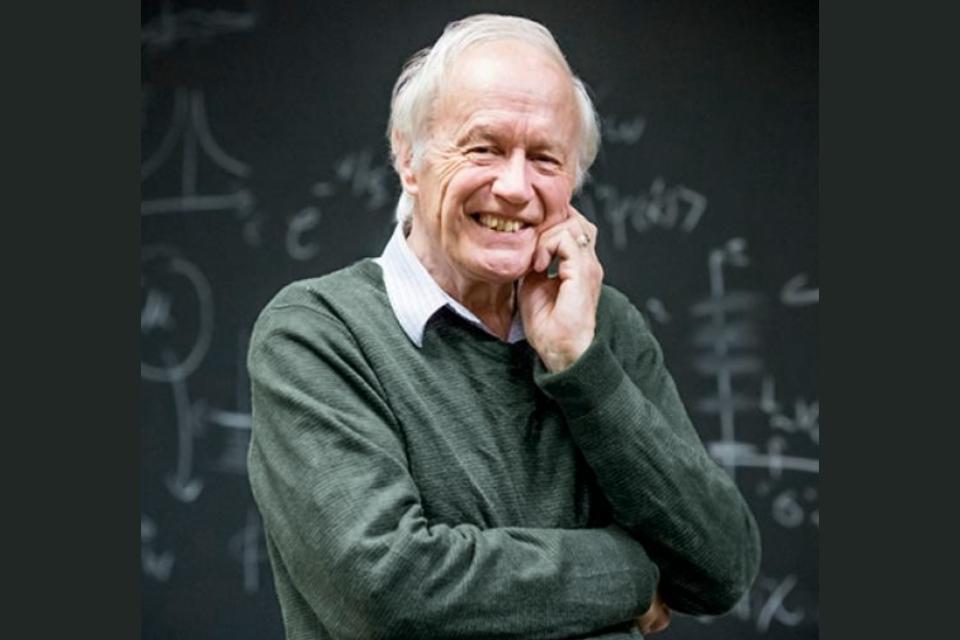
Professor Stephen Blundell reflects on the life and legacy of Sir Anthony Leggett who died on 8 March 2026. A world leader in condensed matter physics, Sir Anthony was a former undergraduate and graduate student at Oxford, and winner of the 2003 Nobel Prize in Physics for his contributions to the theory of superconductors and superfluids.
Tony's beginnings at Oxford might not have hinted at the future direction his career would take. He won a scholarship to Balliol and arrived in 1955 to read what we would now call classics, graduating in 1959 with a ‘BA in literae humaniores’. He then decided to change direction and embark on a second undergraduate degree at Oxford, this time in physics. As he later recalled, it was a time when ‘to do a second undergraduate degree in anything, let alone in a subject in which one had no secondary-school experience, was practically unheard of.’ Funding was an issue but Cold War politics came to the rescue. The 1957 launch of Sputnik led politicians to question how the Soviets had managed to get so far ahead in technology. The assumed answer, as he wrote later was ‘because we have encouraged all our best brains to study useless subjects (such as classics) rather than useful ones (such as science and engineering and particularly physics). Immediately all sorts of scholarships became available for students in the arts who wished to transfer to science; and while I did not in the end need to apply for any of these, I think that the general shift in cultural attitudes which they reflected was an enormous psychological boost to me in making the switch.’ He was helped by David Brink, a physics tutor at Balliol, who judged that Tony was intellectually up to it, and Michael Baker, who accepted him at Merton to read physics and awarded him a scholarship.
Tony stayed at Oxford after his second degree, this time for a DPhil in Theoretical Physics, under the supervision of Dirk ter Haar. After completing his thesis in 1964, he moved to the University of Illinois Urbana-Champaign as a postdoctoral researcher with David Pines and John Bardeen. In 1967, he returned to the UK as a lecturer at the University of Sussex, remaining there until 1983 when he moved back to Illinois for a 35-year stint as the John D. and Catherine T. MacArthur Professor of Physics.
Since his DPhil, Tony had been captivated by the puzzling behaviour of superfluid liquid helium-3. Existing theory at the time, which had successfully explained the superfluidity of helium-4, fell short when applied to its rarer counterpart. Between 1972 and 1975, Tony developed a groundbreaking theory that shed light on this phenomenon by introducing a new physical mechanism and a novel form of symmetry breaking. This framework became the cornerstone for understanding the superfluid phases of helium-3 as the result of anisotropic pairing between its atoms and this masterpiece of intuition was a major reason for his award of the 2003 Nobel Prize in Physics ‘for pioneering contributions to the theory of superconductors and superfluids’, a prize shared with Alexei Abrikosov and Vitaly Ginzburg. He received many other prizes and awards, including a knighthood in 2004. He was also made an Honorary Fellow of his old Oxford colleges: Balliol, Merton and Magdalen.
In addition to his breakthroughs in the theory of superfluidity, Tony made many other pivotal contributions to physics, including the introduction of the Caldeira-Leggett model, a quantum mechanical method to describe dissipation and decoherence in open systems, and in his exploration of macroscopic quantum phenomena, where he fleshed out the implications of quantum mechanics applying to large, macroscopic objects, and not just to subatomic particles. He also made major advances in the foundations of quantum mechanics, in particular through the Leggett-Garg inequality which tests the limits of ‘macrorealism’ – the classical assumption that macroscopic objects exist in definite states and can be measured without disturbance.
Tony Leggett wrote lively and interesting papers, and his wonderful books The Problems of Physics and Quantum Liquids are packed full of insights and are both published by Oxford University Press. His impact in physics has been enormous, and he lived a life marked by brilliance, curiosity, humility, and generosity. He will be much missed.