

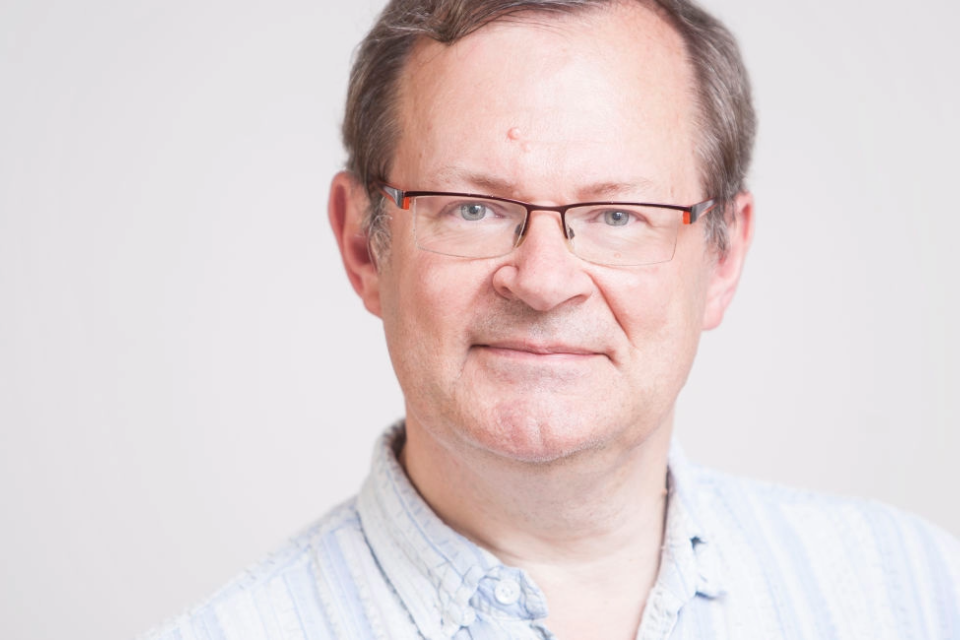
Professor Brian Foster OBE FRS is Donald H Perkins Professor of Experimental Physics and a keen violinist. He organises Oxford May Music every year alongside award-winning violinist Jack Liebeck and this year, it will take place on 2-4 May at St John's College, Oxford. Professor Foster's latest book, Einstein: A Life in Science and Music, marries his two passions of particle physics and music and here he reflects on the role music played in Einstein's life.
More than 20 years ago, when the world seemed a much more stable place, I nevertheless had a problem. World Year of Physics was looming in 2005, the centenary of Einstein’s Annus Mirabilis in which he shook the foundations of physics with five remarkable papers, including, of course, Special Relativity. As a dedicated expositor to the general public, I needed to find a suitable topic to mark this event. Sitting in a pub with my friend and violin teacher, Jack Liebeck, the virtuoso violinist, I shared my problem. He reminded me that Einstein was a dedicated violinist and in a flash the idea for our lecture series 'Superstrings' and 'Einstein’s Universe' was born. Still going, and having reached approaching 200 performances to a total live audience of over 30,000 people across the world, it was this experience that incubated my new book.
As I learnt more about Einstein by giving these lectures, I was startled to observe the scant attention paid to Einstein’s musical activities in the literature. Slowly, the idea of rectifying this omission gathered strength. A little under a decade ago, I launched into what I had intended to be a rather specialised and brief text. However, I soon realised that the story of Einstein and music could not be told without discussing his personality and emotions. The specialised essay became a 'full' biography in which I have nevertheless given particular attention to all things musical and the emotional landscape from which this passion welled, involving his family, lovers and friends. The second of these categories might indeed have edged music into third place in the most important aspects of his life, after, naturally, physics. These are the three main threads in the book.
I scarcely need to discuss Einstein’s physics with this audience but it is a challenge in the book to explain the ideas behind his major papers without using any equations, except, of course, E = mc2. The reader must judge to what extent I have succeeded. Other challenges I encountered included Einstein’s extreme unreliability about the origins of his ideas. His various accounts of the birth of Special Relativity for example are splendidly self-contradictory. He was uninterested in how his ideas had arisen but obsessed by their further development. He also suffered from the common tendency to wishful thinking; what he thought he ought to have done morphed, over the years, into what he thought he had done. An example here is his recollection of his involvement in weapons research in the Second World War. After the war he often stated that his only contribution had been to sign a letter to President Roosevelt about the dangers of the Nazis developing an atomic weapon; the record tells otherwise.
The second of his major preoccupations is perhaps somewhat surprising, but the fact is that Einstein was an inveterate womaniser. He had contempt for the institution of marriage, as both of his wives found out to their cost. His acrimonious separation and later divorce from his first wife, Mileva, was probably catalysed by Einstein’s rekindled passion for his first love as a schoolboy, Marie Winteler. This only recently came to light with the discovery of letters between Marie and Einstein. In addition to their two sons, Mileva first gave birth to a girl, born out of wedlock and probably put out for adoption in Serbia, where she probably died at an early age. Rumours of other illegitimate children fathered by Einstein were rife; these are investigated in the book. His second wife, the comfortably bourgeois Elsa, had to put up with Einstein seducing her friends, flaunting his mistresses at their country cottage in Caputh, and bringing a succession of them to their place of exile in Le Coq, Belgium while Elsa was trying to cope with exile from her beloved Berlin and the danger they were in from Nazi fanatics. Nor did Einstein’s philandering cease when they fled to the USA in 1933. Nevertheless, Elsa never ceased to love him. He was clearly a loveable man; not only women fell for his charm, many of his male friends were captivated by him and exerted themselves to extraordinary degrees to help him out of the many scrapes that he got into through his familial complications.
Einstein’ passion for music seems exceptional, even in a time where it was often one of few available amusements. Many of Einstein’s physicist contemporaries were pianists; of those close to him, Max Born and Paul Ehrenfest were excellent musicians. Perhaps only Max Planck made music such an important part of his life; he sang, composed, conducted, played chamber music and the organ. However, it is difficult to imagine him breaking off what he was doing to run down the street in pursuit of a promising musical collaborator, as Einstein often did. Einstein’s taste in music was conservative. Mozart captivated him from his early youth, closely followed by Bach. The latter’s solo sonatas and partitas were a solace when no pianist was available. His youth however admitted a much broader musical spectrum than he would admit to subsequently. As a schoolboy, his interpretation of Beethoven was praised; he practised Brahms’ G major sonata to prepare for attending a performance by Joseph Joachim. Provided a piece of music had a structure, he could find merit in it. However, structure had to go hand-in-hand with melodic beauty. There is structure aplenty in Schoenberg’s music; it was his atonality that made him consider Schoenberg to be mad. He detested the emotionalism of Wagner. The “impressionism” of composers such as Debussy and Ravel, a blurring of formal organisation in favour of musical colour, found no favour. As to whether Einstein was a 'good' violinist, opinions are mixed. Since he was careful to ensure that he was never recorded, we will never know for sure. However, anyone who plays Beethoven’s 'Kreutzer' sonata in public, as he did in Japan just after winning his Nobel Prize, must have been a good amateur. Robert Mann of the Juilliard Quartet reported on the last time that Einstein is known to have played the violin; in 1952, he joined the quartet to play Mozart’s G minor quartet at his home in Princeton. According to Mann, 'while his out-of-practice hands were fragile, his coordination, sense of pitch, and concentration were awesome.'
Fascinating as his life turns out to have been, it is his science that is Einstein’s memorial. His concepts have become ubiquitous in the twenty-first century in countless applications: satellite navigation, lasers, photovoltaics, particle accelerators, radiotherapy. As physicists, the elegance, breadth and profundity of his work still evokes our awe. His conviction that the basic laws of physics must be economical in concept, elegant in mathematical expression and unified in description guides our search for a fundamental understanding of the universe.
I end with the quote from the beginning of my book, which seems to me almost eerily prophetic. It comes from Chapter 3.LXXXIII of Tristram Shandy, which Laurence Sterne began in 1759. This happens to have been one of Einstein’s favourite books, which he read from cover to cover to his sister Maja in her final illness. I often wonder what he thought when he read it:
'Pray can you tell me – that is, without anger, before I write my chapter upon straight lines – by what mistake – who told them so – or how has it come to pass, that your men of wit and genius have all along confounded this line, with the line of Gravitation?'
Meet the author
Professor Brian Foster is co-hosting Einstein in Oxford: Thinking in Music on Thursday 18 June from 6-7pm followed by a drinks reception at Trinity College.