

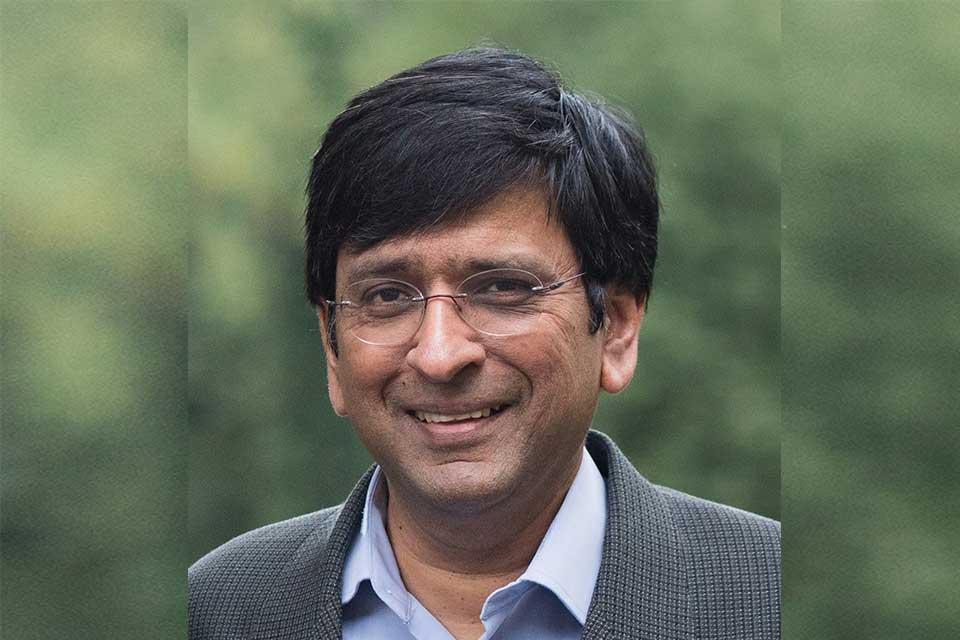
Professor Shivaji Sondhi from the University of Oxford’s Department of Physics was one of an international team of researchers who demonstrated how quantum phenomena can give quantum processors an advantage over classical approaches in carefully defined tasks. The study, led by Google Quantum AI was featured on the cover of Science and demonstrates quantum advantage across increasingly complex tasks. It also illustrates an emerging research direction – using games to reveal the distinctive capabilities of many-body quantum systems – and offers new ways to assess the performance of quantum hardware.
Beyond the immediate technological results, the work points to a developing direction in fundamental physics: the use of quantum games to investigate the properties of many-body quantum systems. Along with theoretical collaborators at Oxford and other institutions, we have pursued this approach since around 2020, asking what new insights emerge when quantum states are characterised not only by their conventional physical properties, but also by what they enable players to accomplish.
Why play games with quantum matter?
One family of games asks participants to coordinate their answers to a set of questions, without communicating once the game begins. Classical players can agree on strategies in advance, but their success is limited by the lack of shared real-time information. Quantum players sharing entangled states can sometimes do substantially better even though they only have access to the qubits in their possession.
Such games are familiar as demonstrations of quantum mechanics’ departure from classical physics. The more recent idea is to use them as tools for exploring complex quantum matter. What can the ground state of a particular system allow players to do? Does the advantage change across a phase transition? Can games expose features of entanglement or quantum dynamics that more conventional probes overlook?
In two 2023 papers with Vir Bulchandani and Fiona Burnell, we explored these questions in concrete many-body settings. One examined the GHZ parity game in different phases of the quantum Ising model, demonstrating a connection between game-playing advantage and phases of matter. The other introduced a multiplayer, multiteam game for the toric code, a canonical model of topological order.
The programme has since expanded beyond nonlocal coordination games. With Chuqiao Lin and Vir Bulchandani, we looked at 'Nash states', inspired by Nash equilibria in classical game theory, as a generalisation of the usual quantum-mechanical notion of an eigenstate. With Raúl Morral-Yepes, Adam Smith and Frank Pollmann, we also explored unitary circuit games in which competing players try to generate or suppress entanglement, producing a new setting in which to examine many-body dynamics and phase transitions.
The idea is to use games as a new lens on quantum matter. Instead of asking only what a quantum state is, we ask what it allows players to do. That gives us a different way of thinking about phases of matter, entanglement and quantum dynamics.
From theory to a quantum processor
The new Google-led experiment demonstrates how some of these ideas can be implemented and tested on real quantum hardware. It focuses on contextuality, the property that quantum measurement outcomes cannot always be regarded as revealing values fixed in advance, independently of the other compatible measurements made alongside them. Contextuality has long been regarded as a possible resource for quantum computational advantage.
For this study, we first implemented the magic square game, in which two players must coordinate their answers without communicating. The best classical strategy wins at most eight times out of nine, or about 88.9% of the time, whereas an ideal quantum strategy can win every time. Using four qubits, we achieved a winning rate of 98.3%.
We then studied the many-player GHZ parity game, the subject of the earlier work I did with Bulchandani and Burnell. The Google team observed a quantum advantage for games involving as many as 71 qubits, remaining above the optimal classical success rate despite the noise and imperfections of the processor.
Finally, using up to 105 qubits, we implemented a shallow-circuit algorithm for the hidden linear function problem. This supplied a large-scale experimental test of a theoretically established separation between quantum and classical circuits under specific resource constraints.
These demonstrations do not establish that quantum computers are universally faster than classical ones. Rather, they identify concrete tasks in which quantum resources permit successes unavailable to classical approaches subject to the same restrictions.
Games as benchmarks — and instruments of discovery
The experiments also suggest a practical way to benchmark quantum processors. Games impose sharply defined success criteria, and departures from ideal performance can reveal subtle hardware errors that other tests may miss. They therefore connect fundamental questions about quantum mechanics to the engineering of more reliable quantum devices.
But their scientific promise may be wider still. Increasingly capable quantum platforms allow researchers to prepare and manipulate complex states that are difficult to investigate by classical calculation. Games could provide a way of asking new questions of these systems, rather than merely checking the answers to familiar ones.
In an Oxford Physics colloquium in October 2026, and in talks elsewhere, I have discussed the possibility of using such platforms in a 'discovery mode', analogous in spirit to how particle accelerators have helped reveal new phenomena in high-energy physics. Quantum games offer one concrete starting point for that ambition.
The Google experiment is exciting not just because it demonstrates quantum advantage, but because it helps bring a broader set of theoretical questions within experimental reach. As these platforms develop, we may be able to use quantum games to discover new kinds of many-body behaviour, not simply to benchmark machines or execute known algorithms.
Quantum-classical separation in bounded-resource tasks arising from measurement contextuality, Google Quantum AI and collaborators, Science 394, 870-874