

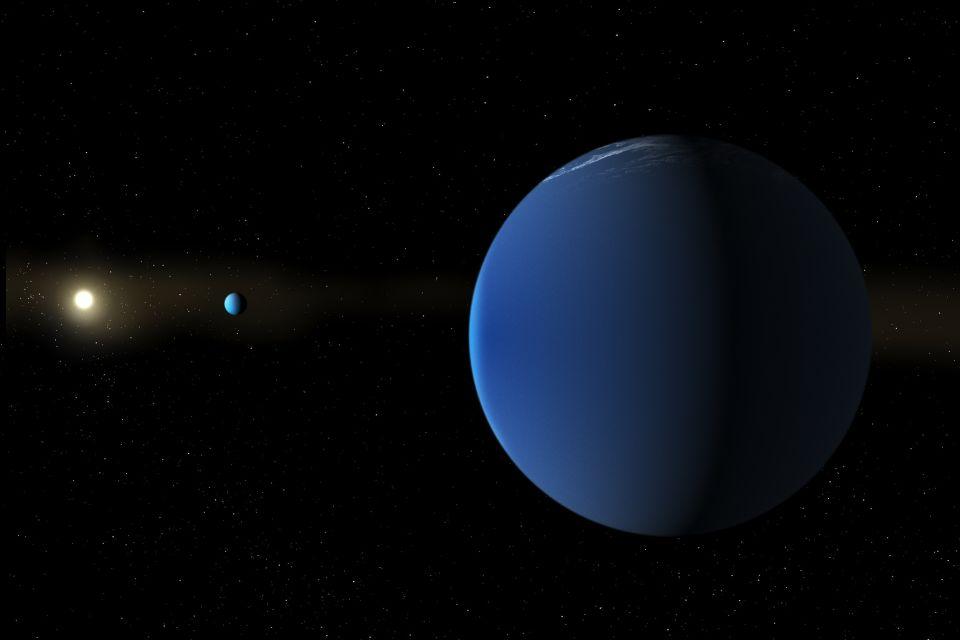
This illustration depicts the Sun-like star TOI-791 and two giant planets that NASA's TESS space telescope discovered in its orbit. These planets, designated TOI-791 b and TOI-791 c, are roughly the size of Jupiter but a tiny fraction of its mass, meaning they have an extraordinarily low density.
An international collaboration led by the University of Oxford has discovered two of the lowest-density giant planets ever detected: rare 'super-puff' planets with densities lower than candy floss. The study -a collaboration between the University of Oxford, Université Côte d’Azur/Observatoire de la Côte d’Azur and the University of Birmingham - has been published today in Monthly Notices of the Royal Astronomical Society.
'Only a handful of these super-puffy planets are known, and it is even rarer to find two in the same system,' explains lead author, Dr George Dransfield from the Department of Physics at the University of Oxford. 'Their extremely low densities make them fascinating targets for understanding how planetary systems form and evolve.'