

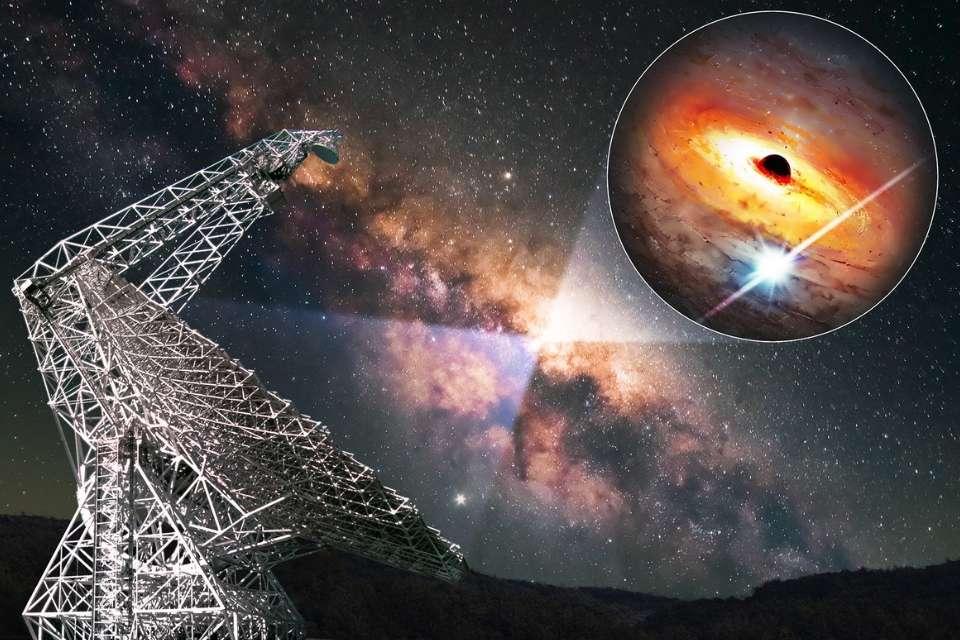
Artist's impression of the Green Bank Telescope gathering data on the centre of the Milky Way. The inset image shows the black hole at our Galaxy's center, and a nearby candidate (unconfirmed) pulsar.
Researchers from Columbia University and Breakthrough Listen have published new results from one of the most sensitive radio searches ever conducted for pulsars in the dynamically complex central region of the Milky Way Galaxy: the Breakthrough Listen Galactic Center Survey. The study, led by recent Columbia PhD graduate Dr Karen I Perez, was published in The Astrophysical Journal. The discovery of a possible millisecond pulsar challenges ideas about how many neutron stars lurk around the Milky Way’s central black hole. Breakthrough Listen is a scientific research programme aimed at finding evidence of civilisations beyond Earth and is headquartered at the University of Oxford’s Department of Physics.
Pulsars are rapidly spinning, highly magnetised neutron stars that emit beams of radio waves sweeping across Earth like cosmic lighthouses. Because their pulses are extremely regular, pulsars can be used as ultra-precise cosmic clocks for studying physics in extreme conditions. The central region of the Milky Way Galaxy is expected to host a large population of pulsars, but detecting them is exceptionally difficult due to strong interstellar scattering and the region’s extreme environment. Radio wavelengths are well suited for these searches because they can probe dense regions of the Galactic Center that are otherwise obscured at optical wavelengths.
The Galactic Center, home to the supermassive black hole Sagittarius A* and dense stellar populations, presents unique scientific opportunities and challenges for understanding stellar dynamics, extreme astrophysical environments, and tests of Einstein’s theory of General Relativity. In this new work, Dr Perez and collaborators conducted more than 20 hours of observations with the Green Bank Telescope (GBT), an observatory in West Virginia, between 2021 and 2023, using the Breakthrough Listen Digital Backend, which enables high-time and high-frequency resolution data products across a wide radio bandwidth. Of these observations, 11 hours were dedicated to the innermost 1.4 arcminutes of the Galactic Center, resulting in one of the deepest and most sensitive pulsar surveys ever performed toward this region.
This survey was also a computationally intensive undertaking. Individual observations of the innermost region lasted 1-2 hours, covered nearly 4 GHz of bandwidth with a sampling time of 44 microseconds, and each produced 3-8 terabytes of data. Processing this data required large-scale computing resources, including Columbia University’s High-Performance Computing cluster, with high-memory allocations and parallelised searches across multiple compute nodes.
The survey identified an intriguing 8.19-millisecond pulsar (MSP) candidate. Given the potential implications of such a discovery, analysis of extensive follow-up observations is underway. ‘Our survey is one of the most sensitive ever conducted toward the Galactic Center,’ said Dr Perez. ‘We should have been sensitive to approximately 10% of MSPs and 50% of canonical, slow pulsars, assuming the pulsar population in the Galactic Center resembles that of the broader Milky Way. Despite this sensitivity, we detected only a single candidate – dubbed the Breakthrough Listen Pulsar (BLPSR) – which remains under active investigation.’
In the absence of any external influences, the pulses from a pulsar arrive at our telescopes with extraordinary regularity, so they can be thought of as very accurate clocks with highly predictable behaviour. Millisecond pulsars in particular exhibit extremely stable clock-like behaviour due to their very rapid rotation. ‘Any external influence on a pulsar, such as the gravitational pull of a massive object, would introduce anomalies in this steady arrival of pulses, which can be measured and modelled,’ said Dr Slavko Bogdanov, research scientist at the Columbia Astrophysics Laboratory. ‘In addition, when the pulses travel near a very massive object, they may be deflected and experience time delays due to the warping of space-time, as predicted by Einstein's General Theory of Relativity.’ Since the central black hole in our Galaxy has a mass about 4 million times the mass of our Sun, it exerts a strong influence on its surroundings.
Detecting, confirming, and carefully measuring the arrival of a pulsar in a close orbit around Sagittarius A* would therefore enable unprecedented tests of General Relativity, including precision measurements of the space-time around a supermassive black hole. Such a discovery would revolutionise physics and remains a major long-standing goal of Galactic Center research. At the same time, the scarcity of detections in this survey raises fundamental questions about the true pulsar population and the complex environment in the Galactic Center.
‘This survey was conducted as part of the deepest Breakthrough Listen Galactic Center search for technosignatures,’ said Dr Vishal Gajjar, staff astronomer at the SETI Institute. Technosignatures are signals that could indicate the presence of advanced technology beyond Earth. ‘Observing along the line of sight with the highest stellar density not only enables the strongest technosignature constraints to date in this direction, but also supports valuable ancillary science, from pulsar population studies to searches for axion dark matter.’
To maximise community impact, Breakthrough Listen is releasing the observations publicly, allowing researchers worldwide to pursue independent analyses and complementary science cases.
‘Breakthrough Listen is one of the largest technosignature search efforts humanity has ever undertaken,’ said Dr Steve Croft, project scientist for the Green Bank Telescope within the Breakthrough Listen programme. ‘By making these Galactic Center observations openly available, we aim to extend their scientific impact well beyond the original search for technosignatures.’
Future next-generation radio facilities, such as the next-generation Very Large Array (ngVLA) and the Square Kilometre Array (SKA), are expected to provide the sensitivity and resolution necessary to uncover this elusive pulsar population and probe the extreme physics of the Galactic Center.
‘We’re looking forward to what follow-up observations might reveal about this pulsar candidate,’ Dr Perez said. If confirmed, it could help us better understand both our own Galaxy, and General Relativity as a whole.’
On the deepest search for galactic center pulsars and an examination of an intriguing millisecond pulsar candidate, K Perez et al, The Astrophysical Journal, 2026 ApJ 998 147