

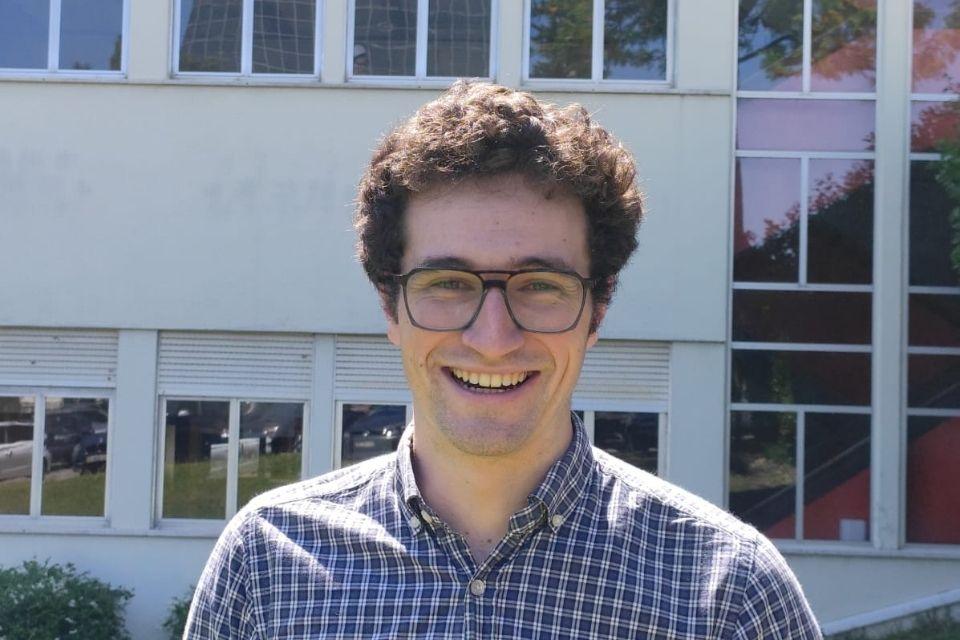
Leverhulme Peierls fellow Dr Pablo Bilbao has been awarded the European Physical Society Plasma Physics Division’s PhD Research Award. The Plasma Physics Division of the EPS recognises up to four scientists for truly outstanding research achievements associated with their DPhil study in the field of plasma physics.
Dr Bilbao’s thesis, ‘Kinetic instabilities in extreme plasma physics: laboratory and astrophysical dynamics’, studies how matter behaves under some of the most extreme conditions in the universe. One such example can be seen around neutron stars, where particles move close to the speed of light and radiate enormous amounts of energy. In these environments, ordinary matter can turn into electron–positron 'pair plasmas', which behave very differently from the plasmas encountered on Earth.
‘One of the big open questions in astrophysics is how these systems produce incredibly bright, coherent radio flashes, such as those seen from pulsars and Fast Radio Bursts,’ explains Dr Bilbao who gained his doctorate at the Instituto Superior Técnico a the University of Lisbon in Portugal. ‘I developed a theoretical understanding showing that when a very hot plasma cools by radiating energy, the particles naturally reorganise themselves into an unstable configuration, which was confirmed using some of the largest computer simulations of this kind of plasmas. The resulting plasma is unstable and can efficiently convert particle energy into intense, highly ordered radio waves. In other words, the act of cooling can itself trigger the mechanism that produces the radiation. I also showed that closely related physics appears in next-generation particle accelerators, where high-energy beams emit radiation as they travel through plasma. There, radiation can reshape the beam in a similar way, potentially enabling new sources of coherent light in the laboratory.’
Dr Bilbao also worked with the CERN Fireball experiment alongside Professor Gianluca Gregori from the University of Oxford. The experiment achieved the first laboratory creation of a relativistic electron–positron pair plasma. He led large-scale computer simulations to interpret the experiment and determine which plasma instabilities should occur under realistic conditions. This helped establish the first experimental constraints on how such pair plasmas behave.
Dr Bilbao is the eighth winner from the University of Oxford in recent years; he joins fellow alumni Dr Robert Ewart (2025), Dr Toby Adkins (2024), Dr David Hosking (2023), Dr Plamen Ivanov (2022), Dr Archie Bott (2020), Dr Justin Ball (2017) and Dr Edmund Highcock (2014).