

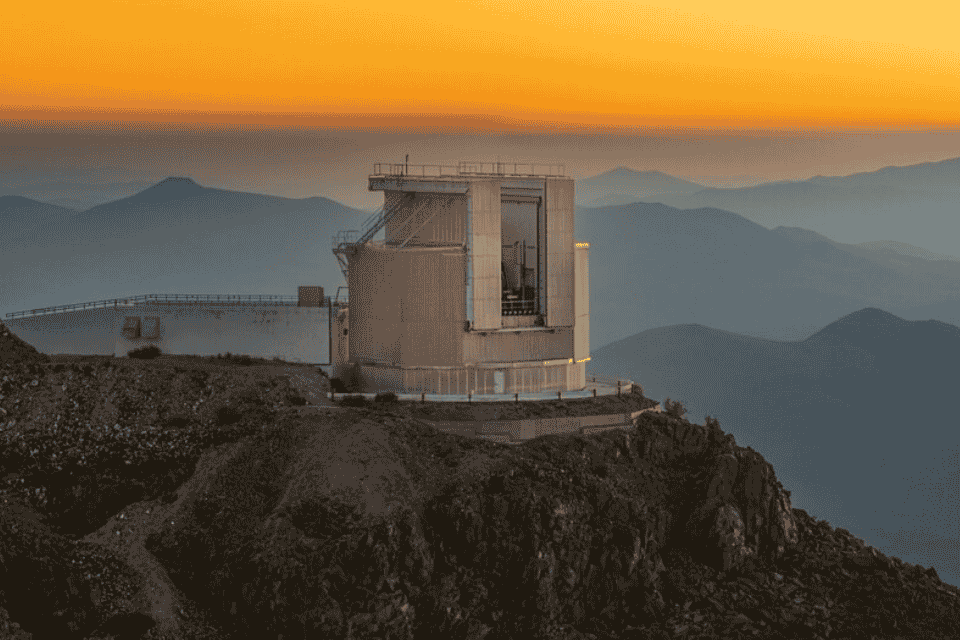
Researchers at the University of Oxford have joined forces with an international consortium in the delivery of a powerful new spectrograph, SOXS (Son of X-Shooter), which achieved 'first light' at the La Silla Observatory in Chile. Installed on the New Technology Telescope (NTT) operated by the European Southern Observatory (ESO), SOXS is purpose-built to study short-lived cosmic events such as supernovae, gamma-ray bursts, kilonovae, and rapidly moving near-Earth asteroids.
Oxford researchers, working in close collaboration with colleagues at Queen’s University Belfast, have made major contributions to both the hardware and software that underpin SOXS. This includes early UK leadership in detector procurement and the development of a fast, automated data-reduction and analysis pipeline that will allow astronomers worldwide to respond to transient events in near real time.
‘The Science and Technology Facilities Council (STFC) identified the opportunity for the UK to become involved in SOXS at an early stage and funded the detector procurement from e2V Teledyne,’ comments Professor Stephen Smartt. ‘This allowed us to acquire an exceptional detector, virtually free from cosmetic defects and with excellent efficiency. Maximising efficiency in every component was key to the SOXS concept. When you consider the throughput gains, and simultaneous wavelength coverage, we have built an instrument about 10 times more efficient than the existing two instruments. In the UK we have led the Public ESO Spectroscopic Survey of Transient Objects (PESSTO) which surveyed the sky for most energetic explosions in the Universe. It was incredibly successful but now we have an instrument 10 times better and twice the amount of telescope time. With the Rubin Observatory’s Legacy Survey of Space and time starting later this year, we are in a great position to follow-up its discoveries.’
SOXS is designed for time-domain astronomy — the study of astronomical phenomena that evolve over minutes, hours, or days. The instrument can be rapidly scheduled in response to real-time alerts and observes simultaneously in optical and near-infrared wavelengths, providing a complete picture of how these fleeting events change over time. In doing so, it replaces two previous NTT instruments with a single system that is around ten times more efficient.
A key part of Oxford’s contribution lies in the software that turns raw observations into science-ready data. The SOXS pipeline has been designed to operate automatically and at speed, enabling rapid public data releases that are essential for studying rapidly evolving cosmic sources.
‘QUB-Oxford have built a fast, efficient data reduction and analysis pipeline,’ comments Dr Matt Nicholl (Queen’s University Belfast). ‘This will produce science ready data in real time, with no delay, so our rapid follow-up with SOXS will be followed by rapid public data releases, often within 24 hours. As we move to surveying the whole visible sky every day, then speed of instruments and data analysis is essential to discover the fastest evolving sources which are associated with black holes and neutron stars. The software pipeline is a key integral part of the whole instrument concept and our Research Software Engineer Dr Dave Young, designed and wrote the whole software, funded by STFC.’
Following final commissioning, SOXS will begin full scientific operations, serving both the international consortium and the wider ESO community. Oxford’s involvement ensures the UK remains at the forefront of global efforts to explore the most dynamic and extreme events in the Universe.