

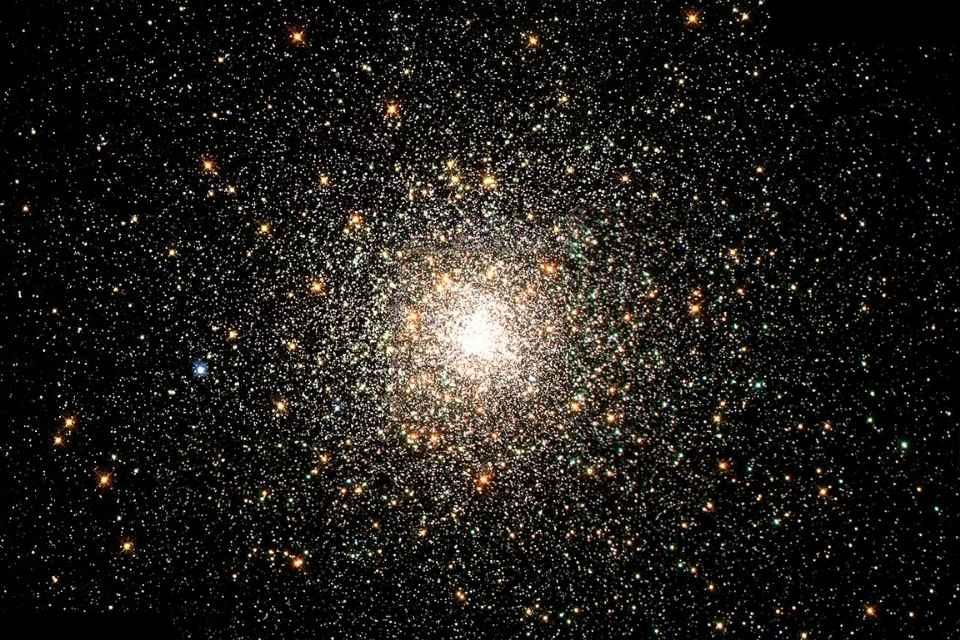
About 28,000 light-years away, the globular cluster M80 is home to hundreds of thousands of stars bound together by gravity. Crowded environments like this can help drive the growth of black holes through consecutive mergers.
The most massive black holes in the Universe detected by the ripples they make in space time were not born directly from collapsing stars, according to a new study. These cosmic giants instead build up through a series of repeated and extremely violent collision events in very densely populated star clusters, an international team of researchers argue.
The study, led by Cardiff University, with researchers from Chicago, Northwestern, Oxford, and other universities in Europe, analysed version 4.0 of LIGO–Virgo–KAGRA’s Gravitational-Wave Transient Catalogue (GWTC4), containing 153 sufficiently confident black hole merger detections.
The team wanted to test the idea that the heaviest black holes in GWTC-4 are ‘second-generation’ objects, formed when earlier black holes merged and then merged again in the dense cores of star clusters, where stars can be packed up to a million times more tightly than in the Sun’s neighbourhood. Their findings, published in Nature Astronomy, probe the origins of the heaviest black holes detected by their gravitational waves, revealing two distinct populations.
‘Gravitational-wave astronomy is now doing more than counting black hole mergers,’ explains lead author Dr Fabio Antonini from Cardiff University’s School of Physics and Astronomy. ‘It is starting to reveal how black holes grow, where they grow, and what that tells us about the lives and deaths of massive stars. This is exciting because we can use the information to test our understanding of how stars and clusters evolve in the Universe.’
In the gravitational-wave data, the team identified a lower-mass population consistent with ordinary stellar collapse; and a higher-mass population whose spins appear exactly like those expected from hierarchical mergers in dense star clusters.
The spins of the low-mass black holes were found to be very low – as would be expected from stellar collapse. The transition mass between the two populations emerges very clearly from the spins data: for masses above it, the spins were found to be consisted with what one would expect from random orientations in space, and had much larger magnitudes.
The study also provides the strongest evidence yet for a ‘mass gap’, where extremely massive stars explode catastrophically rather than collapsing into black holes. The long-predicted theory describes a ‘forbidden’ mass range for black holes made directly from stars, where very massive stars are expected to be disrupted before they can form black holes. The team pinpoints this range in a population of stellar-origin black holes 45 times the mass of the Sun and above, meaning that black holes heavier than that cannot have formed purely from dying stars.
Co-author Dr Yonadav Barry Ginat, Leverhulme-Peierls Fellow at Oxford Physics, comments: ‘Dense stellar clusters are an environment that can allow for second-generation objects in just the right way to produce the spin distribution, and also produce black holes in the mass gap naturally.
‘There is also a clear feature in the distribution of masses that appears at this transition-mass: the curvature of the distribution changes, reflecting the absence of “first-generation” black holes, and the emerging prominence of second-generation ones. We found that this change of curvature is exactly what one would expect if these black holes indeed come from dense clusters.’
Gravitational waves reveal the pair-instability mass gap and constrain nuclear burning in massive stars, F Antonini et al, Nature Astronomy