

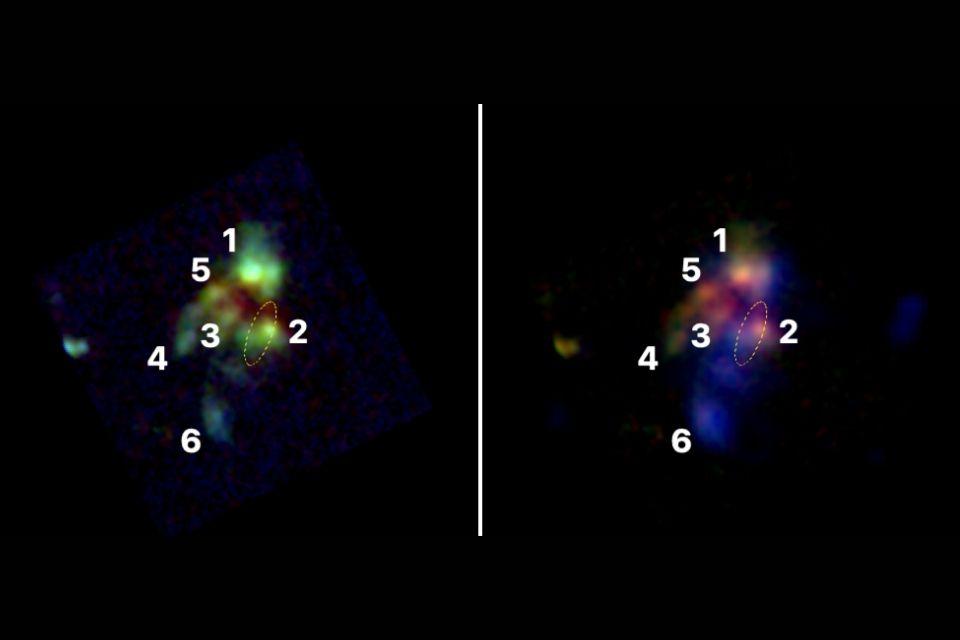
NASA/ESA/CSA JWST images of the complex of galaxies associated with the distant radio source TGSSJ1530+1049 from Saxena et al. (2026). The image on the left, based on photos taken with the NIRCam instrument, shows at least 6 galaxies that are closely packed together. The image on the right, based on data from the NIRCam and NIRSpec instruments, additionally shows large clumps of fast-moving gas (shown in blue), besides the galaxies. The supermassive black hole responsible for the radio emission is believed to be in the area marked by the ellipse.
An international team of astronomers, led by Dr Aayush Saxena from the University of Oxford, has used the NASA/ESA/CSA James Webb Space Telescope (JWST) to observe the birth of a massive galaxy. The event would have occurred more than 12 billion years ago, when the Universe was only about 1.5 billion years old. The study has been published in Astronomy & Astrophysics as well as The Open Journal of Astrophysics.
One of the most intriguing topics in modern astrophysics concerns how and when the first giant galaxies and the massive black holes at their centres were formed. To study this, the team pointed JWST toward the location of TGSSJ1530+1049, a distant source of radio emission in the constellation Serpens. Since radio emission is a key signature of growing supermassive black holes, the team hoped to confirm its distance and study the properties of its galaxy.
‘At the location observed with JWST we unexpectedly found not one galaxy, but a complex of at least 6 galaxies,’ explains Dr Saxena, lead author of The Open Journal of Astrophysics paper and co-principal investigator of the JWST observing program. ‘These galaxies will probably collide to form one large galaxy over time. The supermassive black hole will likely merge with other, fainter black holes in the nuclei of the other galaxies, creating one large black hole at the centre of the final galaxy.’
The new finding supports a previously observed trend that suggests that supermassive black holes formed at the centre of dense regions of galaxies in the early universe. Dr Roderik Overzier from Leiden Observatory in the Netherlands and co-author of both of the papers continues: 'Such structures are known as protoclusters, the very distant progenitors of the clusters of galaxies that populate the universe today. Although supermassive black holes are also found in other places, protoclusters are among the first regions of the universe where primordial matter clumped together to create the first stars, galaxies and black holes.'
It may not be a coincidence that the black hole was found amidst a grouping of colliding galaxies as Dr Krisztina Gabányi, from the Eötvös Loránd University in Hungary and lead author of the Astronomy & Astrophysics paper, explains: ‘Using a network of connected radio telescopes, we obtained a very high resolution image of TGSSJ1530+1049. The radio emission is the result of fast-moving particles that are ejected, while other matter plunges towards the black hole. In this case, we found a relatively small radio structure – about 17,000 light-years in diameter – suggesting that it is still relatively young in cosmic terms. This could indicate that it is still developing, as the black hole is fueled by gas being swept up by the colliding galaxies.’
The results of the study were published in articles in The Open Journal of Astrophysics and Astronomy & Astrophysics, concluding a program of observations with the James Webb Space Telescope that began in 2021.
JWST observes the assembly of a massive galaxy at z~4, A Saxena et al, The Open Journal of Astrophysics, 24 March 2026
High-resolution radio imaging of TGSSJ1530+1049, a radio galaxy in a dense environment at z=4, K E Gabanyi et al, Astronomy & Astrophysics, 18 June 2026