

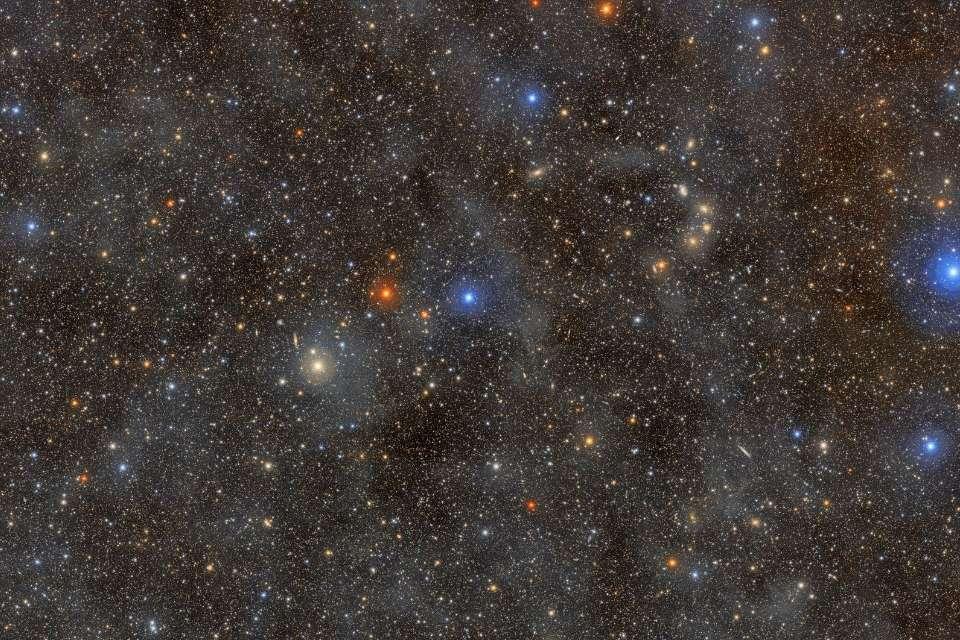
This 1.7-gigapixel image of a field of stars in the constellation Lupus showcases the unprecedented view of the Universe that NSF–DOE Vera C. Rubin Observatory gives us. Equipped with the LSST camera, the largest digital camera in the world, Rubin combines a wide view of the sky with the ability to detect extremely faint objects. With this capability, Rubin can reveal details of the cosmos across an enormous range of scales, from distant galaxies, to individual stars, to the wispy clouds of dust spread throughout our galaxy. The faint, glowing clouds spread across this image are galactic cirrus: clouds of interstellar gas and dust that can be seen in the foreground of the Milky Way. Rubin’s ability to capture scenes like this in unmatched detail will open new windows into the structure of our galaxy and the Universe beyond it.
After more than a decade of planning and preparing, the NSF-DOE Vera C Rubin Observatory’s Legacy Survey of Space and Time officially began last night. The ground-based telescope, perched high on a mountaintop in Chile, will capture the entire southern sky to create an ultra-wide, ultra-high-definition time-lapse record of our Universe. This so-called ‘movie of the sky’ will be the most detailed timelapse view of the cosmos ever generated and will amass the largest ever data set for optical astronomy helping us solve some of the Universe’s biggest mysteries such as the nature of dark energy, and the evolution of the solar system, Milky Way, and galaxies across cosmic time.
The UK is a major international partner of the US-led Rubin Observatory and the LSST:UK Consortium, formed in 2014, is made up of 36 partner institutions with Oxford playing a key role. Researchers across the Department of Physics are involved in different aspects of the ambitious project from contributing to the 3.2 billion pixel camera to preparing for the vast amounts of data and their analysis and interpretation in the coming years.