

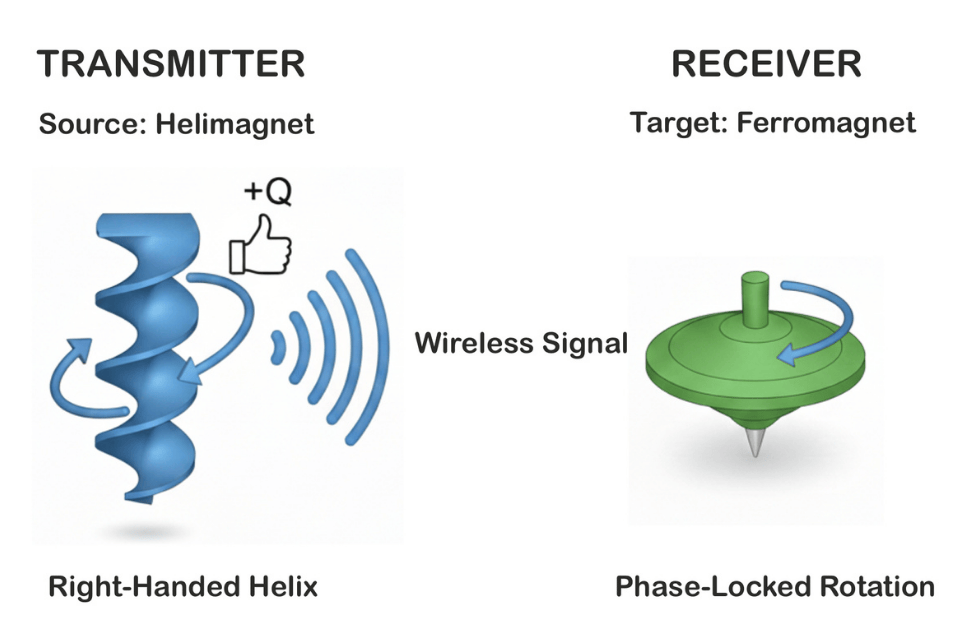
A collaborative study between researchers at the University of Oxford, ShanghaiTech University, and Diamond Light Source has demonstrated a new way for magnetic materials to communicate without wires. Their work, published in Nature Physics, reveals that spin waves emitted by a helimagnetic material can remotely drive another magnetic layer into synchronised motion, even without direct contact.
The researchers worked with helimagnetic materials, in which the atomic magnetic moments form a spiral arrangement. When excited by microwaves, these materials emit collective spin waves, called helimagnons, which travel across a thin non-magnetic spacer and cause a neighbouring ferromagnet to begin precessing in step.
Using time-resolved resonant elastic x-ray scattering (REXS) at Diamond’s BLADE beamline, the team tracked the spin motion in both layers with element specificity and picosecond precision. They discovered that not only the frequency, but also the chirality of the helimagnet’s spin wave was faithfully imprinted on the receiving ferromagnet.
'This is the clearest example we’ve seen of a magnetic structure acting as a wireless source of spin waves', says Professor Shilei Zhang, co-author from ShanghaiTech University and visiting researcher in the Department of Physics at Oxford. 'It shows that information can be sent not just through charge or light, but through chirality—an entire logic in phase and symmetry.'
'It is a remarkably clean system,' adds Professor Thorsten Hesjedal, co-author from the Department of Physics. 'We’re seeing one magnetic layer act as a signal transmitter, remotely driving another with both frequency and phase control—no wires, no contact.'
The work opens new possibilities in magnonics, a field that seeks to replace charge-based electronics with low-power spin-wave communication. Because the helimagnon coupling is both wireless and mode-selective, it offers a simple and robust route to building reconfigurable magnetic devices without complex circuitry.
Ethan Arnold, a DPhil student in the Department of Physics and co-author on the study, contributed to the experimental measurements.
'The most exciting part for me was watching the dynamics unfold in real time,' says Arnold. 'Using REXS at Diamond, we were able to capture the spin motion in both layers with ultrafast resolution. That let us reconstruct exactly how the response of one magnet followed the signal from the other.'
By harnessing the spin dynamics already present in magnetic materials, the team has demonstrated a new method for remote magnetic control—wireless, selective, and encoded in chirality.
Mode Locking between Helimagnetism and Ferromagnetism, Jingyi Chen, Haonan Jin, Ethan Arnold, Gerrit van der Laan, Thorsten Hesjedal, and Shilei Zhang, Nature Physics (2026).