

We work among extraordinary people doing extraordinary things; get to know some of them by reading these quick-fire interviews.
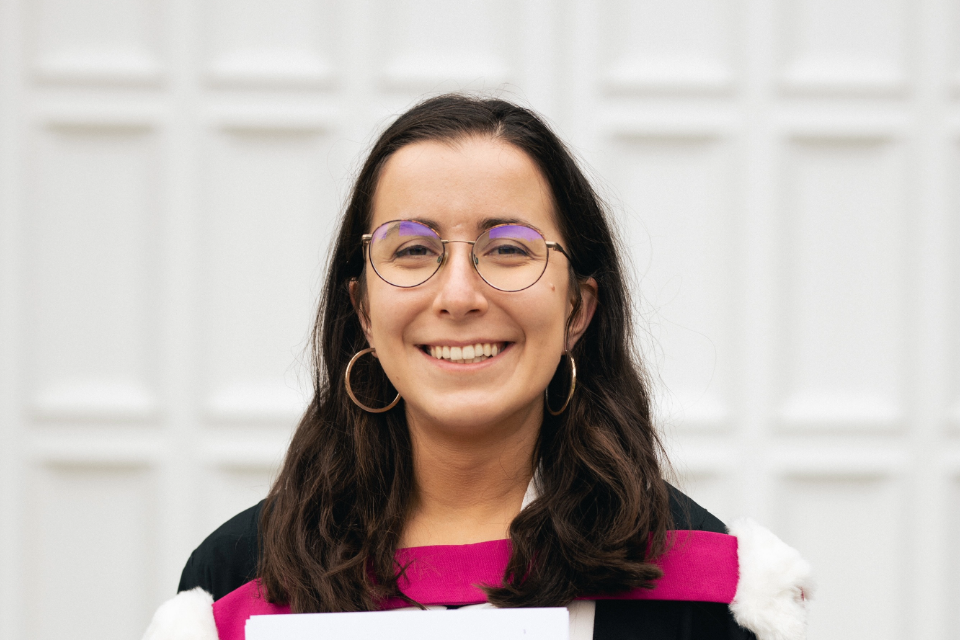
Name: Claire MacLeod
Job title: Communications Officer
What are you currently working on?
I am currently editing a video series for International Women’s Day. I have filmed six interviews that highlight the research and accomplishments of women in the Department of Physics (you can see my interview with Carly Howett here). I also created three compilation videos of women sharing their experience and advice for young physicists. These videos will be released during the first week of March. [View videos here]
While I wait for footage to render, I am also putting together our various newsletters: the internal newsletter that goes out to the entire department every month, the events one that goes out to subscribers and our LinkedIn one that highlights our latest news and development priorities. Newsletters are an essential part of internal and external communications and are always a lot of work. We make sure that each newsletter matches the university style-guide and put a lot of effort into making the layout as accessible as possible.
Describe a typical day
Being a communications officer is like being an in-house journalist. You are always looking for new stories and strategising ways to keep you audience’s attention. When I start my day, the first thing I do is sort through my inbox to figure out what needs to be actioned. I respond to queries about advertising, share resources, follow-up on technical issues, and support colleagues with the department intranet.
A key part of my job is helping with writing up news stories for the department website. When we find out about a new paper or discovery from one of our physicists, we ask the team involved for a lay summary of their project and the key contribution or novel finding. When we structure a news release, we try to ensure that the first paragraph is comprehensible to a ‘clever A-Level student’ or a ‘curious, educated adult.’
My favourite aspect of this job is working closely with academics to help showcase their work to the wider public. This can involve creating a website for a research centre, using SEO to reach international collaborators, promoting projects on social media, or creating a series of videos. I love the passion that academics bring to their research and it is such a privilege to enable that enthusiasm.
What got you into physics?
I grew up in the Golden Age of YouTube. In the early 2010’s, YouTube sponsored dozens of educational channels (in an effort to appear more serious) and accidentally sparked a completely new era of science communication. As a kid, my favourite channels were vlogbrothers, CrashCourse, minutephysics, SciShow, Smarter Every Day, Veritasium, VSauce, ViHart, and the complete works of Brady Haran. These videos made high-level topics engaging and challenged viewers to learn more.
In particular, I loved the work of Brady Haran who interviewed scientists at the University of Nottingham for multiple channels (still ongoing). There was something very calming about the quiet background of an academic’s office, the steady paced documentary-style editing, and the friendly, passionate delivery of the physicists being interviewed.
At first, watching these videos made me want to be a physicist. I studied hard throughout secondary school and took the highest-level science courses on offer. But by my senior year, I realised that I was not as passionate about doing physics as I was talking about physics.
If you had an entire day at your disposal (not at work/studying), what would be your ideal way to spend it?
To be honest, I often spend my days off in the Bodleian library working on my own research interests. It is so rare to have a whole day to myself without being distracted by emails and messages. However, if there is good weather, I love nothing more than spending a whole day on a long hike, listening to an audiobook or podcasts, and exploring the English countryside – especially as a Canadian from Newfoundland. I particularly love swimming outdoors on a hot day followed by pints in the sun with a big group of friends.
What is your favourite place in Oxford?
I realise it is a bit cliché but my favourite place in Oxford is definitely Duke Humfrey’s Library. During my undergraduate degree, I studied the history of libraries and read an article on the development of the Bodleian Library from the original medieval collections of Duke Humphrey of Lancaster. Even before I had visited Oxford, I read about the structure of the collection and how its use transformed over the years from private collection to institutional reading room.
As a modern workspace, Duke Humfrey’s has limitations. But a part of me enjoys how Duke Humfrey’s is so separated from normal life. The opening hours are strictly 9am-5pm, Monday to Friday, so no weekend or evening work is permitted. Belongings must be carried in clear plastic bags, with satchels and coats stored in lockers downstairs. Seating is limited and water bottles are forbidden. When you enter the Old Library, you have to really want to be there and make the most of your time. Perhaps for that reason, I have always found that my best work is done in Duke Humfrey’s Library.
Plan B: what would you be if you weren’t doing the job you are currently doing?
I would either be doing a PhD in History or working in educational media.