

We work among extraordinary people doing extraordinary things; get to know some of them by reading these quick-fire interviews.
Name: Helene Lösl
Job title: Graduate Student, Atomic and Laser Physics
What are you currently working on?
My research focuses on analogue quantum simulation as a way of studying quantum dynamics in interacting many body systems. The idea is to use highly controlled experimental platforms as quantum 'testbeds' for theoretical models that are otherwise very difficult to solve or simulate numerically. I work on implementing specific models by engineering effective interactions, in close collaboration with experimentalists.
A central question in my work is which problems in quantum many body physics can already be addressed using current experimental capabilities, such as ultracold atoms in optical lattices or atoms arranged in tweezer arrays, and how these platforms can be used most effectively. I am also interested in understanding what kinds of measurements are realistically possible in these systems, and which physical quantities and correlations can be extracted from them. In addition, having studied philosophy, I am naturally drawn to more fundamental questions at the interface between physics and the philosophy of science.
Describe a typical day
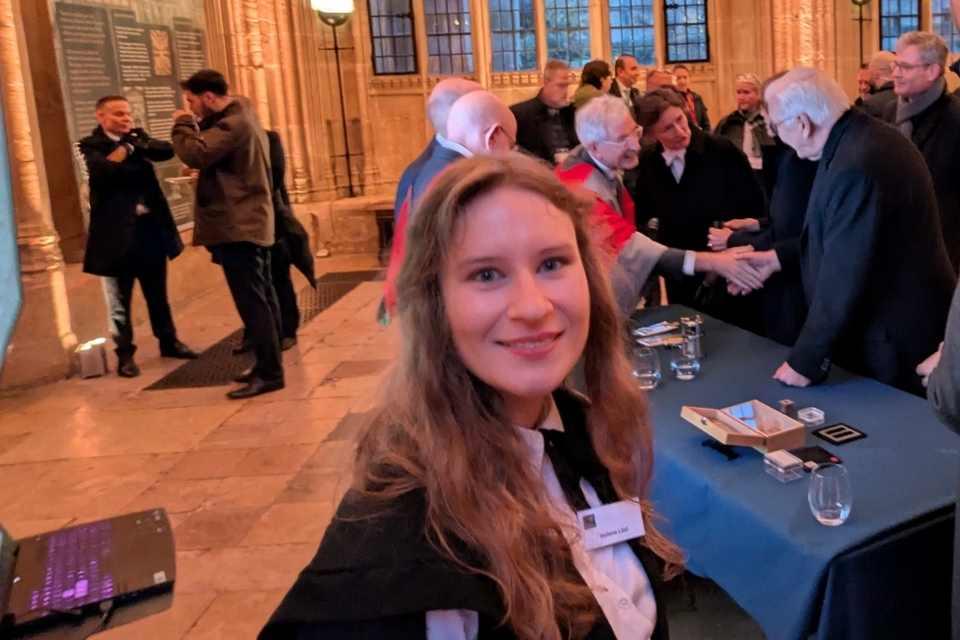
I usually arrive at the office early, often around 8am, and begin with a focused deep-work session while no one else is in the office. A big part of my day is reading papers, writing code and pen and paper calculations, with discussions and seminars interspersed throughout. I also enjoy knitting during my lunch break, which is a nice way to reset. Last term I had the opportunity to tutor undergraduate students at Keble College, which was great, and I also got to talk about my work with the German president, Frank-Walter Steinmeier. He was visiting the University and I spoke to him about my research in quantum simulation and the importance of international collaborations including German universities.
What got you into physics?
I have always been captivated by stories of world explorers like James Cook and Alexander von Humboldt. Since it felt like much of the physical world had been charted, my curiosity naturally turned to space. That interest led me to space and astrophysics, and ultimately into physics more broadly.
If you had an entire day at your disposal (not at work/studying), what would be your ideal way to spend it?
My ideal day would be spent with a long cycling trip maybe with a leisurely stop at a café for some coffee and cake. I would love to spend the rest of the day cooking a nice dinner with my partner and curling up with a good book.
What is your favourite place in Oxford?
Blackwell’s. I try to go about once a week to see what new books have arrived and normally don’t leave empty handed.
What discovery would you like to see in your lifetime?
I would be thrilled to see the discovery of a high temperature superconductor that works at room temperature, together with a clear understanding of the fundamental mechanism that makes it possible.