

We work among extraordinary people doing extraordinary things; get to know some of them by reading these quick-fire interviews.
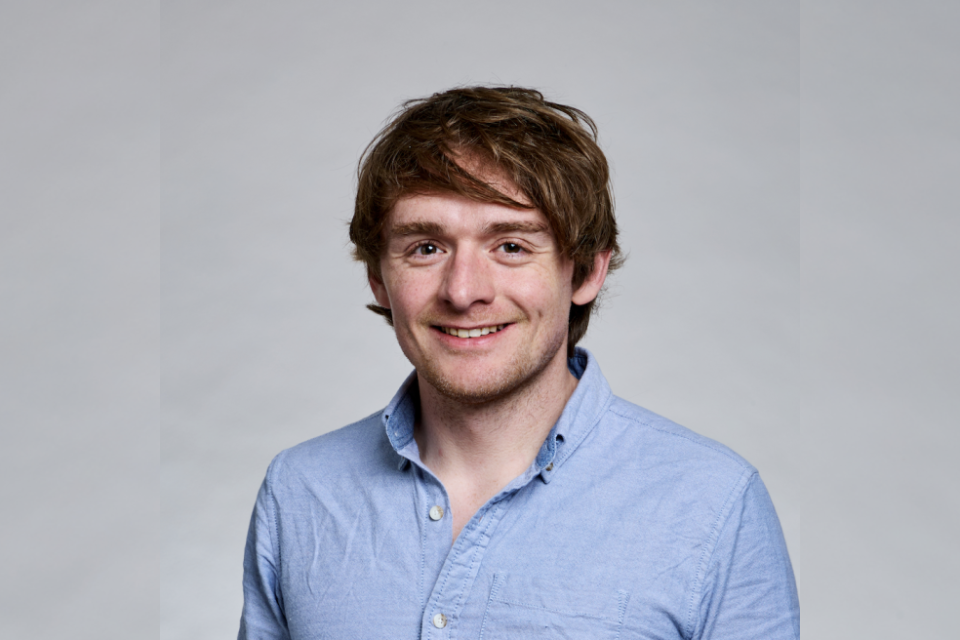
Name: Dr James Matthews
Job title: Royal Society University Research Fellow
What are you currently working on?
My research group works on a range of topics mostly concerned with studying the jets of plasma produced by accreting black holes, both with simulations and observational data. I would say the students I work with make most of the scientific progress. Personally, I also spend a fair bit of time trying to understand 'accretion disc winds' – these are a different kind of plasma flow launched from the accretion disc around the black hole. 'Jets' and 'winds' are broadly the focus of my research, and I've just submitted a paper where I try to work out how powerful the winds are based on the shape of a specific Carbon feature in the ultraviolet spectrum. It sort of works.
I also help run the Summer Research Programme in the Astrophysics sub-department, together with Ashling Gordon. This is designed to give third year undergraduates from across the UK experience of research for eight weeks. This can take up a decent amount of time. For example, we recently had to assess all the applications and match students with supervisors, but is very rewarding work. Many of our students publish papers from their projects and go on to PhD programs, but perhaps more importantly they seem to enjoy it and get a lot of valuable experience.
Describe a typical day
I am wary of saying things like 'I get up at 6am and go running before checking new papers over coffee', as if I'm some kind of hustle-culture influencer. However, I do have a nine-month-old baby, so getting up at 6am is not really a choice any more. I cycle to work (sometimes run), then the workday might start with a quick email catch-up over a coffee, then a student meeting. The meeting is probably supposed to be one hour, but my inability to understand something will make it an hour and a half. At 11 I might go to a seminar from a visiting speaker. You could probably attend seven seminars a week relating to astrophysics and cosmology if you wanted. This is cool, but also sometimes tiring! Afterwards I might go to lunch, either in the canteen with colleagues or to Green Templeton College, where some of us are research associates.
In the afternoon, I often attend a group meeting or telecon, preferably the former. I attend Rob Fender's and Matt Jarvis' group meetings, both of which are very intellectually stimulating and within a friendly environment. In the hours between these scheduled meetings and talks I will try to get some research done: either writing some code, reviewing a collaborator's paper, or writing my own. Writing is probably my favourite part of the job, so I savour that, but I have to be efficient! Around 5pm I will rapidly cycle home to take the baby. A disclaimer: I genuinely love my job and in particular the people I work with, but it's not all sweetness and roses as it's presented here; the academic landscape and lack of job security literally keeps me up at night.
What got you into physics?
At school I liked a few different subjects: maths, science, languages, music. Each might seem distinct, but I think they have in common a simplistic elegance built around patterns, and require varying mixes of logic and creativity. The first thing I found super exciting at school was in chemistry, learning about electron orbitals and how you could predict which elements could bond together. For a while I wanted to be a chemist, but eventually I realised physics was by far my favourite subject, and that the original appeal I found in that logical jigsaw puzzle was the kind of thing I would find a lot in physics. When I got to university, I found physics was way more fun than A-level. I finally understood, for example, why I had been doing integration and differentiation in maths.
Outside school, I used to read non-fiction books about physics and ended up becoming fascinated by two main topics in my mid-teens: black holes and the uncertainty principle. I was as much fascinated by the human process of it as anything else, and one book in particular sticks with me: The Age of Entanglement by Louisa Gilder. It is a fantastic book, a sort of half-dramatisation of the debates and discoveries relating to quantum physics, determinism and entanglement, with profound philosophical implications. My work has nothing to do with this topic really, but it has stuck with me and for a while was a major inspiration. (PS there is no free will.)
If you had an entire day at your disposal (not at work/studying), what would be your ideal way to spend it?
I would ideally: go running along the river; go to a beer garden with my wife and chat for hours or do quiz questions; wander around Magdalen Road with my baby daughter while making funny noises; spend a few hours dialling in a synth patch on Ableton Live; and go to a gig promoted by Divine Schism at somewhere like the Library or the Bully.
What is your favourite place in Oxford?
This is hard to pick. One of my favourite spots is the path along the river down by Iffley Lock and beyond, which is less busy than town but beautiful. Also, when I first came to Oxford I parked off Cowley Road, got out of my car, and saw Truck store, Big Soc, Mario's, and the bustle of the road, and thought: this is where I want to live. I also love various pubs (the Fir Tree, the Chester), and the walk to work from Iffley Road is stunning. I am lucky to live where I do, to be honest.
What discovery would you like to see in your lifetime?
I think I am weirdly unmotivated by discovery, relatively speaking, for a scientist, but I can think of two. First, I would love someone (ideally me, though that seems unlikely) to unambiguously demonstrate where ultrahigh energy cosmic rays are accelerated. Second, I would love to see a detection of an axion-like particle, a hypothetical particle that could be the origin of dark matter.