

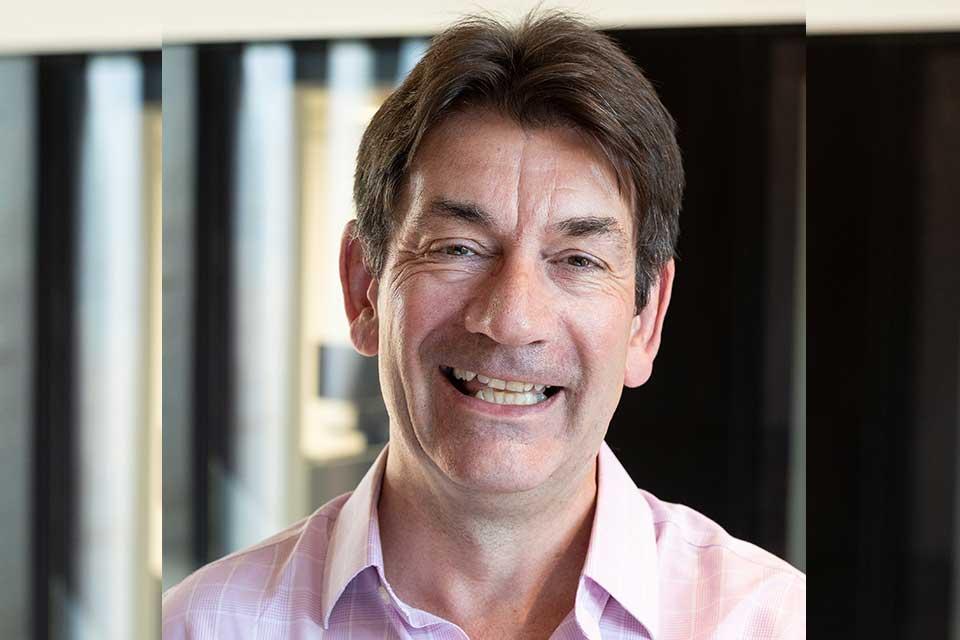
We work among extraordinary people doing extraordinary things; get to know some of them by reading these quick-fire interviews.
Name: Philip Burrows
Job title: Professor of Physics and Director of the John Adams Institute for Accelerator Science
What are you currently working on?
My team works on addressing cutting-edge problems in particle-accelerator physics and technology at leading international facilities. This involves improving the performance of accelerators including the Large Hadron Collider at CERN, the world’s largest, highest-energy particle collider, as well as the UK’s Diamond Light Source and the ISIS neutron and muon source, both located on the nearby Harwell campus. We work on understanding the dynamics of intense beams of subatomic particles moving at almost the speed of light, and developing novel instrumentation for measuring and correcting the beam position and direction. The beams need to be controlled with exquisite accuracy in order to deliver maximum performance for the scientists who use the facilities. We are applying Artificial Intelligence and Machine Learning techniques to help us process and make sense of the huge amounts of information that come in from the diagnostics systems. This allows us to control the beams better than can be done by human operators in real-time and, in some cases, identify faults (eg. equipment that is malfunctioning or near to breaking) ‘early’ via precursor signals that are subtle or otherwise difficult to spot. We also work on designing the accelerators of the future, for example the Future Circular Collider, a next-generation electron-positron collider Higgs-boson factory proposed for realisation at CERN, and proposed linear colliders such as ‘ILC’ and ‘CLIC’. In order to test our feedback and control systems, which will be essential for any of these future colliders to achieve their design performance, we work at accelerator test facilities including ‘CLEAR’ at CERN and ‘ATF’ at KEK (Japan). Environmental sustainability is a key element that is now embedded in our practices as we seek to minimise the environmental impact of current and future particle-accelerator facilities.
Describe a typical day
There is no typical day! I sometimes joke that I should have been a fire-fighter as I seem to spend most of the time dealing with issues that crop up each day. There are more than 100 people in the John Adams Institute: faculty, staff and students, and hence I spend a lot of time supporting the members of the Institute. Recently I have been on four hiring panels for new postdoctoral staff members – it’s a privilege to learn about the talents of impressive early-career researchers who wish to join us, and narrowing down the field is not always easy – if we had more resources we could create more opportunities for the amazing talent pool. I am currently reading draft thesis chapters of my four senior D.Phil. students who should submit in the next few months. I spend a lot of time on financial matters – we are in transition between two large grants and I need to make sure that our students and staff are supported to achieve their research ambitions. I am involved in several large research project proposals to the European Commission, which involves significant coordination effort across multiple institutes in Europe. I spend a lot of time in meetings with colleagues all over the world – I’ll typically have three or four virtual meetings every day with colleagues in Asia and North America, as well as in-person meetings with our team members in Oxford. For the past year I’ve been heavily committed to the update of the European Strategy for Particle Physics, which has involved major time commitments to working groups, as well as giving reports and talks at workshops and conferences. No two days are the same, and they’re always busy.
What got you into physics?
From as far back as I can remember I have been curious about ‘how things work’. Like many children I was fascinated by the night sky and was given a small telescope – I was even allowed to stay up very late to watch ‘The Sky at Night’ on tv, which in those days was on near midnight and hosted by the wonderfully eccentric Patrick Moore. I had an amazing physics teacher in my second year at high school and his inspirational teaching sealed my fate and launched me on my journey. However I didn’t become an astronomer but a particle physicist, which is another story.
If you had an entire day at your disposal (not at work/studying), what would be your ideal way to spend it?
I love ‘doing things’ and, as my family can confirm, I am not good at sitting around ‘relaxing’! So an ideal day would involve lots of outdoor activity: a trip with other families to a local park with our son (who is currently 5), which might include a bike or scooter ride, tree-climbing, digging in a sand pit, riding a zip-wire, swings and roundabouts and, in summer, a swim at our wonderful local outdoor pool. Some good coffee and lunch at a café would be nice. In the afternoon a visit to a (child-friendly) museum or gallery – National Trust venues are excellent for families these days, and provide great tea and cakes. In the evening reading with our son and a family dinner including (for me) a decent glass of wine. Time permitting I’d also fit in a trip to the gym to do a Spin or Pump class!
What is your favourite place in Oxford?
Harcourt Arboretum is a beautiful space a short distance outside the city. It’s both small and large enough for our son to experience trees, plants and walks among the seasonal colours.
What discovery would you like to see in your lifetime?
Without doubt the discovery of dark matter in a particle-physics detector: there’s five times as much dark matter in the universe as normal atomic matter and it would be wonderful to understand what it’s made of.