

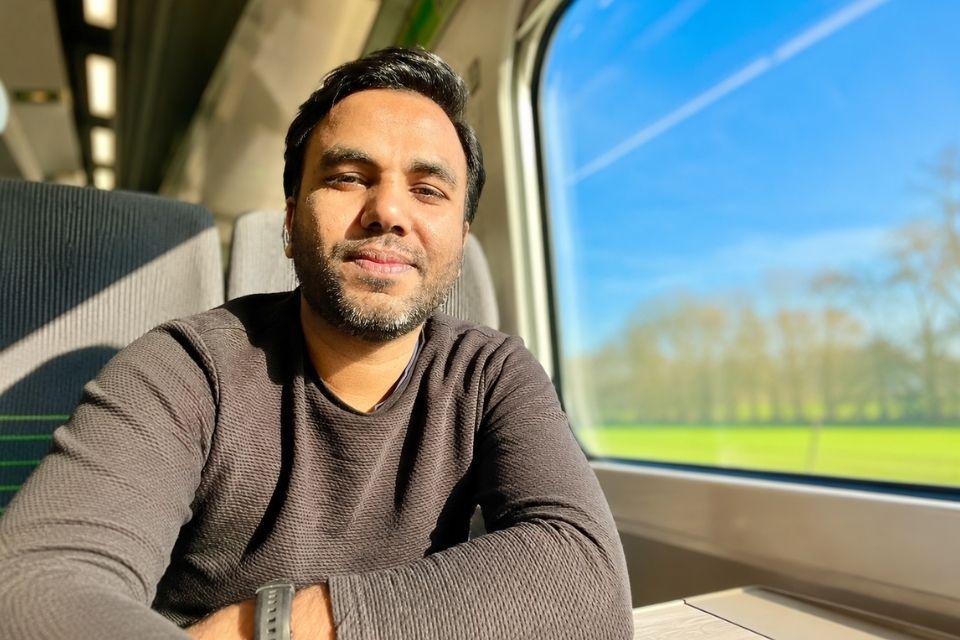
We work among extraordinary people doing extraordinary things; get to know some of them by reading these quick-fire interviews.
Name: Dr Safeer Chenattukuzhiyil
Job title: Royal Society University Research Fellow
What are you currently working on?
In my research group, we explore how physics can help build the intelligent machines of the future. Currently, my group is exploring two exciting ideas. The first is developing new computing devices using ultra-thin quantum materials that are only a few atoms thick. These materials have remarkable properties that could make future computers much faster and far more energy efficient than today's technology.
The second project is even more futuristic. We are asking a simple question: can we build computers that work more like the human brain? Today's AI technologies rely on massive supercomputing facilities that consume huge amounts of energy. By contrast, the human brain performs remarkably complex tasks while using only about as much power as a light bulb, and it does so locally. Inspired by this, we are exploring the idea of physical AI: computing systems in which the natural behaviour of physical systems performs brain-like computation. Our approach harnesses waves. It may sound surprising, but waves, from ripples on water to tiny magnetic waves inside advanced materials, can naturally interact, communicate and process information in ways that resemble the collective behaviour of neurons in the brain. Recently, we demonstrated this concept by building a robotic system controlled by local wave-based hardware. It is an early step, but it offers an exciting glimpse of what future brain-inspired computers might look like. Currently, much of my research is driven by this idea, and I am excited to see where it leads.
Describe a typical day
Nowadays, I don't really have a typical day. I usually start by cycling to work, deliberately taking a route through Oxford's beautiful medieval streets and colleges. It is a great way to set the mood for the day (except on those cold, rainy mornings when cycling becomes a little less enjoyable!). Once I arrive at the department, my schedule can vary enormously. A typical day might involve replying to emails, discussing new ideas with students, carrying out experiments in the lab, writing papers or grant proposals, teaching and supervising students, sometimes reading the latest research articles (often just the summaries), and meeting with collaborators from around the world. Recently, much of my time has been devoted to organising an international workshop at Oxford next week, coordinating everything from the scientific programme to the practical logistics.
What got you into physics?
I wasn't one of those people who knew from school that they wanted to become a physicist. I was simply the kind of student who got good grades, and in my culture, if you did well at school and wanted to study science, physics or maths was often seen as the natural choice. While studying physics at university, I became fascinated by nanotechnology after reading about it and meeting some inspiring scientists at public lectures. That curiosity eventually led me to study nanophysics for both my Master's and PhD. It was only when I started doing research that I realised experimental physics really suited me. I enjoy building things, figuring out why they don't work, and then somehow getting them to work.
In summary, I found my way into experimental physics gradually and without any grand plan. It was only later that I realised I was probably quite good at it.
If you had an entire day at your disposal (not at work/studying), what would be your ideal way to spend it?
Travelling. I have been fortunate enough to live in a few countries, each with its own language and culture, and I have visited many more. Even so, I am always looking for somewhere new to explore. These days, I am especially drawn to places with unfamiliar cultures and landscapes. Of course, one day isn't quite enough to disappear to some faraway land. If I have to stay at home instead, you will probably find me happily glued to the sofa, either playing on the PlayStation or watching films or series in different languages.
What is your favourite place in Oxford?
I always enjoy walking along the river through Christ Church Meadow, especially on colorful autumn days. But if I had to choose what makes Oxford truly special, it would be its stunning medieval architecture. Walking or cycling through Turl Street and Broad Street never gets old, they are beautiful every time.
What discovery would you like to see in your lifetime?
I would love to see physics enable a new generation of brain-inspired computers. AI is already transforming the world, but not yet in a way that is truly sustainable or inherently safe. Developing brain-inspired computing hardware that goes beyond conventional silicon-based architectures will be one of the defining scientific and engineering challenges of the coming decades. It would be incredibly exciting to see that vision become a reality.