

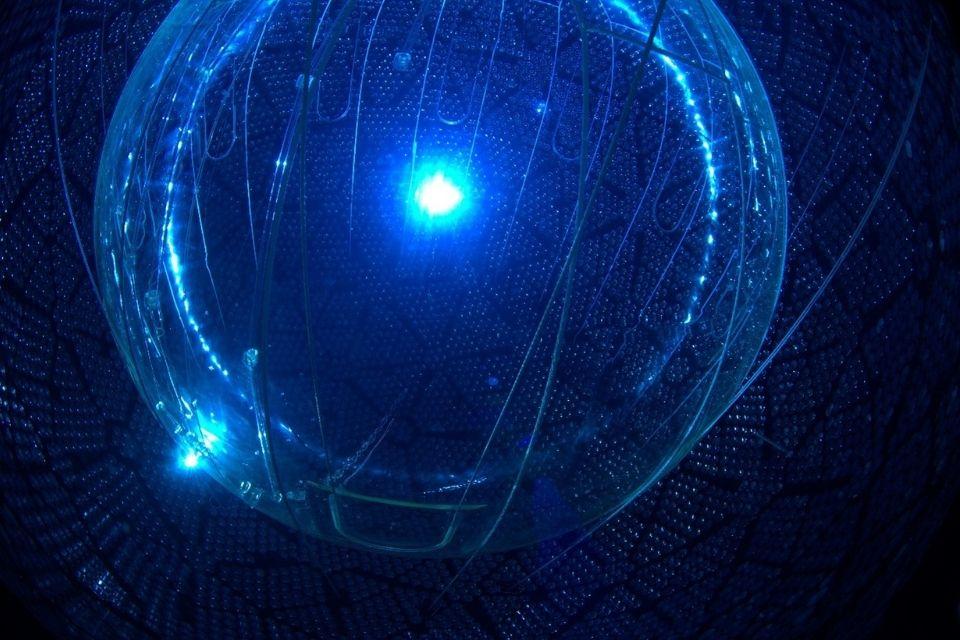
The 12-metre-diameter acrylic vessel surrounded by 9,000 photomultiplier tubes at the heart of the the Sudbury Neutrino Observatory and SNO+ experiments. The vessel currently holds about 800 tonnes of liquid scintillator for neutrino detection.
Physicists at the University of Oxford have led a breakthrough study which has recorded the first observation of carbon-neutrino interactions. The findings, published in Physical Review Letters, open new frontiers in nuclear and particle physics.
Neutrinos are one of the most mysterious particles in the universe, often called “ghost particles” because they rarely interact with anything else. Trillions stream through our bodies every second, yet leave no trace. They are produced during nuclear reactions, including those that take place in the core of our Sun. Their tendency to not interact often makes detecting neutrinos notoriously difficult.
Neutrinos from the Sun have only been seen to interact on a handful of different targets. Now, for the first time, scientists have succeeded in also observing them transform carbon atoms into nitrogen inside a vast underground detector.
The breakthrough, led by researchers at Oxford, was made using the SNO+ detector located two kilometres underground in SNOLAB, an international world-class facility housed in a working mine in Sudbury, Canada. The deep location was crucial to shield the lab from cosmic rays and background radiation that would mask the faint neutrino signals.