

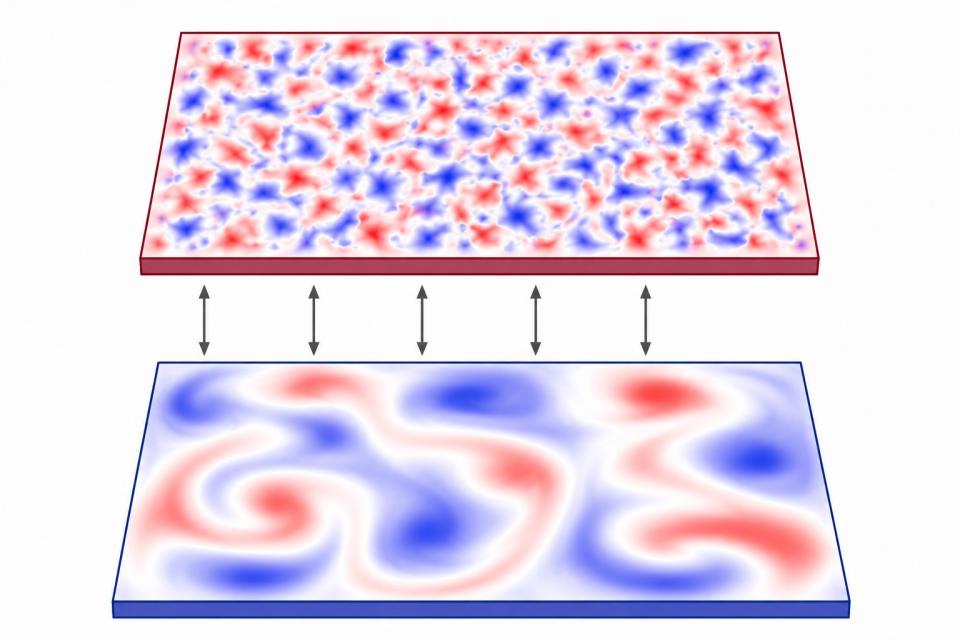
The turbulent behaviour observed in an active cellular layer (top) is inherited by the substrate (bottom) when the two layers are coupled by friction (arrows). The substrate filters out the short length and time scales of the active flow.
Physicists at the University of Oxford have discovered that when ‘active matter’ — such as bacteria, cells, tissues, and suspensions of microtubules powered by molecular motors — generates chaotic turbulent flows, the surrounding fluid does not simply copy them. Instead, it acts as a low-pass filter, inheriting only the large-scale flow patterns while stripping out finer-grained structures. The finding has been published in Newton and has implications for how we measure forces in cells and tissues.
From swimming bacteria to migrating cells, living systems continually stir the fluids around them. This self-generated turbulence is a hallmark of ‘active matter’ — materials whose microscopic components consume energy to produce motion — and has been observed across an enormous range of biological and synthetic systems. In tissues, for example, cells adhere to neighbouring cells and to soft substrates that can deform, flow, and transmit forces over long distances. These interactions play an important role in processes ranging from embryonic development and wound healing to cancer invasion and tissue organisation.
Turbulence itself has been studied extensively but a basic question has received little attention: when an active material is in contact with a surrounding liquid, how much of that chaotic motion actually gets through? It is often difficult to measure forces generated within living tissues directly so many experiments infer cellular activity indirectly through the deformation or motion of the surrounding substrate.
Understanding how active living systems mechanically drive their environment is essential both for interpreting experiments and for comprehending how collective cellular behaviour emerges in biological systems. Furthermore, carefully designed substrates may help to direct the growth of grafted bone or skin.
In their paper, Dr Gianmarco Spera, Professor Julia Yeomans, and Dr Sumesh Thampi, studied a model system in which an active nematic layer — representing cells — was coupled to a liquid substrate. They showed that turbulence generated in the active layer can drive turbulent motion in the surrounding fluid. However, the substrate turbulence was not a faithful copy of the driving active flows. Instead, the surrounding liquid selectively suppressed small and rapidly varying structures while preserving larger-scale motion, effectively acting as a low-pass filter for active turbulence. ‘Chaos spreads — but selectively,’ commented Dr Spera. ‘The neighbouring liquid inherits the turbulence while quietly filtering out its smallest swirls.’
The team explained this behaviour using a combination of hydrodynamic theory and numerical simulations that predicted how flow structures were transmitted between the two layers. They derived a transfer function that linked the velocity fields in the two layers and identified an unusual new form of what physicists call low-Reynolds-number turbulence. Turbulence is most familiar at everyday scales — the swirling of cream in coffee, or the buffeting of an aircraft — where fluids move fast enough for their own momentum to overwhelm viscosity, allowing chaotic motion to develop. These are high-Reynolds-number flows.
At the microscopic scales relevant to cells and bacteria, viscosity dominates completely and the Reynolds number is low, making turbulence normally impossible. Here, however, the chaotic motion in the substrate arises entirely from the stochastic forces transmitted by the neighbouring active layer — a new form of low-Reynolds-number turbulence fundamentally different from any previously described.
They also showed that stresses and strain rates are transmitted differently between the active system and the substrate, with important implications for experiments that infer cellular forces indirectly through substrate deformations, such as traction force microscopy. ‘The substrate beneath a layer of active cells may act like a biological filter, transmitting large-scale stresses while suppressing smaller fluctuations,’ commented Professor Yeomans. These findings provide experimentally testable predictions for how active flows drive neighbouring materials across a broad range of biological and synthetic systems.
This work provokes new questions about how biological systems communicate mechanical information to their surroundings. The team hope to develop predictive frameworks that connect experimentally observed substrate dynamics directly to the forces generated within living tissues, and to explore how substrate patterning might be used to control tissue structure. Dr Thampi, who is currently a professor at the Department of Chemical Engineering at IIT Madras, India, commented ‘We are looking forward to working with experimental colleagues to explore the interactions between cells and their surroundings, and the implications for wound healing and morphogenesis.’
Low-pass filtering of active turbulent flows to liquid substrates, Gianmarco Spera, Julia M. Yeomans, and Sumesh P. Thampi, Newton, 14 May 2026.