

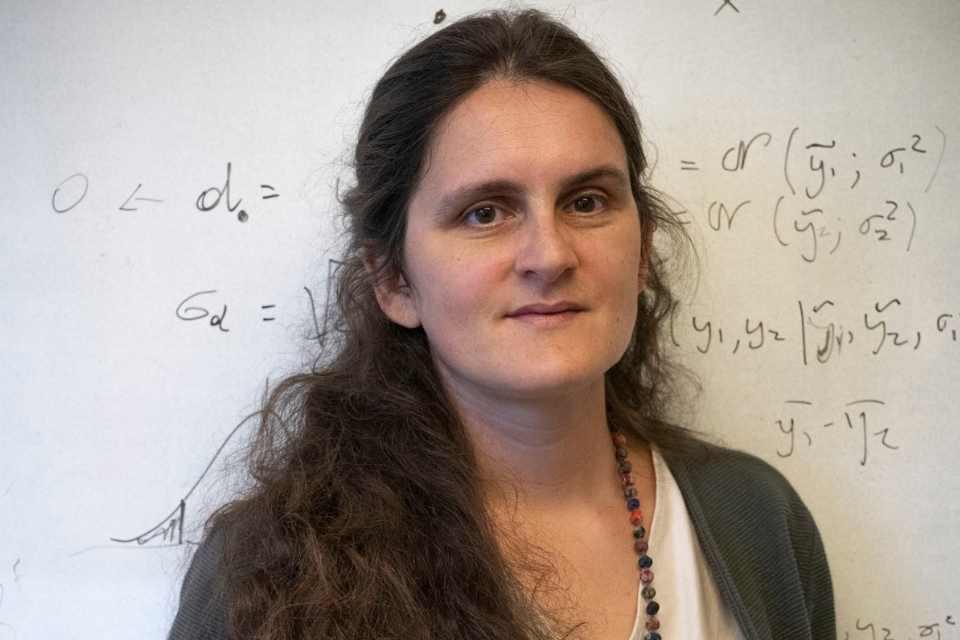
Professor Suzanne Aigrain has been awarded the George Darwin Lectureship by the Royal Astronomical Society.
Professor Aigrain’s research focuses on detecting and characterising exoplanets (planets orbiting stars beyond our Sun), particularly those that could potentially host life. A major challenge in studying these planets is the natural variability of their host stars, which can obscure the subtle effects planets have on the star’s apparent brightness and motion through space, that allow us to detect them indirectly.
Professor Aigrain is an internationally recognised expert in modelling this variability and disentangling it from planetary signals. Over the last 25 years, she has played a key role in surveys that have discovered thousands of exoplanets, and developed methods that are widely used in the community. Looking ahead, she is strongly involved in two major projects aiming to find Earth-like planets: the European Space Agency’s PLATO mission and the UK-led Terra Hunting Experiment.
She is a dedicated science communicator, committed to scientific outreach (including her 2024 TEDx talk), citizen science (through the Planethunters-TESS project) as well as fostering best practice in astronomical data analysis.
‘I am delighted and honoured to receive this award, which recognises both my research and my commitment to communicating it to a variety of audiences, something I very much enjoy,’ she comments. ‘In the next decade, we hope to find habitable planets in the Solar neighbourhood, paving the way to searching for signs of life in their atmospheres, but only if we can achieve the exquisite sensitivity required.’