

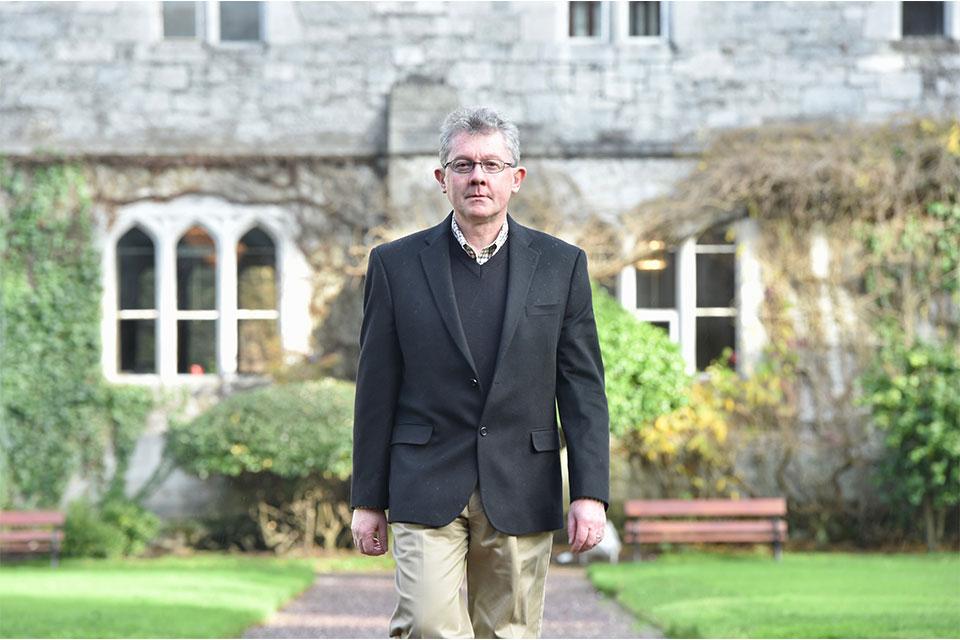
Professor JC Séamus Davis has been awarded the Institute of Physics Michael Faraday Medal and Prize. The gold medal recognises outstanding and sustained contributions to experimental physics and has been awarded to Professor Davis for his discovery and exploration of macroscopic quantum phenomena and states of matter. His strategic approach throughout his career has been to devise exceptional novel physics instruments and techniques that have enabled the study of quantum materials. The resulting ability to interrogate macroscopic quantum physics has led to the discovery of novel states and phenomena of quantum matter in many distinct materials systems.
Professor Davis, who received his BSc from University College Cork, Ireland (1983) and his PhD from the University of California, Berkeley (1989), is being recognised for his leadership role in the study of macroscopic quantum physics in emergent quantum matter, including superconductors, superfluids, supersolids and quantum spin liquids.
His work extends to developing microfabrication technology for superfluid Josephson junctions (JJ), leading to the discovery of the superfluid Josephson Effect. He also developed electronic quantum matter visualisation techniques with the introduction of spectroscopic imaging scanning tunnelling microscopy. This methodology allows for the comprehensive quantitative visualisation of the energy-resolved electronic structure of a quantum material at atomic scale in real space, or throughout its momentum space, or the order parameters of its ordered phases.
Introducing further novel techniques, he went on to discover and visualise the breaking of atomic-scale electronic symmetry, revealing correlated electronic liquid crystal states, including exotic density waves and electronic nematics in both Cu-based and Fe-based superconductors. He then introduced energy-resolved Fourier transform scanning tunnelling microscopy to image Friedel oscillations; through this, he demonstrated that the momentum-space electronic structure of quantum materials can thus be determined using STM. This technique, dubbed QPI, is now used globally to study virtually all types of electronic quantum matter.
He also invented atomic-resolution scanned Josephson tunnelling microscopy (SJTM), leading to the discovery and visualisation of the first electronic supersolid (pair density wave) state. Introduction of SJTM has quickly led to the discovery and exploration of pair density wave states in s-wave superconductors, p-wave spin-triplet superconductors, and d-wave cuprate superconductors.
He then went onto to develop and introduce scanned Andreev tunnelling microscopy (SATM) uniquely designed for studies of intrinsic topological superconductors. Here, his most recent advances include: detection of topological spin-triplet PDW state; the symmetry of intrinsic topological superconductive order in UTe2; discovery and visualisation of superconductive topological surface state in UTe2.
Professor Davis’s groundbreaking work requires equally groundbreaking facilities and his ultra-low-vibration labs in the Department of Physics’ Beecroft Building are some of the most advanced labs in the world. He has three quantum microscopes in Oxford and a further two at the University of Cork where he spends half his time.
‘To study quantum materials, you need new quantum instruments and this is what I have been doing – inventing such instruments, often without precedent,’ explains Professor Davis. ‘My first experiment took 17 years to succeed and so to receive the Faraday Prize is fantastic recognition of our experiential physics strategy based on decades of patience! Our visualisation work now is now used globally to explore and understand quantum matter, essential for driving forward the development of quantum technologies and so the quantum revolution. It is an incredibly exciting time.’
The gold medal is awarded in even-numbered years and the previous winner in 2024 was Professor Laura Herz, also from the Department of Physics at the University of Oxford.