

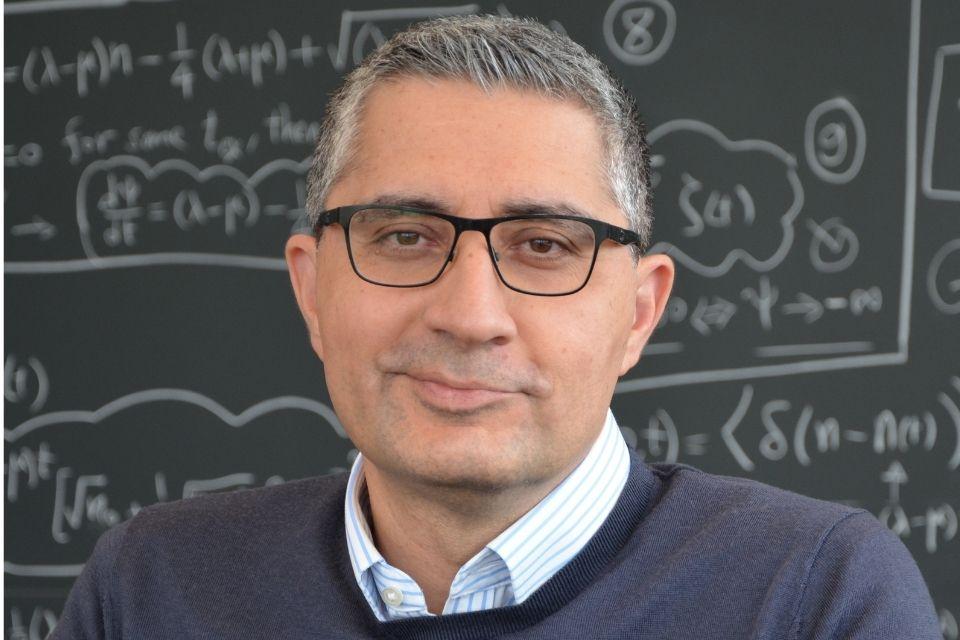
Professor Ramin Golestanian has been elected Fellow of the Royal Society in recognition of his pioneering contributions to the development of the field of active matter. He is Professor of Theoretical Condensed Matter Physics at the Rudolf Peierls Centre for Theoretical Physics and Director of the Max Planck Institute for Dynamics and Self-Organization (MPI-DS) in Göttingen.
Professor Golestanian is a theoretical physicist who specializes in active matter and non-equilibrium statistical physics. He is distinguished for his approach to the study of biological systems by viewing them as living condensed matter. In particular, he has championed the idea of using basic principles that govern the nonequilibrium physics and chemistry of microscopic systems to design active mechanical functional modules, such as microscopic autonomous motors, swimmers, and active colloids, which exhibit a wealth of emergent collective properties.
Golestanian is elected Fellow of the Göttingen Academy of Sciences and Humanities (2021), the American Physical Society (2017), and the Institute of Physics (2011), and recipient of Chaire Paris-Sciences (2022), Holweck Medal of the Société Française de Physique and the Institute of Physics (2014), EPJE Pierre-Gilles de Gennes Lecture Prize (2017), Royal Society Wolfson Research Merit Award (2017), Martin Gutzwiller Fellowship of the MPI-PKS (2017), Nakamura Lecturer Award of UCSB (2014), and 50th-Anniversary Most Distinguished Alumni Award of Sharif University of Technology (2016).
‘I am honoured to receive this distinction, which I undoubtedly owe to the privilege of having worked alongside so many brilliant students, postdocs, and senior colleagues over the years,’ commented Professor Golestanian.
Professor Andrew Boothroyd, Head of Department, comments: 'I am delighted that Ramin’s outstanding work in the field of statistical physics and complex matter has been recognised by the Royal Society. Congratulations on this outstanding achievement!'