

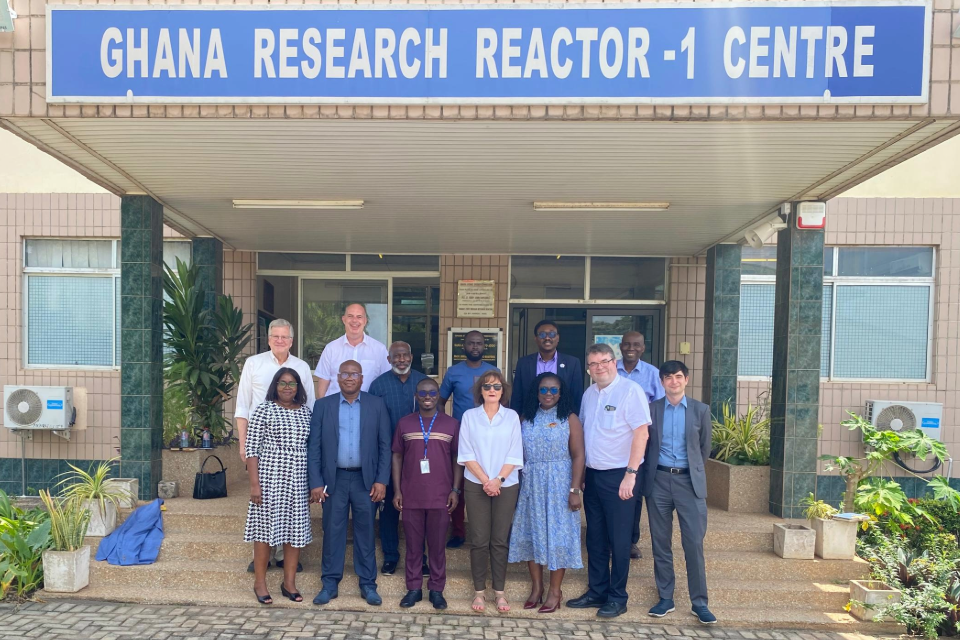
The delegation visited the Ghana Atomic Energy Commission, pictured outside of one of their centres. First row (left to right):
Theodosia Adom, Shirazu Issahaku, Francis Hasford, Michele Dougherty, Hanna Ayettey, Tom Grinyer, Louis Barton.
Top row (left to right): Jon Bagger, Jason Green, Eric Addison, Ernest Yeboah, Anthony Nana Boateng, William Srekumah
The University of Oxford’s leadership in tackling global inequalities in cancer treatment was highlighted this month when a high-profile UK delegation visited the Ghana Atomic Energy Commission (GAEC) specifically to engage with the Oxford-led SAPPHIRE project. The visit centred on discussions with senior representatives from UK research and funding bodies about the project’s progress and future impact.
The Supra‑African Physics Partnership for Health Innovation and Radiotherapy Expansion (SAPPHIRE) is a two‑year programme funded by UK Research and Innovation (UKRI). It is led by Oxford in collaboration with the University of Lancaster, University of Cambridge, and researchers from all cancer centres in Ghana and Pretoria, South Africa. The initiative aims to use a combination of training workshops and shared data driven platforms for AI research, to address the persistent shortage of highly trained medical physicists and radiation oncologists. It also aims to address the frequent breakdowns of linear accelerator (LINAC) machines in Africa. This project is led by Professor Manjit Dosanjh.
On 12 February 2026, a delegation including Professor Michele Dougherty, Executive Chair of the Science and Technology Facilities Council (STFC), and senior representatives from STFC and the Institute of Physics visited GAEC for dedicated discussions on SAPPHIRE’s work. Conversations focused on improving the efficiency, reliability, and long-term sustainability of LINAC systems used in cancer therapy through the project’s research, training, and innovation activities.
During the visit, the SAPPHIRE team presented progress on training initiatives designed to equip junior African medical physicists with advanced skills in data collection and fault analysis for LINAC machines. A live demonstration of the Redmine software platform—adapted to track radiotherapy machine faults—showcased how real-world data are being gathered and analysed to reduce downtime and improve long-term system resilience.
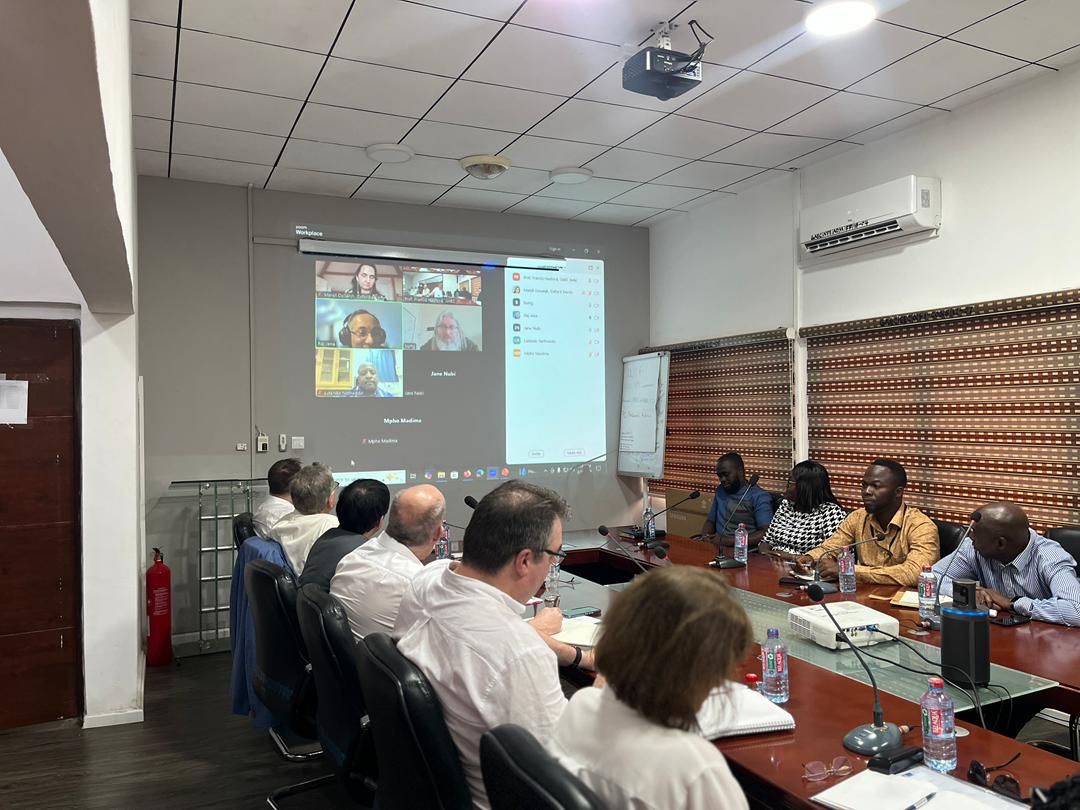
Speaking on behalf of the Ghanaian partners, the Deputy Director General of GAEC, Prof. Francis Hasford welcomed the UK delegation and expressed appreciation for the funding support and collaborative partnership underpinning the SAPPHIRE project and its role in advancing cancer care in Africa and other low- and Middle-Income Countries (LMICs).
The UK delegation comprising Michele Dougherty (Executive Chair of STFC and Astronomer Royal), Tom Grinyer (CEO of IoP), Louis Barson (Director IoP), Jason Green (Assistant Director of UKRI) and Dominic Hurley (Head of International Relations, IOP) expressed strong optimism regarding the project’s success and commended the ongoing work by the SAPPHIRE team to improve access to quality cancer treatment.
'The work being carried out by the SAPPHIRE team is truly inspirational. Despite operating with limited resources, they are overcoming significant challenges and delivering research with the potential to save countless lives across Africa' commented Tom Grinyer. 'Reading about a project in a proposal is one thing, but visiting the team and hearing directly from them made the scale, urgency, and importance of their work unmistakably clear. Their dedication is remarkable, and the visit highlighted not only their commitment to making the project a success but also the invaluable contribution physics makes to society and the vital role of international collaboration.'