

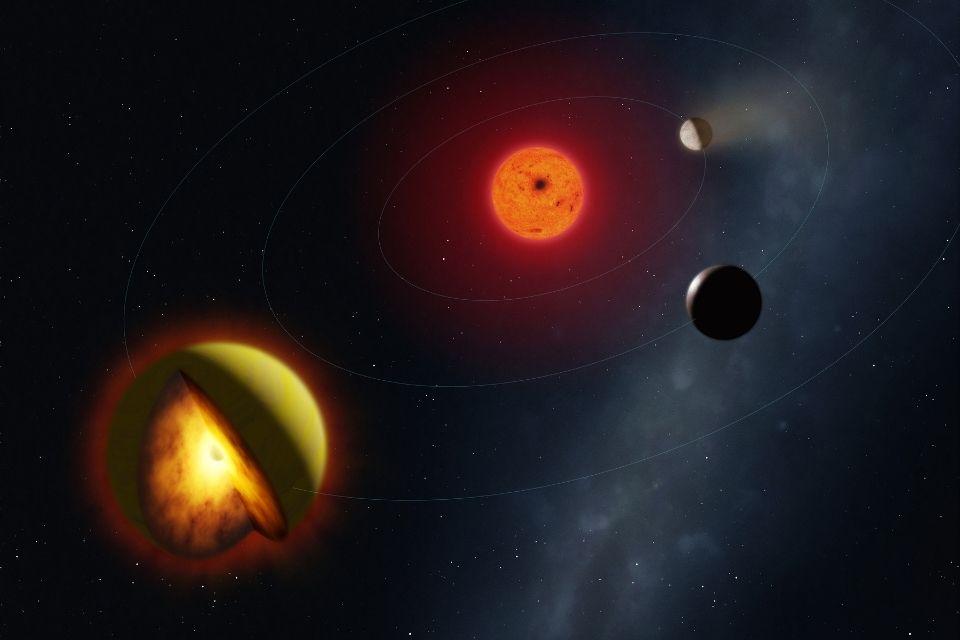
An artist’s impression of L 98-59 d
A study led by the University of Oxford has identified a new type of planet beyond our Solar System – one that stores large amounts of sulphur deep within a permanent ocean of magma. The findings have been published today in Nature Astronomy.
The exoplanet – a planet that orbits a star outside the Solar System – known as L 98-59 d, orbits a small red star about 35 light-years from Earth. Recent observations from the James Webb Space Telescope (JWST) and ground-based observatories suggested something unusual: the planet has an especially low density given its size which is about 1.6 times that of the Earth; it also contains significant amounts of hydrogen sulphide in its atmosphere.
Until now, astronomers would have placed a planet like this into one of two familiar categories, either a rocky ‘gas-dwarf’ with an atmosphere of hydrogen, or a water-rich world made of deep oceans and ice. But these new findings reveal that L 98-59 d fits neither description: instead, it appears to belong to an entirely different class of planet containing heavy sulphur molecules.
A planet with an ocean of magma
Using advanced computer simulations, a team of researchers from the University of Oxford, the University of Groningen, the University of Leeds and ETH Zurich, reconstructed the planet’s history from shortly after its birth to the present day – a span of nearly five billion years. By directly linking telescope observations to these detailed physical models of planetary interiors and atmospheres, they were able to work backwards to determine what must be happening deep inside the planet.
Their results reveal that the mantle of L 98-59 d is likely molten silicate (similar to lava on Earth), with a global magma ocean extending thousands of kilometres beneath. This vast molten reservoir allows the planet to store extremely large amounts of sulphur deep inside its interior, over geologic timescales. The magma ocean also helps L 98-59 d to retain a thick hydrogen-rich atmosphere containing sulphur-bearing gases such as hydrogen sulphide (H2S). Normally, this would be lost to space over time, due to X-ray radiation produced by the host star.
Over billions of years, chemical exchanges between its molten interior and atmosphere have shaped what telescopes observe on L 98-59 d today. The researchers suggest that L 98-59 d may be the first recognised member of a broader population of gas-rich sulphurous planets sustaining long-lived magma oceans. If so, the diversity of worlds in our galaxy may be even greater than previously imagined.
‘This discovery suggests that the categories astronomers currently use to describe small planets may be too simple,’ comments lead author Dr Harrison Nicholls from the Department of Physics at the University of Oxford. ‘While this molten planet is unlikely to support life, it reflects the wide diversity of the worlds which exist beyond the Solar System. We may then ask: what other types of planet are waiting to be uncovered?’
How sulphur shapes the planet
JWST observations from 2024 pointed to the presence of sulphur dioxide, among other sulphur gases, high in L 98-59 d’s upper atmosphere. The team’s new models show that these gases can be created when ultraviolet light from the host star, the red dwarf L 98-59, triggers chemical reactions. At the same time, the magma ocean below acts as a massive reservoir for buffering these volatile gases, storing and releasing them over billions of years after the planet formed. This combination of deep volatile storage within its interior and ultraviolet-driven atmospheric chemistry explains the planet’s notable properties.
According to the simulations, L 98-59 d likely formed with a very large amount of volatile material and may once have looked more like a larger sub-Neptune planet. Over billions of years, it gradually shrank as it cooled and lost some of its atmosphere. Importantly, magma oceans represent the universal initial states of all rocky planets including the Earth and Mars; new insights into magma ocean physics can therefore inform us about our own world and its primordial history.
Co-author Professor Raymond Pierrehumbert from the Department of Physics at the University of Oxford adds: ‘What’s exciting is that we can use computer models to uncover the hidden interior of a planet we will never visit. Although astronomers can only measure a planet’s size, mass and atmospheric composition from afar, this research shows that it is possible to reconstruct the deep past of these alien worlds – and discover types of planets with no equivalent in our own Solar System.’
A wealth of new data are being delivered by JWST, with more to come from the upcoming Ariel and PLATO missions. The research team intend to apply their simulations to these new measurements, using machine learning methods, to map the diversity of worlds beyond the Solar System, and make connections with their early histories. In doing so, we will learn about how planets form, how they evolve, and thereby set expectations for which might be habitable (or not).
Dr Richard Chatterjee, Research Fellow in Exoplanets in the School of Physics and Astronomy at the University of Leeds, adds: ‘Our computer models simulate various planetary processes, effectively enabling us to turn back the clock and understand how this unusual rocky exoplanet, L 98-59 d, evolved. Hydrogen sulphide gas, responsible for the smell of rotten eggs, appears to play a starring role there. But, as always, more observations are needed to understand this planet and others like it. Further investigation may yet show that rather pungent planets are surprisingly common.’
Volatile-rich evolution of molten super-Earth L 98-59 d, H Nicholls et al, Nature Astronomy