

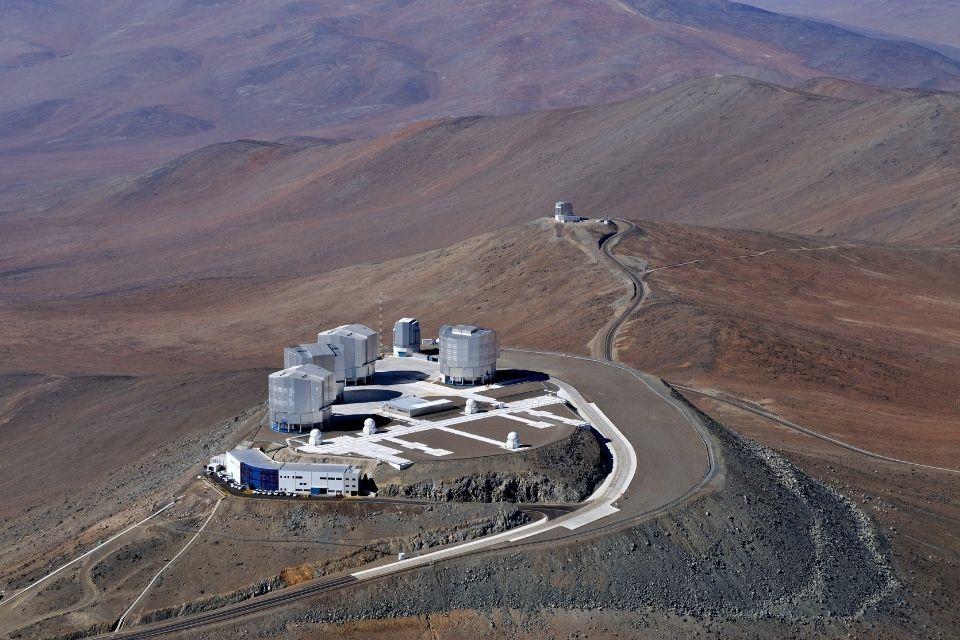
ESO’s Very Large Telescope (VLT) at Paranal, the world’s most advanced ground-based facility for astronomy, the site hosts four 8.2-metre Unit Telescopes, four 1.8-metre Auxiliary Telescopes, the VLT Survey Telescope (VST), and the 4.1-metre Visible and Infrared Survey Telescope for Astronomy (VISTA), seen in the distance on the next mountain peak over from the main platform. This aerial view also shows other structures, including the Observatory Control Room building, on the main platform’s front edge.
Physicists at the University of Oxford have contributed to a new study which has found the strongest evidence yet that some planets outside our Solar System may be magnetic. By using telescopes to measure wind speeds on seven very hot, Jupiter-like exoplanets, they discovered that the winds on these planets are most likely governed by magnetic fields. The results, published today in Nature Astronomy, provide the first robust inference of magnetism on planets outside the Solar System.
The Earth's magnetic field acts as a shield, stopping cosmic radiation from stripping away our atmosphere and enabling our planet to support life. Magnetic fields are also present in other planets within our Solar System, including Jupiter and Saturn. However, for the past 15 years, no one had directly inferred the strength of the magnetic fields of exoplanets (planets beyond our Solar System). This new study, a collaboration led by the Laboratoire Lagrange, Observatoire de la Côte d’Azur, France, has finally succeeded.
Initially, however, the team did not intend to measure magnetic fields but instead wind speeds. Their focus was seven exoplanets orbiting different stars: gas giants like Jupiter, but each tidally locked to its host star and very close to it. Similar to how we always see only one side of the Moon, these planets always keep one face towards the star. This results in a scorching hot day side and a relatively cold night side.
The difference in temperature creates a climate completely different from the one on our planet, with extremely strong winds. The wind speeds for the planets in the sample ranged from around 7200 km/h to over 25 000 km/h; in comparison, the fastest winds measured on Jupiter reach speeds of around 1500 km/h.
Using data from the European Southern Observatory’s Very Large Telescope (ESO's VLT) in the Chilean Atacama Desert, and the Gemini North telescope in Hawai’i, the researchers set out to check if the atmospheric winds behaved the same way for all the hot exoplanets. When they looked at how the winds speeds varied with planet temperature, they saw a very intriguing pattern emerge: the hotter the planet, the slower the wind. The result was surprising, since a hotter planet ought to have a greater contrast in temperature to accelerate the winds.
The team concluded that the most consistent explanation for this mystery is the presence of planet-wide magnetic fields, since these fields can work as a brake, slowing down the motion of charged particles in the atmosphere. The data therefore allowed the researchers to infer the strength of the magnetic field in each of the studied planets. They found them to be comparable in strength to those found in our Solar System: approximately four times as strong as Saturn's or about half the strength of Jupiter's.
Study co-author Associate Professor Thaddeus Komacek from the Department of Physics at the University of Oxford, was part of the team who published an initial theoretical study which proposed that trends in exoplanet wind speed would either confirm or deny the prediction that magnetic fields shape their winds. In the new study, this theory was applied to the observed results, allowing the team to infer exoplanet magnetic fields from wind speeds for the first time.
Associate Professor Komacek said: 'This work finds something quite rare in the field of astrophysics: a clear trend with minimal apparent deviation. The findings demonstrate that interactions with a planetary magnetic field limit the wind speeds of ultra-hot gas giants, a triumph of over fifteen years of theoretical study. That said, the lack of variation in the data is somewhat puzzling, because one might expect planets to have a broad range of possible magnetic field strengths. Further work is needed with a larger sample and improved theoretical models to tease out the resulting dependence of magnetic field strength on planetary properties.'
These strong magnetic fields may affect more than just the wind on these distant planets, potentially producing magnetically driven aurorae that are even more dramatic than the Northern and Southern Lights on Earth. The team hope that the arrival of ESO’s Extremely Large Telescope will help them to characterise not only large, Jupiter-like exoplanets but also smaller ones like Earth, possibly even detecting gases that could produce aurorae on these distant worlds.
Magnetic field strengths of hot giant exoplanets consistent with Solar System values, Julia V Siedel et al Nature Astronomy.