

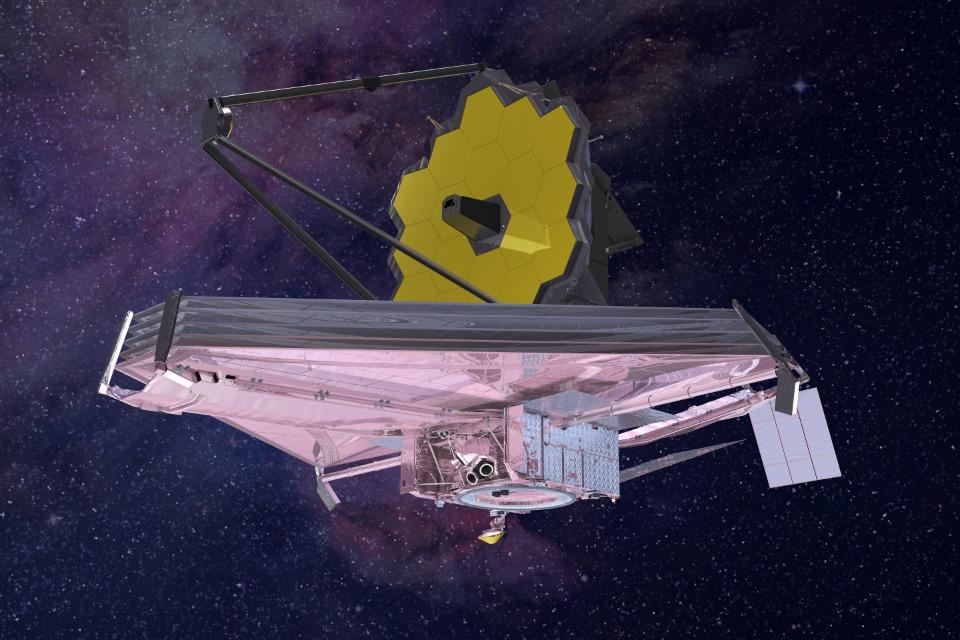
Artist's conception of JWST
Two researchers, Dr Jake Taylor and Dr James Gillanders, from the Department of Physics have been awarded observing time on the James Webb Space Telescope (JWST). Their observations will be undertaken during the upcoming Cycle 5 (July 2026 – June 2027)
Dr Jake Taylor, a Glasstone Fellow in the department, has been awarded 112.7 hours to carry out the largest survey ever conducted with JWST focused on the emission spectra of hot Jupiter exoplanets. Hot Jupiters are gas giant planets that orbit extremely close to their host stars, making them among the most intensively studied exoplanets due to their high temperatures and large apparent sizes. By analysing how nine of these planets emit heat, the study will investigate their thermal structure and atmospheric composition, and enable direct comparisons across a population observed within a single coordinated survey — an approach that allows the team to identify broader trends that studies of individual planets cannot reveal.
In support of the programme, Dr Taylor has also been awarded 1.73 million core-hours on the STFC DiRAC high-performance computing facility at the University of Leicester to support the computational modelling required to interpret the data.
'This is the largest JWST programme ever awarded to study the emission spectra of hot Jupiters, and the largest programme ever awarded to a UK Principal Investigator to study exoplanet atmospheres,' said Dr Taylor. 'The data will be valuable in helping us understand the atmospheric processes that govern planetary atmospheres, adding a piece to the puzzle of how planets form. With observations of 9 exoplanets, the data will benefit the exoplanet groups that span Astrophysics and AOPP, and will be a treasure trove of information for years to come.'
Dr James Gillanders, also of the Department of Physics, has been awarded 49 hours to observe the next nearby kilonova — the intense thermal transient produced when two neutron stars collide and merge. These violent events drive the rapid neutron-capture process, the most extreme nucleosynthesis pathway known, which is responsible for producing around half of all elements heavier than iron, including gold, platinum, iodine and uranium. Only two kilonovae have previously been observed spectroscopically. Dr Gillanders' programme will obtain high-quality JWST observations across the near-to-mid infrared at later times and longer wavelengths than have been sampled before, thus enabling a more complete picture to be established of how kilonovae evolve, and of their role in heavy element production throughout the Universe.
'I am delighted to be awarded time to observe the next kilonova with JWST,' said Dr Gillanders. 'With this programme, we hope to obtain the first mid-infrared spectra of a kilonova; with this, we will be able to map its evolution across the infrared from intermediate to very late times. These data will enable us to tether the production of specific heavy elements to kilonovae, advancing our understanding of the role these extreme mergers play in producing many of the heaviest elements in the Universe. It is a huge privilege to be awarded time to undertake this critical science; I owe a debt of gratitude to all of my collaborators, especially my co-PI Dr Quentin Pognan. We are all now waiting (somewhat) patiently for the next kilonova to be discovered!'
Further details about the observing programmes are available via the Space Telescope Science Institute and the proposal for the kilonova programme.