

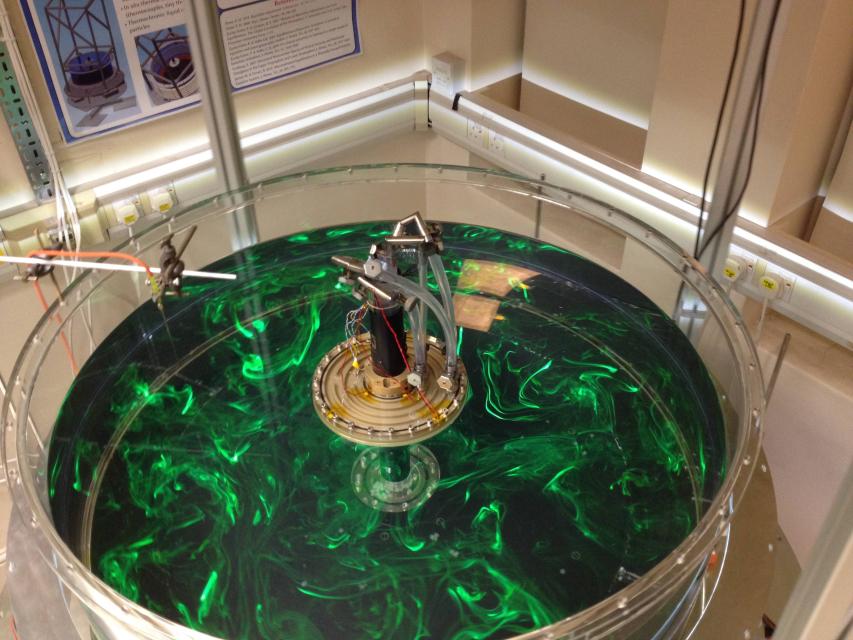
Visualisation of baroclinic eddies in a 1m differentially heated rotating tank in the Oxford GFD laboratory.
A new Oxford study has recreated the essential physics of turbulence in a laboratory with a spinning tank of water. The study was led by by Dr Shan-Shan Ding and Professor Peter Read based in the Geophysical Fluid Dynamics Lab. Their paper has been selected as an Editors’ Suggestion in Physical Review Letters.
Weather systems, ocean currents and the jet stream are all shaped by turbulence: the chaotic swirling of fluid at scales ranging from centimetres to thousands of kilometres. Understanding exactly how energy moves between these scales is crucial for forecasting weather and modelling climate – but measuring it directly in the real atmosphere is extraordinarily difficult.
The Oxford experiment uses a rotating, differentially heated fluid annulus – a cylindrical tank in which an outer ring is gently warmed while the inner region is cooled, and which spins to mimic the effect of the Earth’s rotation. This configuration generates baroclinic eddies: the swirling, tilting vortices that in the real atmosphere grow from the temperature contrast between the equator and the poles and drive much of the weather experienced at mid-latitudes. Using advanced optical measurement techniques known as particle image velocimetry, the team mapped the velocity of the fluid in unprecedented detail across a wide range of rotation rates.
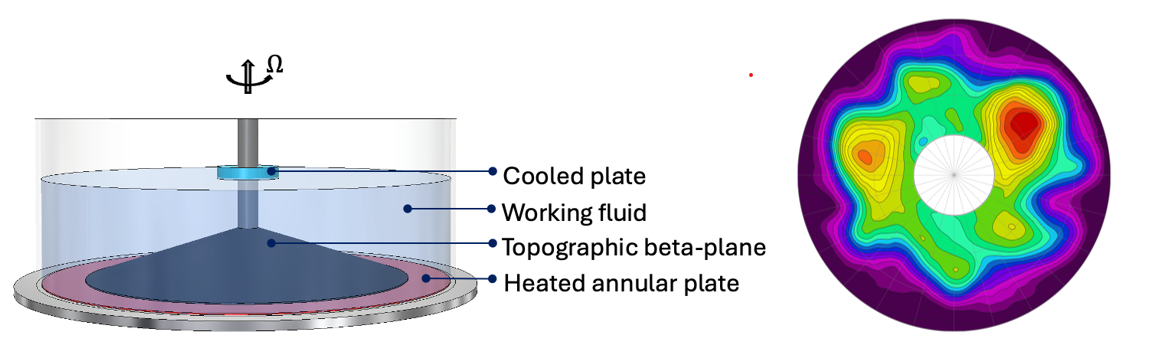
The measurements from this experiment confirmed a theoretically predicted energy spectrum in which kinetic energy of synoptic and mesoscale motion on the largest scales decays with the inverse cube of the wavenumber. This is a signature that has been observed in aircraft measurements of the atmosphere near the tropopause since the 1980s but whose physical origins have remained debated.
Crucially, the team also made an unexpected discovery: the way energy is distributed and exchanged across scales depends on how strongly the atmosphere is layered by density. This is a factor that existing theories do not fully account for. This could prove important for understanding why the atmospheres of other planets behave so differently from Earth's, where conditions such as gravity, atmospheric composition, and the heat of the parent star vary enormously.
The findings provide independent experimental benchmarks for testing the numerical models used in weather forecasting and climate prediction, which currently rely on approximations whose accuracy is difficult to verify from atmospheric observations alone.
Stratification-dependent enstrophy-controlled regime in geostrophic turbulence, Ding et al, Physical Review Letters (2026).