

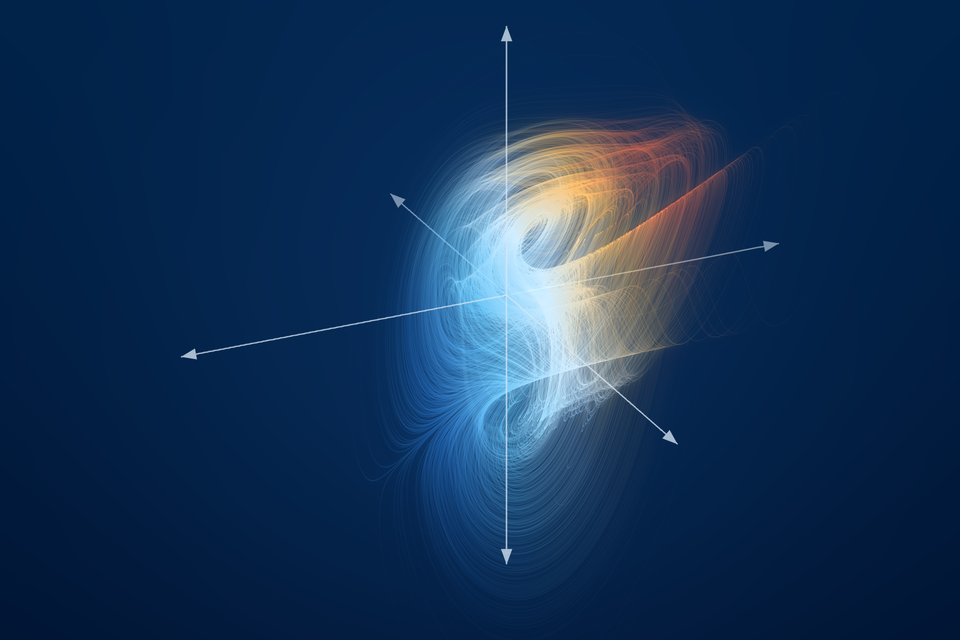
AI visualisation of the model in the recent paper by Nicoll et al in Earth System Dynamics.
Researchers in the Department of Physics have used an AI technique called equation discovery to derive, directly from observational data, three simple equations that describe how the North Atlantic Ocean, atmosphere and rainfall interact over decades. The study, carried out with the UK Centre for Ecology & Hydrology and the Met Office, has been published in Earth System Dynamics and selected as a highlight paper by the journal's editors.
The climate of the North Atlantic varies naturally over years and decades, and two patterns dominate. The Atlantic Multidecadal Variability (AMV) describes slow swings in sea surface temperature across the North Atlantic, which have been linked to Atlantic hurricane activity, droughts in the Sahel and summer weather in Europe and North America. The North Atlantic Oscillation (NAO) is a see-saw in air pressure between the Azores and Iceland that strongly influences winter weather across Europe.
Both patterns help forecasters predict climate from seasons to decades ahead, but how they interact, and the role that rainfall plays in linking them, is still debated.
To investigate, the team turned to equation discovery, an emerging AI approach that searches data to uncover the simplest mathematical equations able to describe how a system changes over time. Unlike many machine-learning methods, which make predictions without revealing how they reached them, equation discovery produces equations that scientists can read and interpret.
Using an algorithm called Sparse Identification of Nonlinear Dynamics (SINDy), the researchers analysed monthly observed records of the AMV, the NAO and North Atlantic rainfall from 1950 to 2022. From hundreds of candidate models, they selected a set of three linked equations that balanced accuracy with simplicity. They then tested the equations against earlier records, from 1900 to 1939, which played no part in building them.
'Rather than starting with equations that we think should describe the climate system, we let the data guide us towards the equations that best capture how the North Atlantic evolves. What is particularly exciting is that the result is a small set of equations that we can actually read and interpret. They give us a much simpler view of a very complicated system, while still capturing important features of its decadal variability. That makes it possible to use the equations not just to make predictions, but also to investigate the physical processes and feedbacks that drive climate variability.' says Andrew Nicoll, a DPhil student in the Atmospheric Processes group and lead author of the study.
Despite their simplicity, the equations captured the decadal variability seen in the observations. On the earlier records, they showed skill in predicting statistics of the AMV and North Atlantic rainfall several years to a decade ahead.
The model also produced a distinct 20-year cycle in all three quantities, even though it was built only from month-to-month changes in the data. The researchers interpret this as a slowly fading ocean oscillation, driven by the NAO and paced by the gradual adjustment of ocean currents.
Most notably, terms involving rainfall were among the most robust across all the candidate models, suggesting that rainfall acts as an important link between the ocean and the atmosphere. When water vapour condenses into rain it releases heat into the atmosphere, while the fresh water that rain adds to the ocean lowers its salinity, which can slow the circulation that carries heat northwards. On this basis, the team proposes new feedback mechanisms, including that the way the NAO responds to ocean temperatures depends on whether North Atlantic rainfall is above or below normal.
In selecting the paper as a highlight, the journal's editors said it 'presents data-driven equation discovery as a powerful scientific method to study climate variability, and thereby exemplifies how machine-learning methods do not only work as black boxes, but can also help us better understand complex Earth system dynamics.'
The researchers suggest that, with the right starting conditions, such equations could help estimate rainfall trends over the North Atlantic, Europe and North America for the decade ahead, and are now using the model to study how predictable the region's climate is on decadal timescales.
'In the past we’ve checked that our ML models are doing the right thing by comparing them to known science. What’s particularly exciting about this study, is that our ML tools are now revealing new scientific knowledge. Our simple equations have given us several new ideas about the dynamics of the North Atlantic. Over the coming months we will be checking these predictions against observational data and developing new theories for the region.' adds Professor Hannah Christensen, Professor of Atmospheric Physics, who leads the Atmospheric Processes group.
The research was funded by the Natural Environment Research Council (NERC) through the Oxford University Environmental Research Doctoral Training Partnership, the Leverhulme Trust, the EU-funded EERIE project and the Advanced Research and Invention Agency (ARIA).
New insights into decadal climate variability in the North Atlantic revealed by data-driven dynamical models, A. J. Nicoll et al., Earth System Dynamics, 7 August 2026