Home
Department Of Physics text logo
  • Research
    • Our research
    • Our research groups
    • Our research in action
    • Research funding support
    • Summer internships for undergraduates
  • Study
    • Undergraduates
    • Postgraduates
  • Engage
    • For alumni
    • For business
    • For schools
    • For the public
  • Support
Menu

Latest news and comment

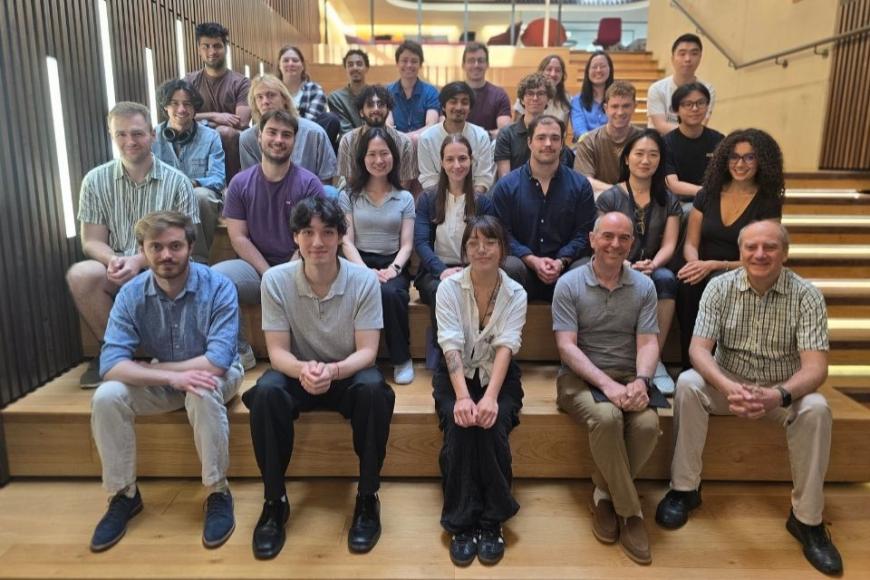
Partners Day for the Oxford Superconductivity CDT

Superconductivity CDT Partners’ Day strengthens links with industry

Industry and research partners joined doctoral students and supervisors in Oxford for a day of talks, panel discussions and networking as part of the Superconductivity CDT Residential Week 2026.
2 June 2026
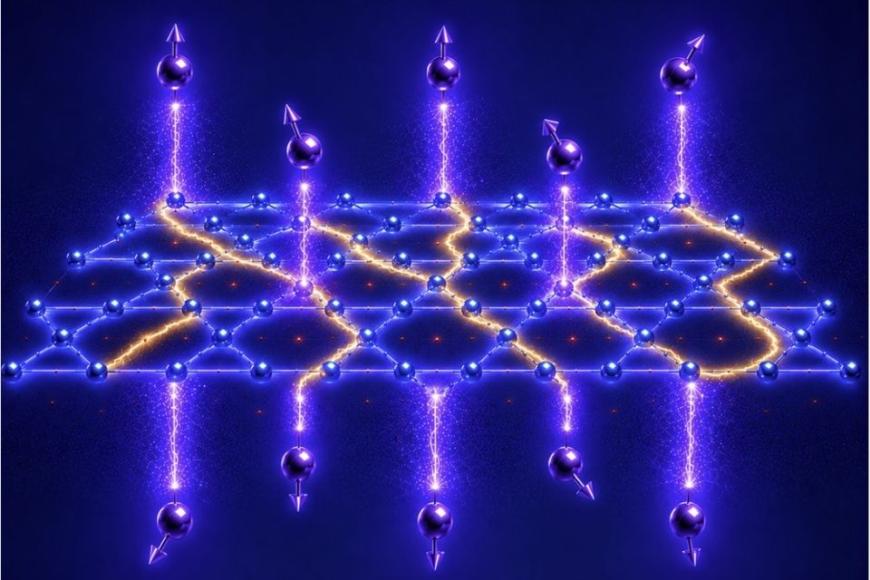
Artist's impression of X-ray Magnetic Vector Chronoscopy

New X-ray technique ‘films’ magnetic waves in 3D

Researchers from the University of Oxford, Diamond Light Source, and ShanghaiTech University have developed an advanced X-ray method that, for the first time, enables scientists to observe the complete three-dimensional motion of magnetic waves.
27 May 2026
Sir Anthony Leggett

Commentary: Professor Blundell on Anthony Leggett (1938-2026)

Professor Stephen Blundell reflects on the life and legacy of Nobel prize winner Sir Anthony Leggett who died on 8 March 2026.
10 March 2026
Schematic illustration of conformal, oriented perovskite crystal structure deposited via co-evaporation on a micron-textured industrial standard Si wafer.

Efficient and stable perovskite solar cells made without solvents

Researchers from the University of Oxford and the Hong Kong University of Science and Technology have developed a new way to make high-performance perovskite solar cells entirely without solvents.
23 February 2026
Clockwise from top left: Cosmin Andrei, Dr Gabriel Araneda Machuca, Oana Bazavan, Dr Keith Norman and Dr Mustafa Bakr

Quantum physicists: the people behind the future

Having celebrated the International Year of Quantum last year, here we speak to people across the Department of Physics to find out how they found their way into quantum, what their days look like now, and how they see the field changing.
12 February 2026
Image showing magnets sending wireless messages to nearby magnets.

Magnetic signals without wires: helimagnets synchronise distant layers

A new study has shown that certain magnet materials, when excited by microwaves to move in oscillation, emits a wireless signal that can drive nearby magnets to move in sync.
30 January 2026
An illustration of strain from the journal article

Engineering magnetic states for future devices

Scientists at Oxford have found a simple and effective way to control magnetism at the nanoscale, opening a new route to engineering advanced materials for next-generation low-energy technologies.
20 January 2026
Professor Moritz Riede

Professor Riede among first cohort of Green Future Fellows

Professor Moritz Riede from the Department of Physics at the University of Oxford is one of 13 Green Future Fellows to receive landmark funding from the Royal Academy of Engineering.
18 December 2025
Image of Superconductivity CDT Cohort

Launching the Superconductivity CDT

The brand new EPSRC Centre for Doctoral Training in Superconductivity: Enabling Transformative Technologies has welcomed its first 16-strong cohort.
16 December 2025
A crystal of the newly discovered piezoelectric material viewed under a microscope

New material for next-gen devices

Scientists have developed a new material that converts motion into electricity (piezoelectricity) with greater efficiency and without using toxic lead – paving the way for a new generation of devices that we use in everyday life.
26 November 2025
Terahertz light can reversibly switch an unusual form of structural order in solids – called ferroaxiality – between clockwise and counterclockwise rotational patterns.

Light-controlled switching of ferroaxial states opens path to ultrafast data storage

Researchers use circularly polarised terahertz pulses to reversibly switch ferroaxial domains, revealing a new route to stable, light-driven data storage technologies.
10 October 2025
The hardware set up for the control electronics in the laboratory at Oxford.

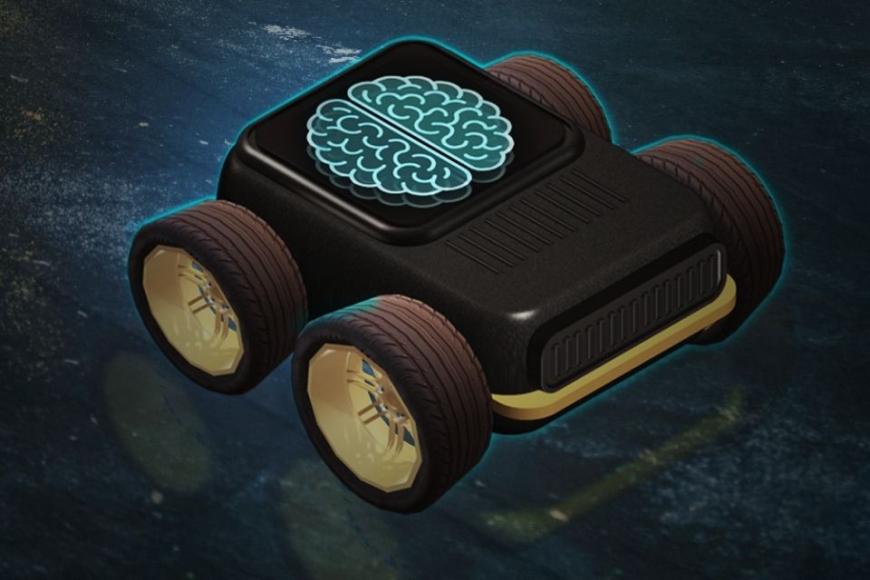
Developing AI agents for self-driving quantum laboratories

Oxford physicists have developed an AI framework that allows quantum laboratories to run and adapt experiments autonomously.
23 September 2025
  • Load More

Footer Menu

  • Contact us
  • Giving to the Dept of Physics
  • Work with us
  • Media

User account menu

  • Log in

Follow us

FIND US

Clarendon Laboratory,

Parks Road,

Oxford,

OX1 3PU

CONTACT US

Tel: +44(0)1865272200

University of Oxfrod logo Department Of Physics text logo
IOP Juno Champion logo Athena Swan Silver Award logo

© University of Oxford - Department of Physics

Cookies | Privacy policy | Accessibility statement

Built by: Versantus

  • Home
  • Research
  • Study
  • Engage
  • Our people
  • News & Comment
  • Events
  • Our facilities & services
  • About us
  • Giving to Physics
  • Current students
  • Staff intranet