Home
Department Of Physics text logo
  • Research
    • Our research
    • Our research groups
    • Our research in action
    • Research funding support
    • Summer internships for undergraduates
  • Study
    • Undergraduates
    • Postgraduates
  • Engage
    • For young people
    • For teachers
    • For the public
    • For alumni
    • For business
  • Support
Menu
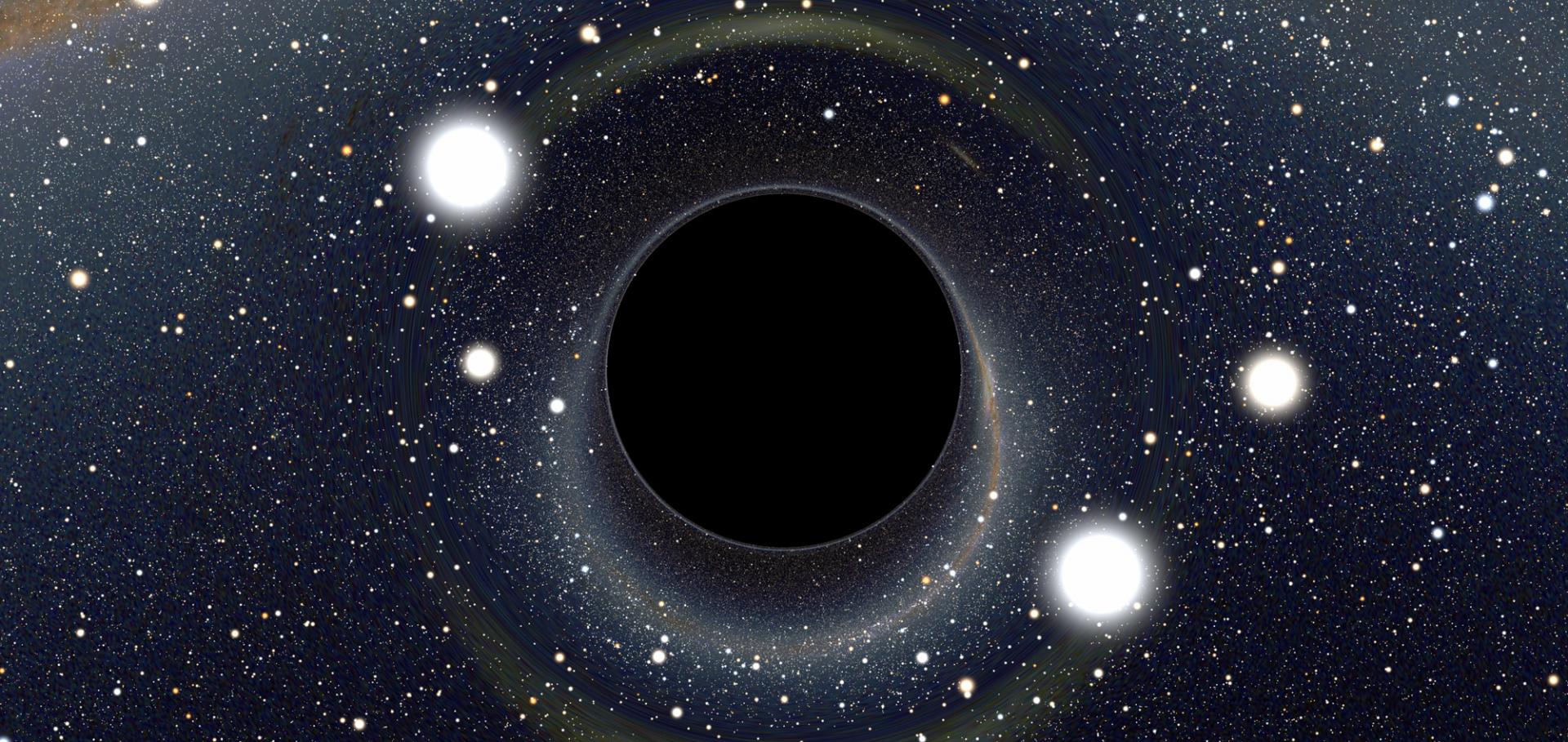
Black Hole

Lensing of space time around a black hole. At Oxford we study black holes observationally and theoretically on all size and time scales - it is some of our core work.

Credit: ALAIN RIAZUELO, IAP/UPMC/CNRS. CLICK HERE TO VIEW MORE IMAGES.

Dr Andrew Hughes

Postdoctoral Research Assistant

Sub department

  • Astrophysics
andrew.hughes@physics.ox.ac.uk
Denys Wilkinson Building, room Daliz 2
  • About
  • Publications

Optical outburst evolution of the transient black hole X-ray binary Swift J1727.8−1613: disc response to jet ejections and late-outburst emergence of powerful disc winds

Monthly Notices of the Royal Astronomical Society Oxford University Press (OUP) 550:4 (2026) stag1175

Authors:

N Castro Segura, K Solomons, JM Corral-Santana, C Knigge, PA Charles, M Brigitte, S Fijma, M Díaz Trigo, A Gúrpide, DAH Buckley, F Carotenuto, AJ Castro-Tirado, DL Coppejans, M Georganti, A Hughes, KS Long, J Matthews, I Monageng, I Pelisoli, TD Russell, D Steeghs, J Svoboda, AJ Tetarenko, FM Vincentelli, AGW Wallis

Abstract:

ABSTRACT Swift J1727.8–1613 is a newly discovered transient low-mass X-ray binary harbouring a stellar-mass ($\sim 10\,\mathrm{ M}_\odot$) black hole. We present state-resolved VLT/X-Shooter optical spectroscopy of its 2023 outburst, sampling the luminous hard-to-soft and late soft-to-hard transitions. During the onset of the brightest radio flare, He ii flux rises relative to adjacent epochs, with reduced peak-to-peak separation and full-width-half-maximum, consistent with enhanced irradiation shifting line emissivity to larger radii. We detect no contemporaneous change in the line base tracing the inner disc. The most dramatic change occurs at the onset of the dim-hard state, when strong, broad (higher-order) Balmer lines appear in absorption, and He ii remains in emission, but becomes highly asymmetric. While the hardening of the X-ray spectrum likely promotes the reappearance of an underlying disc photosphere, the kinematic alignment between the Balmer absorption ($v_w\sim -750\, \mathrm{km\, s^{-1}}$) and the suppressed blue peak of He ii suggests a unified origin in a massive, cool ($T\lesssim 10^{4}\, \mathrm{K}$) accretion disc wind. Radiative transfer simulations demonstrate that such asymmetric He ii profiles are naturally produced in a rotating and accelerating outflow. Using the Sobolev approximation, we estimate the wind mass-loss rate to be $\dot{M}_w\gtrsim 10^{-9}\, \mathrm{ M}_\odot \, \mathrm{yr^{-1}}$, comparable to the instantaneous accretion rate and a significant fraction of the secular mass-transfer rate from the donor. If persistent at quiescent-level X-ray luminosities, this outflow could strongly impact the system’s secular evolution.
More details from the publisher
More details

Spectropolarimetric detection of baryonic mass loading in a transient relativistic jet: application to the black hole X-ray binary Swift J1727.8$-$1613

(2026)

Authors:

AK Hughes, RP Fender, GR Sivakoff, FJ Cowie, I Heywood, JH Matthews, K Savard, F Carotenuto, TD Russell, CM Wood, MC Baglio, S Corbel, SE Motta
Details from ArXiV

The peculiar hard state behaviour of the black hole X-ray binary Swift J1727.8$-$1613

ArXiv 2506.12387 (2025)

Authors:

AK Hughes, F Carotenuto, TD Russell, AJ Tetarenko, JCA Miller-Jones, RM Plotkin, A Bahramian, JS Bright, FJ Cowie, J Crook-Mansour, R Fender, JK Khaulsay, A Kirby, S Jones, M McCollough, R Rao, GR Sivakoff, SD Vrtilek, DRA Williams-Baldwin, CM Wood, D Altamirano, P Casella, N Castro Segura, S Corbel, M Del Santo, C Echiburu-Trujillo, J van den Eijnden, E Gallo, P Gandhi, KII Koljonen, T Maccarone, SB Markoff, S Motta, DM Russell, P Saikia, AW Shaw, R Soria, JA Tomsick, W Yu, X Zhang
Details from ArXiV

Comprehensive Radio Monitoring of the Black Hole X-ray Binary Swift J1727.8$-$1613 during its 2023$-$2024 Outburst

(2025)

Authors:

Andrew K Hughes, Francesco Carotenuto, Thomas D Russell, Alexandra J Tetarenko, James CA Miller-Jones, Arash Bahramian, Joe S Bright, Fraser J Cowie, Rob Fender, Mark A Gurwell, Jasvinderjit K Khaulsay, Anastasia Kirby, Serena Jones, Elodie Lescure, Michael McCollough, Richard M Plotkin, Ramprasad Rao, Saeqa D Vrtilek, David RA Williams-Baldwin, Callan M Wood, Gregory R Sivakoff, Diego Altamirano, Piergiorgio Casella, Stephane Corbel, David R DeBoer, Melania Del Santo, Constanza Echiburu-Trujillo, Wael Farah, Poshak Gandhi, Karri II Koljonen, Thomas Maccarone, James H Matthews, Sera B Markoff, Alexander W Pollak, David M Russell, Payaswini Saikia, Noel Castro Segura, Aarran W Shaw, Andrew Siemion, Roberto Soria, John A Tomsick, Jakob van den Eijnden
More details from the publisher
Details from ArXiV

SAX J1810.8-2609: An Outbursting Neutron Star X-ray Binary with Persistent Spatially Coincident Radio Emission

(2023)

Authors:

AK Hughes, GR Sivakoff, J van den Eijnden, R Fender, JCA Miller-Jones, E Tremou
More details from the publisher
Details from ArXiV

Pagination

  • Current page 1
  • Page 2
  • Next page Next
  • Last page Last

Footer Menu

  • Contact us
  • Giving to the Dept of Physics
  • Work with us
  • Media

User account menu

  • Log in

Follow us

FIND US

Clarendon Laboratory,

Parks Road,

Oxford,

OX1 3PU

CONTACT US

Tel: +44(0)1865272200

University of Oxfrod logo Department Of Physics text logo
IOP Juno Champion logo Athena Swan Silver Award logo

© University of Oxford - Department of Physics

Cookies | Privacy policy | Accessibility statement

Built by: Versantus

  • Home
  • Research
  • Study
  • Engage
  • Our people
  • News & Comment
  • Events
  • Our facilities & services
  • About us
  • Giving to Physics
  • Current students
  • Staff intranet