Home
Department Of Physics text logo
  • Research
    • Our research
    • Our research groups
    • Our research in action
    • Research funding support
    • Summer internships for undergraduates
  • Study
    • Undergraduates
    • Postgraduates
  • Engage
    • For young people
    • For teachers
    • For the public
    • For alumni
    • For business
  • Support
Menu
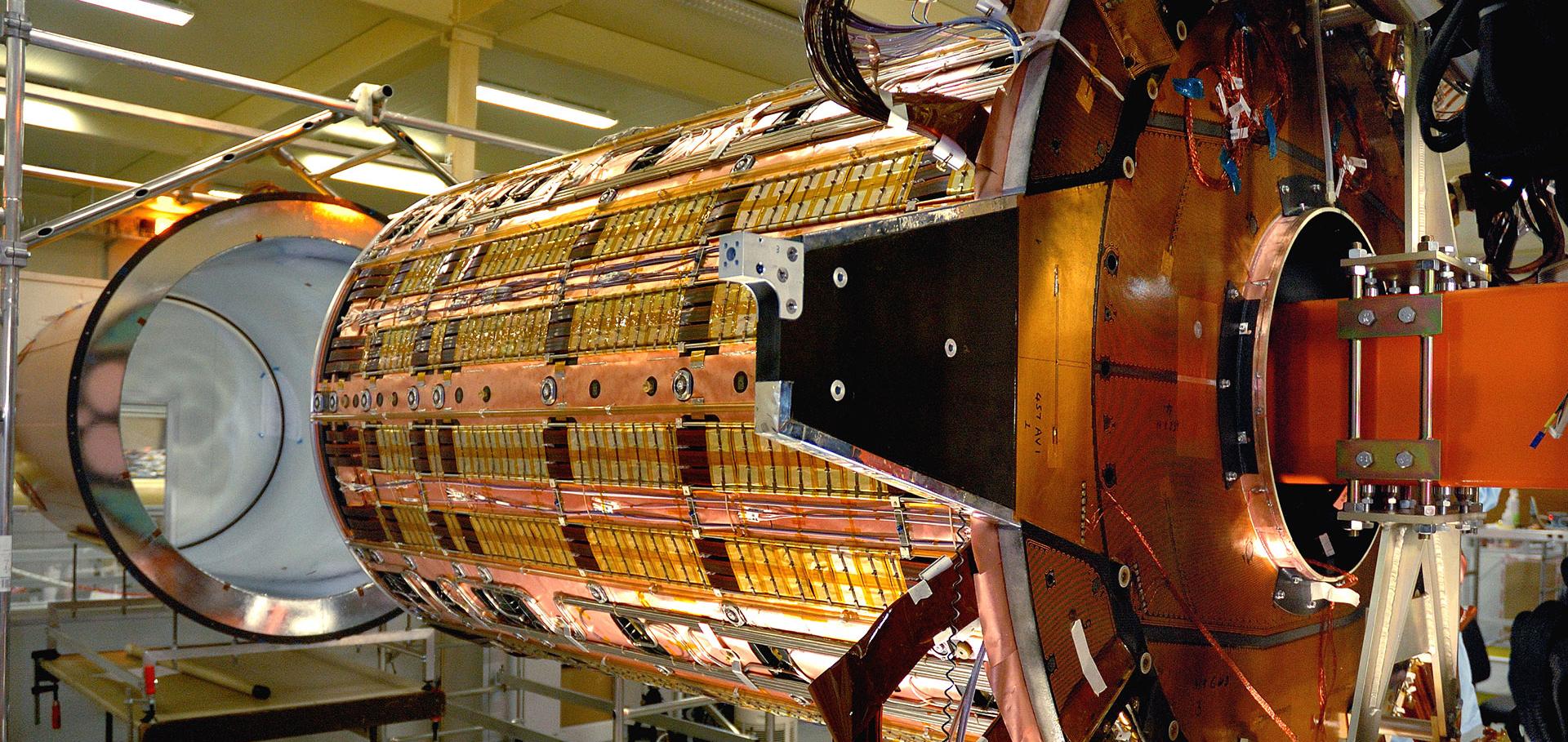
Insertion of STC into TRT at the Department of Physics, Oxford
Credit: CERN

David Bacher

PDRA

Sub department

  • Particle Physics

Research groups

  • LHCb
david.bacher@physics.ox.ac.uk
Telephone: (2)73382
Denys Wilkinson Building, room 653
  • About
  • Publications

Three-pion Bose-Einstein correlations measured in proton-proton collisions

Journal of High Energy Physics Springer 2025:8 (2025) 174

Authors:

R Aaij, ASW Abdelmotteleb, C Abellan Beteta, F Abudinén, T Ackernley, AA Adefisoye, B Adeva, M Adinolfi, P Adlarson, C Agapopoulou, CA Aidala, Z Ajaltouni, S Akar, K Akiba, P Albicocco, J Albrecht, F Alessio, Z Aliouche, P Alvarez Cartelle, R Amalric, S Amato, JL Amey, Y Amhis, L An, D Bacher

Abstract:

A study on the Bose-Einstein correlations for triplets of same-sign pions is presented. The analysis is performed using proton-proton collisions at a centre-of-mass energy of s = 7 TeV, recorded by the LHCb experiment, corresponding to an integrated luminosity of 1.0 fb−1. For the first time, the results are interpreted in the core-halo model. The parameters of the model are determined in regions of charged-particle multiplicity. This measurement provides insight into the nature of hadronisation in terms of coherence, being consistent with the presence of coherent emission of pions.
More details from the publisher
Details from ORA
More details

Observation of the $${{{\varLambda } ^0_{b}} \!\rightarrow {{J \hspace{-1.66656pt}/\hspace{-1.111pt}\psi }} {{\varXi } ^-} {{K} ^+} }$$ and $${{{{\varXi } ^0_{b}} \!\rightarrow {{J \hspace{-1.66656pt}/\hspace{-1.111pt}\psi }} {{\varXi } ^-} {{\pi } ^+} }}$$ decays

The European Physical Journal C SpringerOpen 85:7 (2025) 812

Authors:

R Aaij, ASW Abdelmotteleb, C Abellan Beteta, F Abudinén, T Ackernley, AA Adefisoye, B Adeva, M Adinolfi, P Adlarson, C Agapopoulou, CA Aidala, Z Ajaltouni, S Akar, K Akiba, P Albicocco, J Albrecht, F Alessio, M Alexander, Z Aliouche, P Alvarez Cartelle, R Amalric, S Amato, JL Amey, Y Amhis, L An, L Anderlini, M Andersson, A Andreianov, P Andreola, M Andreotti, D Andreou, A Anelli, D Ao, F Archilli, M Argenton, S Arguedas Cuendis, A Artamonov, M Artuso, E Aslanides, R Ataíde Da Silva, M Atzeni, B Audurier, D Bacher, I Bachiller Perea, S Bachmann, M Bachmayer, JJ Back, P Baladron Rodriguez, V Balagura, A Balboni

Abstract:

The first observation of the Ξb0 → J/ψΞ− π+ decay and the most precise measurement of the branching fraction of the Λb0 → J/ψΞ− K+ decay are reported, using proton-proton collision data from the LHCb experiment collected in 2016–2018 at a centre of-mass energy of 13 TeV, corresponding to an integrated luminosity of 5.4 fb−1. Using the Λb0 → J/ψΛ and Ξb0 → J/ψΞ− decays as normalisation channels, the ratios of branching fractions are measured to be B(Λb0 → J/ψΞ− K+)/B(Λb0 → J/ψΛ) = (1.17 ± 0.14 ± 0.08) × 10−2, B(Ξb0 → J/ψΞ− π+)/B(Ξb0 → J/ψΞ−) = (11.9 ± 1.4 ± 0.6) × 10−2, where the first uncertainty is statistical and the second systematic
More details from the publisher
Details from ORA
More details

Measurement of the ψ (2S) to J /ψ cross-section ratio as a function of centrality in PbPb collisions at s NN = 5. 02 TeV

Journal of High Energy Physics Springer 2025:7 (2025) 235

Authors:

R Aaij, ASW Abdelmotteleb, C Abellan Beteta, F Abudinén, T Ackernley, AA Adefisoye, B Adeva, M Adinolfi, P Adlarson, C Agapopoulou, CA Aidala, Z Ajaltouni, S Akar, K Akiba, P Albicocco, J Albrecht, F Alessio, M Alexander, Z Aliouche, P Alvarez Cartelle, R Amalric, S Amato, JL Amey, Y Amhis, D Bacher

Abstract:

The ratio of prompt production cross-sections of ψ(2S) and J/ψ mesons in their dimuon final state is measured as a function of centrality, using data collected by the LHCb detector in PbPb collisions at sNN = 5.02 TeV, for the first time in the forward rapidity region. The measured ratio shows no dependence on the collision centrality, and is compared to the latest theory predictions and to the recent measurements in literature.
More details from the publisher
Details from ORA
More details

Measurement of the branching fraction ratio R K at large dilepton invariant mass

Journal of High Energy Physics Springer 2025:7 (2025) 198

Authors:

R Aaij, ASW Abdelmotteleb, C Abellan Beteta, F Abudinén, T Ackernley, AA Adefisoye, B Adeva, M Adinolfi, P Adlarson, C Agapopoulou, CA Aidala, Z Ajaltouni, S Akar, K Akiba, P Albicocco, J Albrecht, F Alessio, Z Aliouche, P Alvarez Cartelle, R Amalric, S Amato, JL Amey, Y Amhis, L An, D Bacher

Abstract:

A test of lepton universality between muons and electrons is performed using B+ → K+ℓ+ℓ− decays (where ℓ = e, μ), in the dilepton invariant-mass-squared region above 14.3 GeV2/c4. The data used for the measurement consists of beauty meson decays produced in proton-proton collisions, corresponding to an integrated luminosity of 9 fb−1, collected by the LHCb experiment between 2011 and 2018. The ratio of branching fractions for B+→ K+μ+μ− and B+→ K+e+e− decays is measured to be RK=1.08−0.09+0.11stat−0.04+0.04syst, which is consistent with the Standard Model prediction of unity. This constitutes the most precise test of lepton flavour universality using B+ → K+ℓ+ℓ− decays with dilepton invariant-mass-squared above the ψ(2S) mass, whilst being the first of its kind at a hadron collider.
More details from the publisher
Details from ORA
More details

Observation of the decay B s 0 → K 0 p p ¯ and measurement of the B s 0 → K 0 p p ¯ branching fractions

Journal of High Energy Physics Springer 2025:7 (2025) 121

Authors:

R Aaij, ASW Abdelmotteleb, C Abellan Beteta, F Abudinén, T Ackernley, AA Adefisoye, B Adeva, M Adinolfi, P Adlarson, C Agapopoulou, CA Aidala, Z Ajaltouni, S Akar, K Akiba, P Albicocco, J Albrecht, F Alessio, Z Aliouche, P Alvarez Cartelle, R Amalric, S Amato, JL Amey, Y Amhis, L An, D Bacher

Abstract:

A study of the charmless baryonic decays Bs0→K0pp¯ is presented, where Bs0 denotes either a B0 or a Bs0 meson. The analysis is based on proton-proton collision data collected by the LHCb experiment at centre-of-mass energies of 7, 8, and 13 TeV, corresponding to an integrated luminosity of 9 fb−1. The decay Bs0→K0pp¯ is observed for the first time, with a measured branching fraction of (9.14 ± 1.69 ± 0.90 ± 0.33 ± 0.20) × 10−7 and a significance of 5.6σ. The uncertainties respectively account for statistical and systematic contributions, the precision of the branching fraction of the normalisation channel B0→ K0π+π− and the fragmentation fraction ratio fs/fd. The branching fraction determined for B0→K0pp¯ is (2.82 ± 0.08 ± 0.12 ± 0.10) × 10−6, which is the most precise measurement to date.
More details from the publisher
Details from ORA
More details

Pagination

  • First page First
  • Previous page Prev
  • …
  • Page 8
  • Page 9
  • Page 10
  • Page 11
  • Current page 12
  • Page 13
  • Page 14
  • Page 15
  • Page 16
  • …
  • Next page Next
  • Last page Last

Footer Menu

  • Contact us
  • Giving to the Dept of Physics
  • Work with us
  • Media

User account menu

  • Log in

Follow us

FIND US

Clarendon Laboratory,

Parks Road,

Oxford,

OX1 3PU

CONTACT US

Tel: +44(0)1865272200

University of Oxfrod logo Department Of Physics text logo
IOP Juno Champion logo Athena Swan Silver Award logo

© University of Oxford - Department of Physics

Cookies | Privacy policy | Accessibility statement

Built by: Versantus

  • Home
  • Research
  • Study
  • Engage
  • Our people
  • News & Comment
  • Events
  • Our facilities & services
  • About us
  • Giving to Physics
  • Current students
  • Staff intranet