

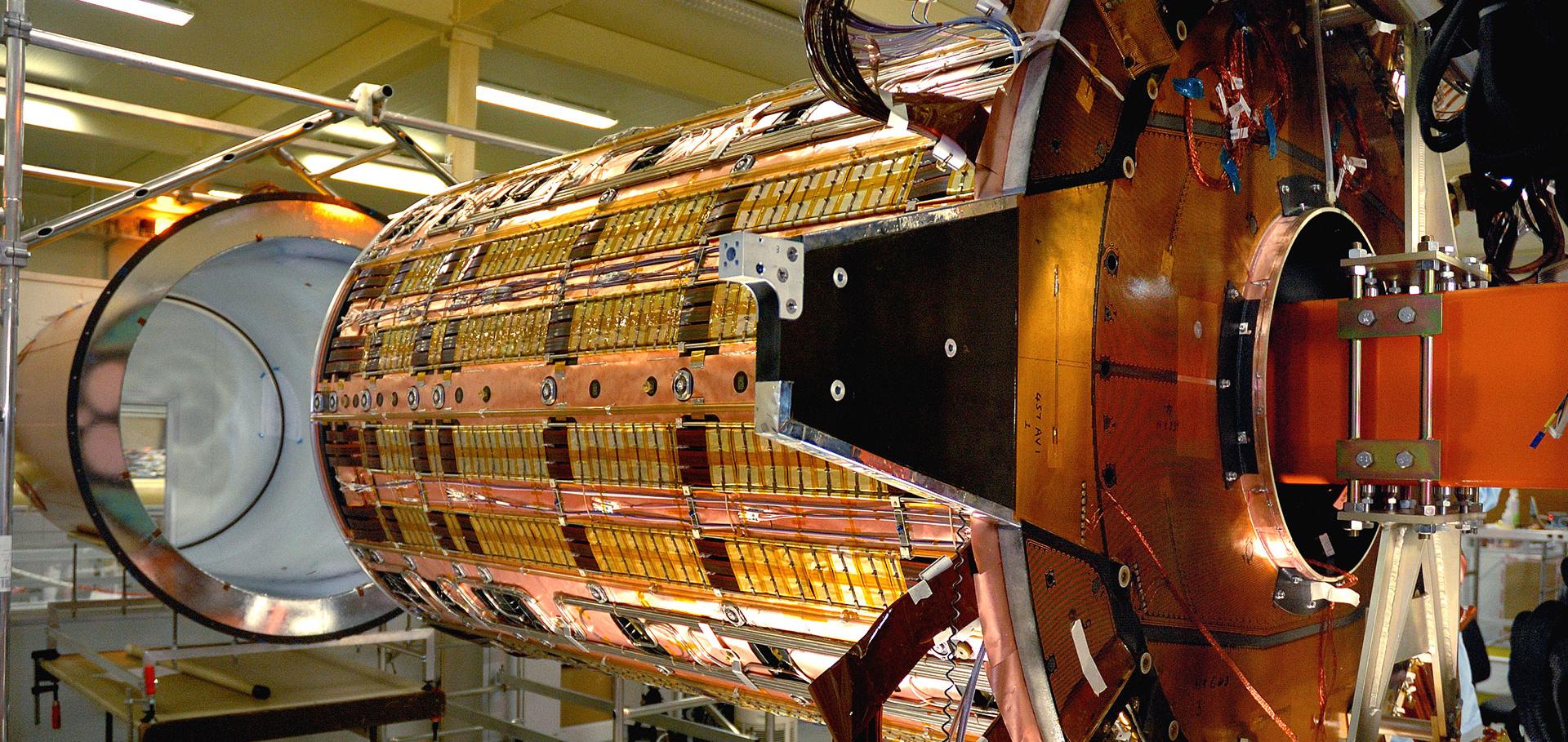

DarkSide-20k Veto Photon-Detector Units: construction and characterization
Journal of Instrumentation 19:5 (2024)
Abstract:
DarkSide-20k is a global direct dark matter search experiment situated underground at LNGS (Italy), designed to reach a total exposure of 200 tonne-years nearly free from instrumental backgrounds. The core of the detector is a dual-phase Time Projection Chamber (TPC) filled with 50 tonne of low-radioactivity liquid argon. The entire TPC wall is surrounded by a gadolinium-loaded polymethylmethacrylate (Gd-PMMA), which acts as a neutron veto, immersed in a second low-radioactivity liquid argon bath enclosed in a stainless steel vessel. The neutron veto is equipped with large-area Silicon PhotoMultiplier (SiPM) array detectors, placed on the outside of the TPC wall. SiPMs are arranged in a compact design meant to minimize the material used for PCBs, cables and connectors: the so-called Veto Photon-Detector Units (vPDUs). A vPDU comprises 16 vTiles, each containing 24 SIPMs, together with front-end electronics, and a motherboard, which distributes voltage and control signals, sums vTiles channels, and drives the electrical signal transmission. The neutron veto will be equipped with 120 vPDUs. The paper will focus on the production of the first vPDUs, describing the assembly chain in the U.K. institutes, in order to underline the rigorous QA/QC procedures, up to the final characterization of the first completed prototypes. Tests will be extensively performed in liquid nitrogen baths either for the single vTiles and for the assembled vPDUs, with the purpose of assigning a “quality passport” to each component.QUEST-DMC superfluid 3 He detector for sub-GeV dark matter
The European Physical Journal C SpringerOpen 84:3 (2024) 248
Abstract:
The focus of dark matter searches to date has been on Weakly Interacting Massive Particles (WIMPs) in the GeV/c2-TeV/c2 mass range. The direct, indirect and collider searches in this mass range have been extensive but ultimately unsuccessful, providing a strong motivation for widening the search outside this range. Here we describe a new concept for a dark matter experiment, employing superfluid 3He as a detector for dark matter that is close to the mass of the proton, of order 1 GeV/c2. The QUEST-DMC detector concept is based on quasiparticle detection in a bolometer cell by a nanomechanical resonator. In this paper we develop the energy measurement methodology and detector response model, simulate candidate dark matter signals and expected background interactions, and calculate the sensitivity of such a detector. We project that such a detector can reach sub-eV nuclear recoil energy threshold, opening up new windows on the parameter space of both spin-dependent and spin-independent interactions of light dark matter candidates.QUEST-DMC superfluid $^3$He detector for sub-GeV dark matter
(2023)
Recent results from MICE on multiple Coulomb scattering and energy loss
ArXiv 1805.07128 (2018)