Home
Department Of Physics text logo
  • Research
    • Our research
    • Our research groups
    • Our research in action
    • Research funding support
    • Summer internships for undergraduates
  • Study
    • Undergraduates
    • Postgraduates
  • Engage
    • For young people
    • For teachers
    • For the public
    • For alumni
    • For business
  • Support
Menu
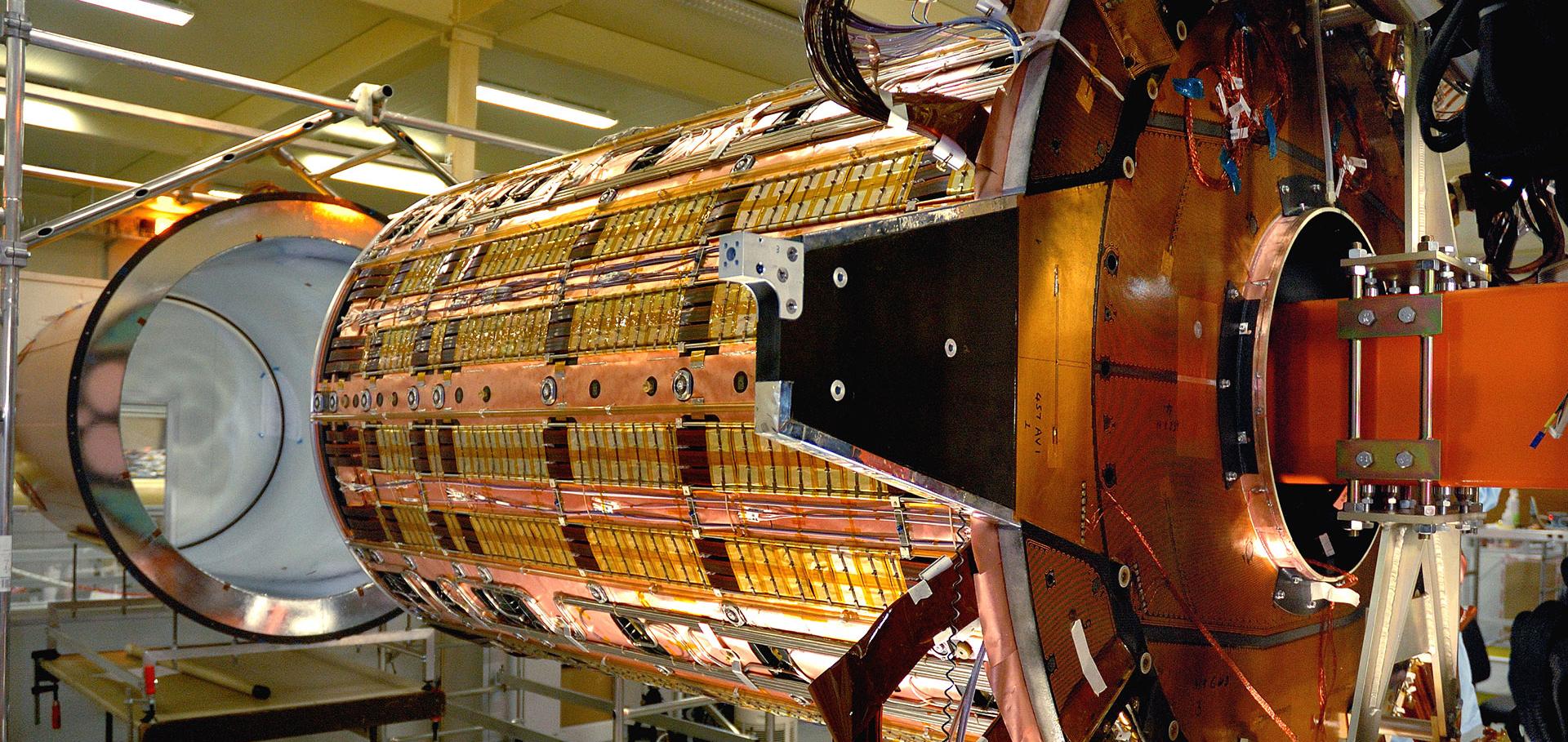
Insertion of STC into TRT at the Department of Physics, Oxford
Credit: CERN

Dr. James Frost

Visitor

Research theme

  • Fundamental particles and interactions

Sub department

  • Particle Physics

Research groups

  • ATLAS
  • FASER2
james.frost@physics.ox.ac.uk
Telephone: 01865 (2)73337
Denys Wilkinson Building, room 602
  • About
  • Publications

Dielectric function of degenerate InSb: Beyond the hydrodynamic model

Physical Review B Condensed Matter and Materials Physics 73:15 (2006)

Authors:

GR Bell, TD Veal, JA Frost, CF McConville

Abstract:

The plasmon excitations of the degenerate free-electron gas in the surface space-charge region of InSb have been studied using high-resolution electron-energy-loss spectroscopy. Semiclassical dielectric theory simulations of the energy-loss spectra have been performed using the hydrodynamic and Boltzmann-Mermin models. While both analyses include the effects of temperature, conduction band nonparabolicity, spatial dispersion and collisional damping, the hydrodynamic model is not able to quantitatively reproduce the experimental spectra at higher excitation wave vectors. The measured spectral shapes are only accurately reproduced when collisionless plasmon damping is included explicitly using the Boltzmann-Mermin dielectric function. © 2006 The American Physical Society.
More details from the publisher

Higgs self-coupling measurements using deep learning in the $b\bar{b}b\bar{b}$ final state

The Journal of High Energy Physics Springer Verlag (Germany)

Authors:

Jacob Amacker, William Balunas, Lydia Beresford, Daniela Bortoletto, James Frost, Cigdem Issever, Jesse Liu, James McKee, Alessandro Micheli, Santiago Paredes Saenz, Michael Spannowsky, Beojan Stanislaus

Abstract:

Measuring the Higgs trilinear self-coupling $\lambda_{hhh}$ is experimentally demanding but fundamental for understanding the shape of the Higgs potential. We present a comprehensive analysis strategy for the HL-LHC using di-Higgs events in the four $b$-quark channel ($hh \to 4b$), extending current methods in several directions. We perform deep learning to suppress the formidable multijet background with dedicated optimisation for BSM $\lambda_{hhh}$ scenarios. We compare the $\lambda_{hhh}$ constraining power of events using different multiplicities of large radius jets with a two-prong structure that reconstruct boosted $h \to bb$ decays. We show that current uncertainties in the SM top Yukawa coupling $y_t$ can modify $\lambda_{hhh}$ constraints by $\sim 20\%$. For SM $y_t$, we find prospects of $-0.8 < \lambda_{hhh} / \lambda_{hhh}^\text{SM} < 6.6$ at 68% CL under simplified assumptions for 3000~fb$^{-1}$ of HL-LHC data. Our results provide a careful assessment of di-Higgs identification and machine learning techniques for all-hadronic measurements of the Higgs self-coupling and sharpens the requirements for future improvement.
More details from the publisher
Details from ORA
More details
Details from ArXiV

Pagination

  • First page First
  • Previous page Prev
  • …
  • Page 87
  • Page 88
  • Page 89
  • Page 90
  • Page 91
  • Page 92
  • Page 93
  • Page 94
  • Current page 95

Footer Menu

  • Contact us
  • Giving to the Dept of Physics
  • Work with us
  • Media

User account menu

  • Log in

Follow us

FIND US

Clarendon Laboratory,

Parks Road,

Oxford,

OX1 3PU

CONTACT US

Tel: +44(0)1865272200

University of Oxfrod logo Department Of Physics text logo
IOP Juno Champion logo Athena Swan Silver Award logo

© University of Oxford - Department of Physics

Cookies | Privacy policy | Accessibility statement

Built by: Versantus

  • Home
  • Research
  • Study
  • Engage
  • Our people
  • News & Comment
  • Events
  • Our facilities & services
  • About us
  • Giving to Physics
  • Current students
  • Staff intranet