
Home
Department Of Physics text logo
  • Research
    • Our research
    • Our research groups
    • Our research in action
    • Research funding support
    • Summer internships for undergraduates
  • Study
    • Undergraduates
    • Postgraduates
  • Engage
    • For young people
    • For teachers
    • For the public
    • For alumni
    • For business
  • Support
Menu
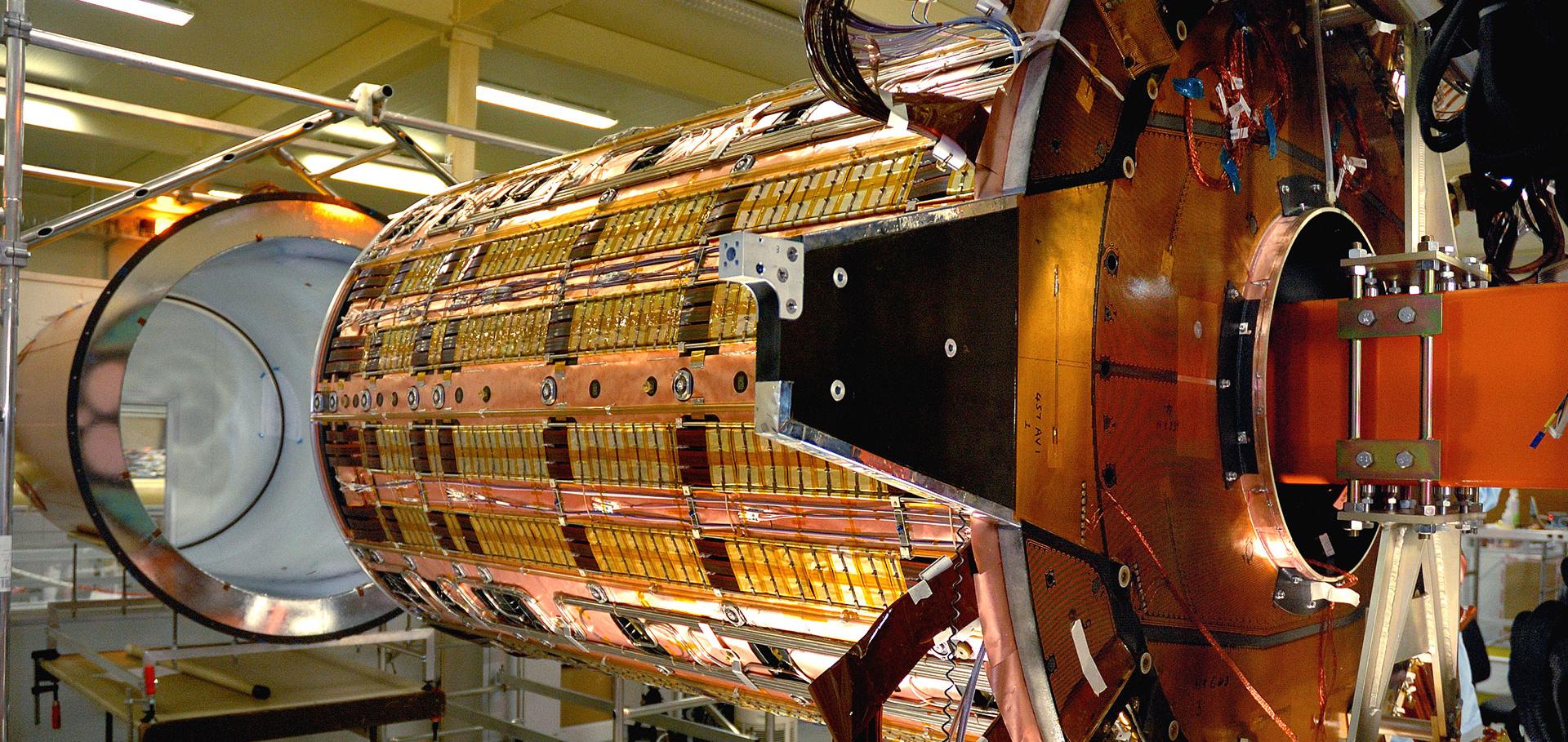
Insertion of STC into TRT at the Department of Physics, Oxford
Credit: CERN

Dr Elizabeth Gallas

Database Design Engineer

Research theme

  • Fundamental particles and interactions

Sub department

  • Particle Physics

Research groups

  • ATLAS
  • Accelerator Neutrinos
  • About
  • Metadata and Databases
  • Publications

Readiness of the ATLAS liquid argon calorimeter for LHC collisions

European Physical Journal C 70:3 (2010) 723-753

Authors:

The ATLAS Collaboration, G Aad, B Abbott, J Abdallah, AA Abdelalim, A Abdesselam, O Abdinov, B Abi, M Abolins, H Abramowicz, H Abreu, BS Acharya, DL Adams, TN Addy, J Adelman, C Adorisio, P Adragna, T Adye, S Aefsky, JA Aguilar-Saavedra, M Aharrouche, SP Ahlen, F Ahles, A Ahmad, H Ahmed, M Ahsan, G Aielli, T Akdogan, TPA Åkesson, G Akimoto, AV Akimov, A Aktas, MS Alam, MA Alam, J Albert, S Albrand, M Aleksa, IN Aleksandrov, F Alessandria, C Alexa, G Alexander, G Alexandre, T Alexopoulos, M Alhroob, M Aliev, G Alimonti, J Alison, M Aliyev, PP Allport, SE Allwood-Spiers, J Almond, A Aloisio, R Alon, A Alonso, MG Alviggi, K Amako, C Amelung, VV Ammosov, A Amorim, G Amorós, N Amram, C Anastopoulos, T Andeen, CF Anders, KJ Anderson, A Andreazza, V Andrei, XS Anduaga, A Angerami, F Anghinolfi, N Anjos, A Antonaki, M Antonelli, S Antonelli, B Antunovic, F Anulli, S Aoun, G Arabidze, I Aracena, Y Arai, ATH Arce, JP Archambault, S Arfaoui, JF Arguin, T Argyropoulos, E Arik, M Arik, AJ Armbruster, O Arnaez, C Arnault, A Artamonov, D Arutinov, M Asai, S Asai, R Asfandiyarov, S Ask, B Åsman, D Asner, L Asquith, K Assamagan

Abstract:

The ATLAS liquid argon calorimeter has been operating continuously since August 2006. At this time, only part of the calorimeter was readout, but since the beginning of 2008, all calorimeter cells have been connected to the ATLAS readout system in preparation for LHC collisions. This paper gives an overview of the liquid argon calorimeter performance measured in situ with random triggers, calibration data, cosmic muons, and LHC beam splash events. Results on the detector operation, timing performance, electronics noise, and gain stability are presented. High energy deposits from radiative cosmic muons and beam splash events allow to check the intrinsic constant term of the energy resolution. The uniformity of the electromagnetic barrel calorimeter response along η (averaged over Φ) is measured at the percent level using minimum ionizing cosmic muons. Finally, studies of electromagnetic showers from radiative muons have been used to cross-check the Monte Carlo simulation. The performance results obtained using the ATLAS readout, data acquisition, and reconstruction software indicate that the liquid argon calorimeter is well-prepared for collisions at the dawn of the LHC era. © 2010 CERN for the benefit of the ATLAS collaboration.
More details from the publisher
More details

The ATLAS Inner Detector commissioning and calibration

European Physical Journal C 70:3 (2010) 787-821

Authors:

G Aad, B Abbott, J Abdallah, AA Abdelalim, A Abdesselam, O Abdinov, B Abi, M Abolins, H Abramowicz, H Abreu, BS Acharya, DL Adams, TN Addy, J Adelman, C Adorisio, P Adragna, T Adye, S Aefsky, JA Aguilar-Saavedra, M Aharrouche, SP Ahlen, F Ahles, A Ahmad, M Ahsan, G Aielli, T Akdogan, TPA Åkesson, G Akimoto, AV Akimov, A Aktas, MS Alam, MA Alam, S Albrand, M Aleksa, IN Aleksandrov, C Alexa, G Alexander, G Alexandre, T Alexopoulos, M Alhroob, M Aliev, G Alimonti, J Alison, M Aliyev, PP Allport, SE Allwood-Spiers, J Almond, A Aloisio, R Alon, A Alonso, MG Alviggi, K Amako, C Amelung, A Amorim, G Amorós, N Amram, C Anastopoulos, T Andeen, CF Anders, KJ Anderson, A Andreazza, V Andrei, XS Anduaga, A Angerami, F Anghinolfi, N Anjos, A Annovi, A Antonaki, M Antonelli, S Antonelli, J Antos, B Antunovic, F Anulli, S Aoun, G Arabidze, I Aracena, Y Arai, ATH Arce, JP Archambault, S Arfaoui, JF Arguin, T Argyropoulos, M Arik, AJ Armbruster, O Arnaez, C Arnault, A Artamonov, D Arutinov, M Asai, S Asai, R Asfandiyarov, S Ask, B Åsman, D Asner, L Asquith, K Assamagan, A Astvatsatourov, G Atoian, B Auerbach, K Augsten

Abstract:

The ATLAS Inner Detector is a composite tracking system consisting of silicon pixels, silicon strips and straw tubes in a 2 T magnetic field. Its installation was completed in August 2008 and the detector took part in data-taking with single LHC beams and cosmic rays. The initial detector operation, hardware commissioning and in-situ calibrations are described. Tracking performance has been measured with 7. 6 million cosmic-ray events, collected using a tracking trigger and reconstructed with modular pattern-recognition and fitting software. The intrinsic hit efficiency and tracking trigger efficiencies are close to 100%. Lorentz angle measurements for both electrons and holes, specific energy-loss calibration and transition radiation turn-on measurements have been performed. Different alignment techniques have been used to reconstruct the detector geometry. After the initial alignment, a transverse impact parameter resolution of 22. 1±0. 9 μm and a relative momentum resolution σp/p=(4. 83±0. 16)×10-4 GeV-1×pT have been measured for high momentum tracks. © 2010 CERN for the benefit of the ATLAS collaboration.
More details from the publisher
More details

Search for new particles in two-jet final states in 7 TeV proton-proton collisions with the ATLAS detector at the LHC

Physical Review Letters 105:16 (2010)

Authors:

G Aad, B Abbott, J Abdallah, AA Abdelalim, A Abdesselam, O Abdinov, B Abi, M Abolins, H Abramowicz, H Abreu, E Acerbi, BS Acharya, M Ackers, DL Adams, TN Addy, J Adelman, M Aderholz, S Adomeit, C Adorisio, P Adragna, T Adye, S Aefsky, JA Aguilar-Saavedra, M Aharrouche, SP Ahlen, F Ahles, A Ahmad, H Ahmed, M Ahsan, G Aielli, T Akdogan, TPA Åkesson, G Akimoto, AV Akimov, A Aktas, MS Alam, MA Alam, S Albrand, M Aleksa, IN Aleksandrov, M Aleppo, F Alessandria, C Alexa, G Alexander, G Alexandre, T Alexopoulos, M Alhroob, M Aliev, G Alimonti, J Alison, M Aliyev, PP Allport, SE Allwood-Spiers, J Almond, A Aloisio, R Alon, A Alonso, J Alonso, MG Alviggi, K Amako, P Amaral, G Ambrosio, C Amelung, VV Ammosov, A Amorim, G Amorós, N Amram, C Anastopoulos, T Andeen, CF Anders, KJ Anderson, A Andreazza, V Andrei, ML Andrieux, XS Anduaga, A Angerami, F Anghinolfi, N Anjos, A Annovi, A Antonaki, M Antonelli, S Antonelli, J Antos, B Antunovic, F Anulli, S Aoun, G Arabidze, I Aracena, Y Arai, ATH Arce, JP Archambault, S Arfaoui, JF Arguin, T Argyropoulos, E Arik, M Arik, AJ Armbruster, KE Arms, SR Armstrong, O Arnaez

Abstract:

A search for new heavy particles manifested as resonances in two-jet final states is presented. The data were produced in 7 TeV proton-proton collisions by the LHC and correspond to an integrated luminosity of 315nb-1 collected by the ATLAS detector. No resonances were observed. Upper limits were set on the product of cross section and signal acceptance for excited-quark (q*) production as a function of q* mass. These exclude at the 95% C.L. the q* mass interval 0.30*1.26TeV, extending the reach of previous experiments. © 2010 CERN, for the ATLAS Collaboration.
More details from the publisher
More details
More details

Metadata aided run selection at ATLAS

Journal of Physics: Conference Series IOP Publishing 331 (2010) 1-6

Authors:

Ryan Buckingham, Elizabeth Gallas, JC-L Tseng, F Viegas, E Vinek

Abstract:

Management of the large volume of data collected by any large scale scientific experiment requires the collection of coherent metadata quantities, which can be used by reconstruction or analysis programs and/or user interfaces, to pinpoint collections of data needed for specific purposes. In the ATLAS experiment at the LHC, we have collected metadata from systems storing non-event-wise data (Conditions) into a relational database. The Conditions metadata (COMA) database tables not only contain conditions known at the time of event recording, but also allow for the addition of conditions data collected as a result of later analysis of the data (such as improved measurements of beam conditions or assessments of data quality). A new web based interface called "runBrowser" makes these Conditions Metadata available as a Run based selection service. runBrowser, based on PHP and JavaScript, uses jQuery to present selection criteria and report results. It not only facilitates data selection by conditions attributes, but also gives the user information at each stage about the relationship between the conditions chosen and the remaining conditions criteria available. When a set of COMA selections are complete, runBrowser produces a human readable report as well as an XML file in a standardized ATLAS format. This XML can be saved for later use or refinement in a future runBrowser session, shared with physics/detector groups, or used as input to ELSSI (event level Metadata browser) or other ATLAS run or event processing services.
More details from the publisher
Details from ORA

The ATLAS Simulation Infrastructure

European Physical Journal C 70:3 (2010) 823-874

Authors:

The ATLAS Collaboration, G Aad, B Abbott, J Abdallah, AA Abdelalim, A Abdesselam, O Abdinov, B Abi, M Abolins, H Abramowicz, H Abreu, BS Acharya, DL Adams, TN Addy, J Adelman, C Adorisio, P Adragna, T Adye, S Aefsky, JA Aguilar-Saavedra, M Aharrouche, SP Ahlen, F Ahles, A Ahmad, H Ahmed, M Ahsan, G Aielli, T Akdogan, TPA Åkesson, G Akimoto, AV Akimov, A Aktas, MS Alam, MA Alam, S Albrand, M Aleksa, IN Aleksandrov, C Alexa, G Alexander, G Alexandre, T Alexopoulos, M Alhroob, M Aliev, G Alimonti, J Alison, M Aliyev, PP Allport, SE Allwood-Spiers, J Almond, A Aloisio, R Alon, A Alonso, MG Alviggi, K Amako, C Amelung, A Amorim, G Amorós, N Amram, C Anastopoulos, T Andeen, CF Anders, KJ Anderson, A Andreazza, V Andrei, XS Anduaga, A Angerami, F Anghinolfi, N Anjos, A Annovi, A Antonaki, M Antonelli, S Antonelli, J Antos, B Antunovic, F Anulli, S Aoun, G Arabidze, I Aracena, Y Arai, ATH Arce, JP Archambault, S Arfaoui, JF Arguin, T Argyropoulos, M Arik, AJ Armbruster, O Arnaez, C Arnault, A Artamonov, D Arutinov, M Asai, S Asai, R Asfandiyarov, S Ask, B Åsman, D Asner, L Asquith, K Assamagan, A Astbury, A Astvatsatourov

Abstract:

The simulation software for the ATLAS Experiment at the Large Hadron Collider is being used for large-scale production of events on the LHC Computing Grid. This simulation requires many components, from the generators that simulate particle collisions, through packages simulating the response of the various detectors and triggers. All of these components come together under the ATLAS simulation infrastructure. In this paper, that infrastructure is discussed, including that supporting the detector description, interfacing the event generation, and combining the GEANT4 simulation of the response of the individual detectors. Also described are the tools allowing the software validation, performance testing, and the validation of the simulated output against known physics processes. © 2010 CERN for the benefit of the ATLAS collaboration.
More details from the publisher
More details

Pagination

  • First page First
  • Previous page Prev
  • …
  • Page 336
  • Page 337
  • Page 338
  • Page 339
  • Current page 340
  • Page 341
  • Page 342
  • Page 343
  • Page 344
  • …
  • Next page Next
  • Last page Last

Footer Menu

  • Contact us
  • Giving to the Dept of Physics
  • Work with us
  • Media

User account menu

  • Log in

Follow us

FIND US

Clarendon Laboratory,

Parks Road,

Oxford,

OX1 3PU

CONTACT US

Tel: +44(0)1865272200

University of Oxfrod logo Department Of Physics text logo
IOP Juno Champion logo Athena Swan Silver Award logo

© University of Oxford - Department of Physics

Cookies | Privacy policy | Accessibility statement

Built by: Versantus

  • Home
  • Research
  • Study
  • Engage
  • Our people
  • News & Comment
  • Events
  • Our facilities & services
  • About us
  • Giving to Physics
  • Current students
  • Staff intranet