Home
Department Of Physics text logo
  • Research
    • Our research
    • Our research groups
    • Our research in action
    • Research funding support
    • Summer internships for undergraduates
  • Study
    • Undergraduates
    • Postgraduates
  • Engage
    • For alumni
    • For business
    • For schools
    • For the public
  • Support
Menu
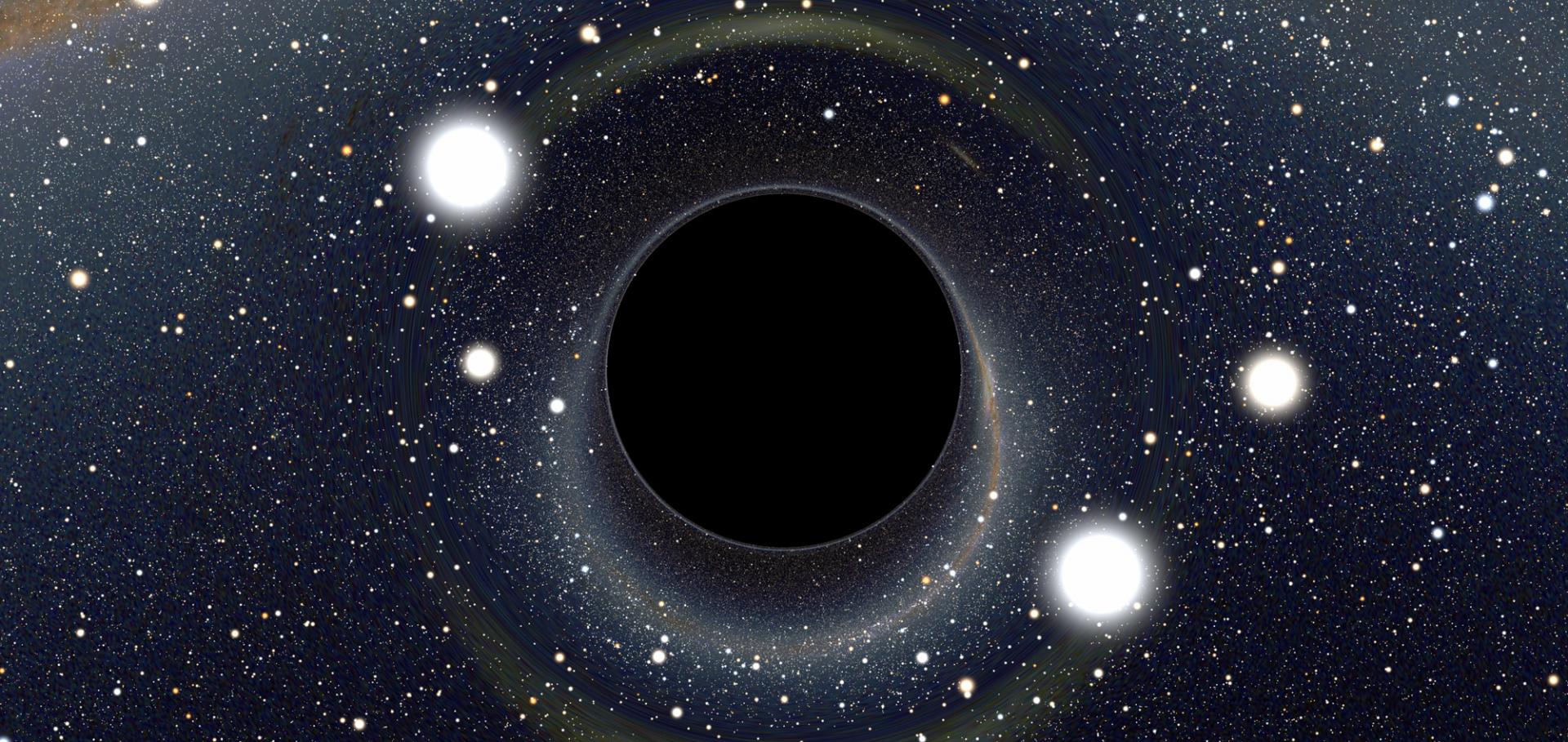
Black Hole

Lensing of space time around a black hole. At Oxford we study black holes observationally and theoretically on all size and time scales - it is some of our core work.

Credit: ALAIN RIAZUELO, IAP/UPMC/CNRS. CLICK HERE TO VIEW MORE IMAGES.

Lance Miller

Professor of Astrophysics

Research theme

  • Astronomy and astrophysics

Sub department

  • Astrophysics

Research groups

  • Beecroft Institute for Particle Astrophysics and Cosmology
  • Cosmology
  • Euclid
Lance.Miller@physics.ox.ac.uk
  • About
  • Publications

CFHTLenS: weak lensing calibrated scaling relations for low-mass clusters of galaxies

Monthly Notices of the Royal Astronomical Society Oxford University Press (OUP) 451:2 (2015) 1460-1481

Authors:

K Kettula, S Giodini, E van Uitert, H Hoekstra, A Finoguenov, M Lerchster, T Erben, C Heymans, H Hildebrandt, TD Kitching, A Mahdavi, Y Mellier, L Miller, M Mirkazemi, L Van Waerbeke, J Coupon, E Egami, L Fu, MJ Hudson, JP Kneib, K Kuijken, HJ McCracken, MJ Pereira, B Rowe, T Schrabback, M Tanaka, M Velander
More details from the publisher
More details
Details from ArXiV

Contamination of early-type galaxy alignments to galaxy lensing-CMB lensing cross-correlation

Monthly Notices of the Royal Astronomical Society 453:1 (2015) 682-689

Authors:

NE Chisari, J Dunkley, L Miller, R Allison

Abstract:

Galaxy shapes are subject to distortions due to the tidal field of the Universe. The crosscorrelation of galaxy lensing with the lensing of the cosmic microwave background (CMB) cannot easily be separated from the cross-correlation of galaxy intrinsic shapes with CMB lensing. Previous work suggested that the intrinsic alignment contamination can be 15 per cent of this cross-spectrum for the CFHT Stripe 82 (CS82) and Atacama Cosmology Telescope surveys. Here we re-examine these estimates using up-to-date observational constraints of intrinsic alignments at a redshift more similar to that of CS82 galaxies. We find an ≈ 10 per cent contamination of the cross-spectrum from red galaxies, with ≈ 3 per cent uncertainty due to uncertainties in the redshift distribution of source galaxies and the modelling of the spectral energy distribution. Blue galaxies are consistent with being unaligned, but could contaminate the cross-spectrum by an additional 9.5 per cent within current 95 per cent confidence levels. While our fiducial estimate of alignment contamination is similar to previous work, our work suggests that the relevance of alignments for CMB lensing-galaxy lensing cross-correlation remains largely unconstrained. Little information is currently available about alignments at z > 1.2. We consider the upper limiting case where all z > 1.2 galaxies are aligned with the same strength as low-redshift luminous red galaxies, finding as much as ≈ 60 per cent contamination.
More details from the publisher
Details from ArXiV

Euclid space mission: a cosmological challenge for the next 15 years

Proceedings of the International Astronomical Union Cambridge University Press 10:S306 (2015) 375-378

Authors:

Roberto Scaramella, Yannick Mellier, Jerome Amiaux, Carlo Burigana, C Sofia Carvalho, Jean-Charles Cuillandre, Antonio D Silva, Joao Dinis, Adriano Derosa, Elena Maiorano, Paolo Franzetti, Bianca Garilli, Michele Maris, Massimo Meneghetti, Ismael Tereno, Stefanie Wachter, Luca Amendola, Mark Cropper, Vincenzo Cardone, Robert Massey, Sami Niemi, Henk Hoekstra, Thomas Kitching, Lance Miller, Timothy Schrabback, Elisabetta Semboloni, Andrew Taylor, Massimo Viola, Thierry Maciaszek, Anne Ealet, Luigi Guzzo, Knud Jahnke, Will Percival, Fabio Pasian, Marc Sauvage

Abstract:

Euclid is the next ESA mission devoted to cosmology. It aims at observing most of the extragalactic sky, studying both gravitational lensing and clustering over $\sim$15,000 square degrees. The mission is expected to be launched in year 2020 and to last six years. The sheer amount of data of different kinds, the variety of (un)known systematic effects and the complexity of measures require efforts both in sophisticated simulations and techniques of data analysis. We review the mission main characteristics, some aspects of the the survey and highlight some of the areas of interest to this meeting
More details from the publisher
Details from ORA
Details from ArXiV

GREAT3 results – I. Systematic errors in shear estimation and the impact of real galaxy morphology

Monthly Notices of the Royal Astronomical Society Oxford University Press (OUP) 450:3 (2015) 2963-3007

Authors:

Rachel Mandelbaum, Barnaby Rowe, Robert Armstrong, Deborah Bard, Emmanuel Bertin, James Bosch, Dominique Boutigny, Frederic Courbin, William A Dawson, Annamaria Donnarumma, Ian Fenech Conti, Raphaël Gavazzi, Marc Gentile, Mandeep SS Gill, David W Hogg, Eric M Huff, M James Jee, Tomasz Kacprzak, Martin Kilbinger, Thibault Kuntzer, Dustin Lang, Wentao Luo, Marisa C March, Philip J Marshall, Joshua E Meyers, Lance Miller, Hironao Miyatake, Reiko Nakajima, Fred Maurice Ngolé Mboula, Guldariya Nurbaeva, Yuki Okura, Stéphane Paulin-Henriksson, Jason Rhodes, Michael D Schneider, Huanyuan Shan, Erin S Sheldon, Melanie Simet, Jean-Luc Starck, Florent Sureau, Malte Tewes, Kristian Zarb Adami, Jun Zhang, Joe Zuntz
More details from the publisher
More details
Details from ArXiV

PROPERTIES OF WEAK LENSING CLUSTERS DETECTED ON HYPER SUPRIME-CAM's 2.3 deg2FIELD

The Astrophysical Journal American Astronomical Society 807:1 (2015) 22-22

Authors:

Satoshi Miyazaki, Masamune Oguri, Takashi Hamana, Masayuki Tanaka, Lance Miller, Yousuke Utsumi, Yutaka Komiyama, Hisanori Furusawa, Junya Sakurai, Satoshi Kawanomoto, Fumiaki Nakata, Fumihiro Uraguchi, Michitaro Koike, Daigo Tomono, Robert Lupton, James E Gunn, Hiroshi Karoji, Hiroaki Aihara, Hitoshi Murayama, Masahiro Takada
More details from the publisher
Details from ORA
More details
Details from ArXiV

Pagination

  • First page First
  • Previous page Prev
  • …
  • Page 13
  • Page 14
  • Page 15
  • Page 16
  • Current page 17
  • Page 18
  • Page 19
  • Page 20
  • Page 21
  • …
  • Next page Next
  • Last page Last

Footer Menu

  • Contact us
  • Giving to the Dept of Physics
  • Work with us
  • Media

User account menu

  • Log in

Follow us

FIND US

Clarendon Laboratory,

Parks Road,

Oxford,

OX1 3PU

CONTACT US

Tel: +44(0)1865272200

University of Oxfrod logo Department Of Physics text logo
IOP Juno Champion logo Athena Swan Silver Award logo

© University of Oxford - Department of Physics

Cookies | Privacy policy | Accessibility statement

Built by: Versantus

  • Home
  • Research
  • Study
  • Engage
  • Our people
  • News & Comment
  • Events
  • Our facilities & services
  • About us
  • Giving to Physics
  • Current students
  • Staff intranet