Home
Department Of Physics text logo
  • Research
    • Our research
    • Our research groups
    • Our research in action
    • Research funding support
    • Summer internships for undergraduates
  • Study
    • Undergraduates
    • Postgraduates
  • Engage
    • For young people
    • For teachers
    • For the public
    • For alumni
    • For business
  • Support
Menu
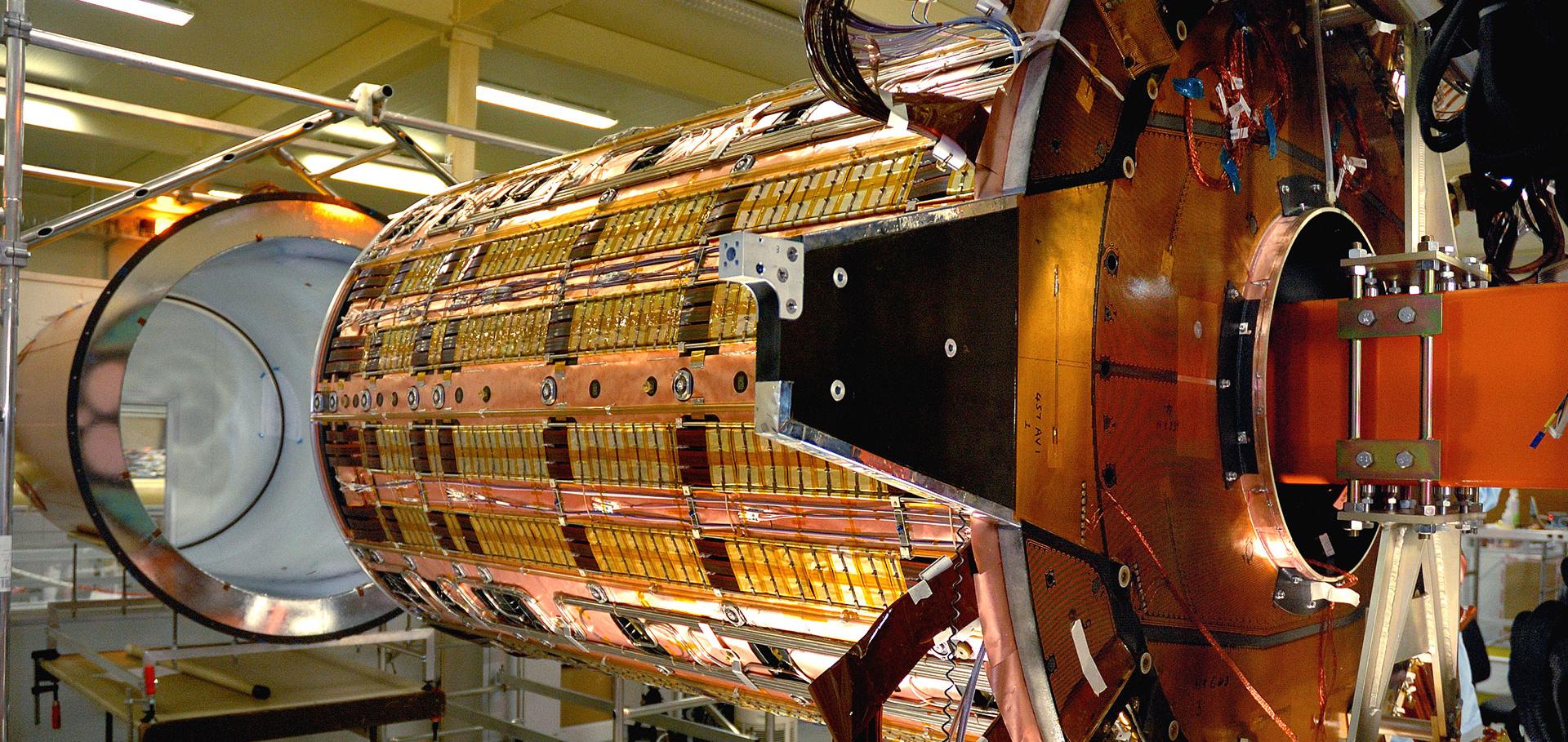
Insertion of STC into TRT at the Department of Physics, Oxford
Credit: CERN

Malcolm John

Professor of Physics

Research theme

  • Fundamental particles and interactions

Sub department

  • Particle Physics

Research groups

  • LHCb
malcolm.john@physics.ox.ac.uk
Telephone: 01865 (2)73401
Denys Wilkinson Building, room 670
  • About
  • Publications

Observation of Υ(4S) Decays to π+π-Υ(1S) and π+π-Υ(2S)

Physical Review Letters 96:23 (2006)

Authors:

B Aubert, R Barate, M Bona, D Boutigny, F Couderc, Y Karyotakis, JP Lees, V Poireau, V Tisserand, A Zghiche, E Grauges, A Palano, JC Chen, ND Qi, G Rong, P Wang, YS Zhu, G Eigen, I Ofte, B Stugu, GS Abrams, M Battaglia, DN Brown, J Button-Shafer, RN Cahn, E Charles, MS Gill, Y Groysman, RG Jacobsen, JA Kadyk, LT Kerth, YG Kolomensky, G Kukartsev, G Lynch, LM Mir, PJ Oddone, TJ Orimoto, M Pripstein, NA Roe, MT Ronan, WA Wenzel, M Barrett, KE Ford, TJ Harrison, AJ Hart, CM Hawkes, SE Morgan, AT Watson, K Goetzen, T Held, H Koch, B Lewandowski, M Pelizaeus, K Peters, T Schroeder, M Steinke, JT Boyd, JP Burke, WN Cottingham, D Walker, T Cuhadar-Donszelmann, BG Fulsom, C Hearty, NS Knecht, TS Mattison, JA McKenna, A Khan, P Kyberd, M Saleem, L Teodorescu, VE Blinov, AD Bukin, VP Druzhinin, VB Golubev, AP Onuchin, SI Serednyakov, YI Skovpen, EP Solodov, KY Todyshev, DS Best, M Bondioli, M Bruinsma, M Chao, S Curry, I Eschrich, D Kirkby, AJ Lankford, P Lund, M Mandelkern, RK Mommsen, W Roethel, DP Stoker, S Abachi, C Buchanan, SD Foulkes, JW Gary, O Long, BC Shen, K Wang, L Zhang

Abstract:

We present the first measurement of Υ(4S) decays to π+π-Υ(1S) and π+π-Υ(2S) based on a sample of 230×106Υ(4S) mesons collected with the BABAR detector. We measure the product branching fractions B(Υ(4S)→π+π-Υ(1S)) ×B(Υ(1S)→μ+μ-)=(2.23±0.25stat±0.27syst) ×10-6 and B(Υ(4S)→π+π-Υ(2S))×B(Υ(2S) →μ+μ-)=(1.69±0.26stat±0.20syst)×10-6, from which we derive the partial widths Γ(Υ(4S)→π+π-Υ(1S))=(1. 8±0.4)keV and Γ(Υ(4S)→π+π-Υ(2S))=(2. 7±0.8)keV. © 2006 The American Physical Society.
More details from the publisher

Search for B+→ π+ and B0→ π0 decays

Physical Review D Particles Fields Gravitation and Cosmology 74:1 (2006)

Authors:

B Aubert, R Barate, M Bona, D Boutigny, F Couderc, Y Karyotakis, JP Lees, V Poireau, V Tisserand, A Zghiche, E Grauges, A Palano, M Pappagallo, JC Chen, ND Qi, G Rong, P Wang, YS Zhu, G Eigen, I Ofte, B Stugu, GS Abrams, M Battaglia, DN Brown, J Button-Shafer, RN Cahn, E Charles, CT Day, MS Gill, Y Groysman, RG Jacobsen, JA Kadyk, LT Kerth, YG Kolomensky, G Kukartsev, G Lynch, LM Mir, PJ Oddone, TJ Orimoto, M Pripstein, NA Roe, MT Ronan, WA Wenzel, M Barrett, KE Ford, TJ Harrison, AJ Hart, CM Hawkes, SE Morgan, AT Watson, K Goetzen, T Held, H Koch, B Lewandowski, M Pelizaeus, K Peters, T Schroeder, M Steinke, JT Boyd, JP Burke, WN Cottingham, D Walker, T Cuhadar-Donszelmann, BG Fulsom, C Hearty, NS Knecht, TS Mattison, JA McKenna, A Khan, P Kyberd, M Saleem, L Teodorescu, VE Blinov, AD Bukin, VP Druzhinin, VB Golubev, AP Onuchin, SI Serednyakov, YI Skovpen, EP Solodov, KY Todyshev, DS Best, M Bondioli, M Bruinsma, M Chao, S Curry, I Eschrich, D Kirkby, AJ Lankford, P Lund, M Mandelkern, RK Mommsen, W Roethel, DP Stoker, S Abachi, C Buchanan, SD Foulkes, JW Gary, O Long, BC Shen

Abstract:

A search has been made for the decays B+→ π+ and B0→ π0 in a data sample of approximately 232×106 BB̄ pairs recorded at the Υ(4S) resonance with the BABAR detector at the PEP-II B-meson Factory at SLAC. No significant signals have been observed, and therefore upper limits have been set on the branching fractions: B(B+→ π+)<2.4×10⁻⁷ and B(B0→ π0)<2.8×10⁻⁷ at 90% probability. © 2006 The American Physical Society.
More details from the publisher

Search for B+→X(3872)K+, X(3872)→J/ψγ

Physical Review D Particles Fields Gravitation and Cosmology 74:7 (2006)

Authors:

B Aubert, R Barate, M Bona, D Boutigny, F Couderc, Y Karyotakis, JP Lees, V Poireau, V Tisserand, A Zghiche, E Grauges, A Palano, JC Chen, ND Qi, G Rong, P Wang, YS Zhu, G Eigen, I Ofte, B Stugu, GS Abrams, M Battaglia, DN Brown, J Button-Shafer, RN Cahn, E Charles, MS Gill, Y Groysman, RG Jacobsen, JA Kadyk, LT Kerth, YG Kolomensky, G Kukartsev, G Lynch, LM Mir, TJ Orimoto, M Pripstein, NA Roe, MT Ronan, WA Wenzel, P Del Amo Sanchez, M Barrett, KE Ford, TJ Harrison, AJ Hart, CM Hawkes, SE Morgan, AT Watson, T Held, H Koch, B Lewandowski, M Pelizaeus, K Peters, T Schroeder, M Steinke, JT Boyd, JP Burke, WN Cottingham, D Walker, T Cuhadar-Donszelmann, BG Fulsom, C Hearty, NS Knecht, TS Mattison, JA McKenna, A Khan, P Kyberd, M Saleem, DJ Sherwood, L Teodorescu, VE Blinov, AD Bukin, VP Druzhinin, VB Golubev, AP Onuchin, SI Serednyakov, YI Skovpen, EP Solodov, KY Todyshev, DS Best, M Bondioli, M Bruinsma, M Chao, S Curry, I Eschrich, D Kirkby, AJ Lankford, P Lund, M Mandelkern, RK Mommsen, W Roethel, DP Stoker, S Abachi, C Buchanan, SD Foulkes, JW Gary, O Long, BC Shen, K Wang, L Zhang

Abstract:

In a study of B+→J/ψγK+ decays, we find evidence for the radiative decay X(3872)→J/ψγ with a statistical significance of 3.4σ. We measure the product of branching fractions B(B+→X(3872)K+) •B(X(3872)→J/ψγ)=(3.3±1.0±0.3)×10-6, where the uncertainties are statistical and systematic, respectively. We also measure the branching fraction B(B+→χc1K+)=(4.9±0.2±0.4) ×10-4. These results are obtained from (287±3) million BB̄ decays collected at the Υ(4S) resonance with the BABAR detector at the PEP-II B Factory at SLAC. © 2006 The American Physical Society.
More details from the publisher

Search for the decay of a B0 or B̄0 meson to K̄*0K0 or K*0K̄0

Physical Review D Particles Fields Gravitation and Cosmology 74:7 (2006)

Authors:

B Aubert, R Barate, M Bona, D Boutigny, F Couderc, Y Karyotakis, JP Lees, V Poireau, V Tisserand, A Zghiche, E Grauges, A Palano, JC Chen, ND Qi, G Rong, P Wang, YS Zhu, G Eigen, I Ofte, B Stugu, GS Abrams, M Battaglia, DN Brown, J Button-Shafer, RN Cahn, E Charles, MS Gill, Y Groysman, RG Jacobsen, JA Kadyk, LT Kerth, YG Kolomensky, G Kukartsev, G Lynch, LM Mir, PJ Oddone, TJ Orimoto, M Pripstein, NA Roe, MT Ronan, WA Wenzel, P Del Amo Sanchez, M Barrett, KE Ford, TJ Harrison, AJ Hart, CM Hawkes, SE Morgan, AT Watson, K Goetzen, T Held, H Koch, B Lewandowski, M Pelizaeus, K Peters, T Schroeder, M Steinke, JT Boyd, JP Burke, WN Cottingham, D Walker, T Cuhadar-Donszelmann, BG Fulsom, C Hearty, NS Knecht, TS Mattison, JA McKenna, A Khan, P Kyberd, M Saleem, DJ Sherwood, L Teodorescu, VE Blinov, AD Bukin, VP Druzhinin, VB Golubev, AP Onuchin, SI Serednyakov, YI Skovpen, EP Solodov, KY Todyshev, DS Best, M Bondioli, M Bruinsma, M Chao, S Curry, I Eschrich, D Kirkby, AJ Lankford, P Lund, M Mandelkern, RK Mommsen, W Roethel, DP Stoker, S Abachi, C Buchanan, SD Foulkes, JW Gary, O Long, BC Shen

Abstract:

We present a search for the decay of a B0 or B̄0 meson to a K̄*0K0 or K*0K̄0 final state, using a sample of approximately 232×106 BB̄ events collected with the BABAR detector at the PEP-II asymmetric energy e+e- collider at SLAC. The measured branching fraction is B(B0→K̄*0K0)+B(B0→K*0K̄0)=(0.2-0.8- 0.3+0.9+0.1)×10-6. We obtain the following upper limit for the branching fraction at 90% confidence level: B(B0→K̄*0K0) +B(B0→K*0K̄0)<1.9×10⁻⁶. We use our result to constrain the standard model prediction for the deviation of the CP asymmetry in B0→K0 from sin2β. © 2006 The American Physical Society.
More details from the publisher

Search for the decay B0→KS0KS0KL0

Physical Review D Particles Fields Gravitation and Cosmology 74:3 (2006)

Authors:

B Aubert, R Barate, M Bona, D Boutigny, F Couderc, Y Karyotakis, JP Lees, V Poireau, V Tisserand, A Zghiche, E Grauges, A Palano, JC Chen, ND Qi, G Rong, P Wang, YS Zhu, G Eigen, I Ofte, B Stugu, GS Abrams, M Battaglia, DN Brown, J Button-Shafer, RN Cahn, E Charles, MS Gill, Y Groysman, RG Jacobsen, JA Kadyk, LT Kerth, YG Kolomensky, G Kukartsev, G Lynch, LM Mir, PJ Oddone, TJ Orimoto, M Pripstein, NA Roe, MT Ronan, WA Wenzel, P Del Amo Sanchez, M Barrett, KE Ford, TJ Harrison, AJ Hart, CM Hawkes, SE Morgan, AT Watson, K Goetzen, T Held, H Koch, B Lewandowski, M Pelizaeus, K Peters, T Schroeder, M Steinke, JT Boyd, JP Burke, WN Cottingham, D Walker, T Cuhadar-Donszelmann, BG Fulsom, C Hearty, NS Knecht, TS Mattison, JA McKenna, A Khan, P Kyberd, M Saleem, L Teodorescu, VE Blinov, AD Bukin, VP Druzhinin, VB Golubev, AP Onuchin, SI Serednyakov, YI Skovpen, EP Solodov, KY Todyshev, DS Best, M Bondioli, M Bruinsma, M Chao, S Curry, I Eschrich, D Kirkby, AJ Lankford, P Lund, M Mandelkern, RK Mommsen, W Roethel, DP Stoker, S Abachi, C Buchanan, SD Foulkes, JW Gary, O Long, BC Shen, K Wang

Abstract:

We present the first search for the decay B0→KS0KS0KL0 using a data sample of 232×106 BB̄ pairs. We find no statistically significant evidence for the nonresonant component of this decay. Our central value for the branching fraction, assuming the true Dalitz distribution is uniform and excluding the resonance, is B(B0→KS0KS0KL0)=(2.4-2.5+2.7±0.6) ×10-6 where the errors are statistical and systematic, respectively. We set a single-sided Bayesian upper limit of B(B0→KS0KS0KL0)<7.4×10- 6 at 90% confidence level using a uniform prior probability for physical values. Assuming the worst-case true Dalitz distribution, where the signal is entirely in the region of lowest efficiency, the 90% confidence level upper limit is B(B0→KS0KS0KL0)<16×10-6. © 2006 The American Physical Society.
More details from the publisher

Pagination

  • First page First
  • Previous page Prev
  • …
  • Page 262
  • Page 263
  • Page 264
  • Page 265
  • Current page 266
  • Page 267
  • Page 268
  • Page 269
  • Page 270
  • …
  • Next page Next
  • Last page Last

Footer Menu

  • Contact us
  • Giving to the Dept of Physics
  • Work with us
  • Media

User account menu

  • Log in

Follow us

FIND US

Clarendon Laboratory,

Parks Road,

Oxford,

OX1 3PU

CONTACT US

Tel: +44(0)1865272200

University of Oxfrod logo Department Of Physics text logo
IOP Juno Champion logo Athena Swan Silver Award logo

© University of Oxford - Department of Physics

Cookies | Privacy policy | Accessibility statement

Built by: Versantus

  • Home
  • Research
  • Study
  • Engage
  • Our people
  • News & Comment
  • Events
  • Our facilities & services
  • About us
  • Giving to Physics
  • Current students
  • Staff intranet