

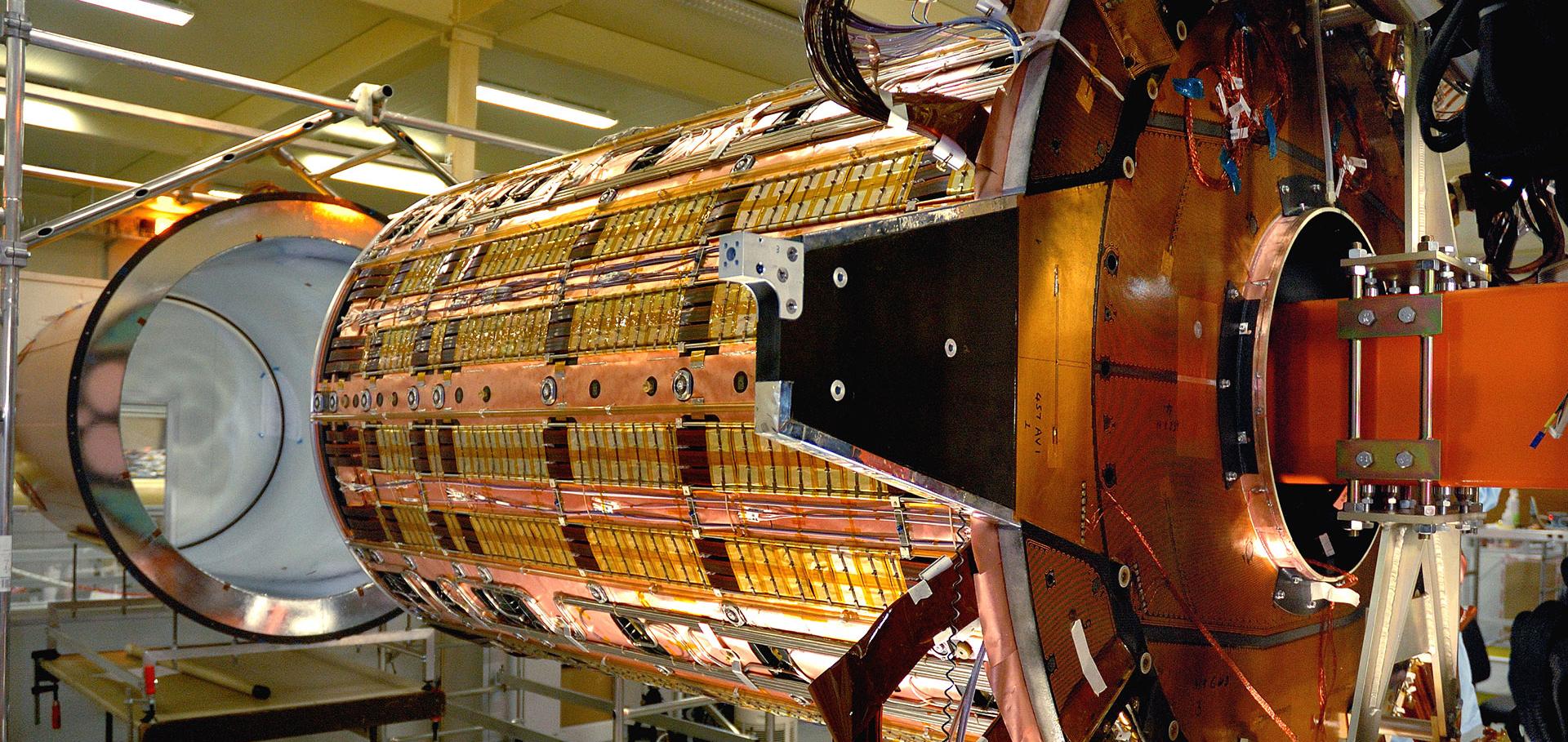

Search for a Higgs boson in the diphoton final state using the full CDF data set from pp collisions at s=1.96TeV
Physics Letters, Section B: Nuclear, Elementary Particle and High-Energy Physics 717:1-3 (2012) 173-181
Abstract:
A search for a narrow Higgs boson resonance in the diphoton mass spectrum is presented based on data corresponding to 10fb -1 of integrated luminosity collected by the CDF experiment from proton-antiproton collisions at s=1.96TeV. To increase the sensitivity of the search, we employ a multivariate discriminant technique for the first time in this channel at CDF. No evidence of signal is observed, and upper limits are set on the cross section times branching ratio of the resonant state as a function of the Higgs boson mass. The limits are interpreted in the context of the standard model with an expected (observed) limit on the cross section times branching ratio of 9.9 (17.0) times the standard model prediction at the 95% credibility level for a Higgs boson mass of 125GeV/c 2. Moreover, a Higgs boson with suppressed couplings to fermions is excluded for masses below 114GeV/c 2 at the 95% credibility level. © 2012 Elsevier B.V.Transverse momentum cross section of e +e - pairs in the Z-boson region from pp̄ collisions at √s=1.96TeV
Physical Review D - Particles, Fields, Gravitation and Cosmology 86:5 (2012)
Abstract:
The transverse momentum cross section of e +e - pairs in the Z-boson mass region of 66-116GeV/c2 is precisely measured using Run II data corresponding to 2.1fb -1 of integrated luminosity recorded by the Collider Detector at Fermilab. The cross section is compared with two quantum chromodynamic calculations. One is a fixed-order perturbative calculation at O(αs2), and the other combines perturbative predictions at high transverse momentum with the gluon resummation formalism at low transverse momentum. Comparisons of the measurement with calculations show reasonable agreement. The measurement is of sufficient precision to allow refinements in the understanding of the transverse momentum distribution. © 2012 American Physical Society.Measurement of the difference in CP-violating asymmetries in D0→K +K- and D0→π+π- decays at CDF
Physical Review Letters 109:11 (2012)
Abstract:
We report a measurement of the difference (ΔACP) between time-integrated CP-violating asymmetries in D0→K+K- and D0→π+π- decays reconstructed in the full data set of proton-antiproton collisions collected by the Collider Detector at Fermilab, corresponding to 9.7fb-1 of integrated luminosity. The strong decay D*+→D0π+ is used to identify the charm meson at production as D0 or D̄0. We measure ΔACP=[-0.62±0.21(stat)±0.10(syst)]%, which differs from zero by 2.7 Gaussian standard deviations. This result supports similar evidence for CP violation in charm-quark decays obtained in proton-proton collisions. © 2012 American Physical Society.Search for the Standard Model Higgs Boson Decaying to a bb̄ Pair in Events with One Charged Lepton and Large Missing Transverse Energy Using the Full CDF Data Set
Physical Review Letters 109:11 (2012)
Abstract:
We present a search for the standard model Higgs boson produced in association with a W boson in √s=1.96TeV pp̄ collision data collected with the CDFA II detector at the Tevatron corresponding to an integrated luminosity of 9.45fb-1. In events consistent with the decay of the Higgs boson to a bottom-quark pair and the W boson to an electron or muon and a neutrino, we set 95% credibility level upper limits on the WH production cross section times the H→bb̄ branching ratio as a function of Higgs boson mass. At a Higgs boson mass of 125GeV/c2, we observe (expect) a limit of 4.9 (2.8) times the standard model value. © 2012 American Physical Society.Search for the standard model higgs boson decaying to a bb̄ pair in events with two oppositely charged leptons using the full CDF data set
Physical Review Letters 109:11 (2012)