Home
Department Of Physics text logo
  • Research
    • Our research
    • Our research groups
    • Our research in action
    • Research funding support
    • Summer internships for undergraduates
  • Study
    • Undergraduates
    • Postgraduates
  • Engage
    • For young people
    • For teachers
    • For the public
    • For alumni
    • For business
  • Support
Menu
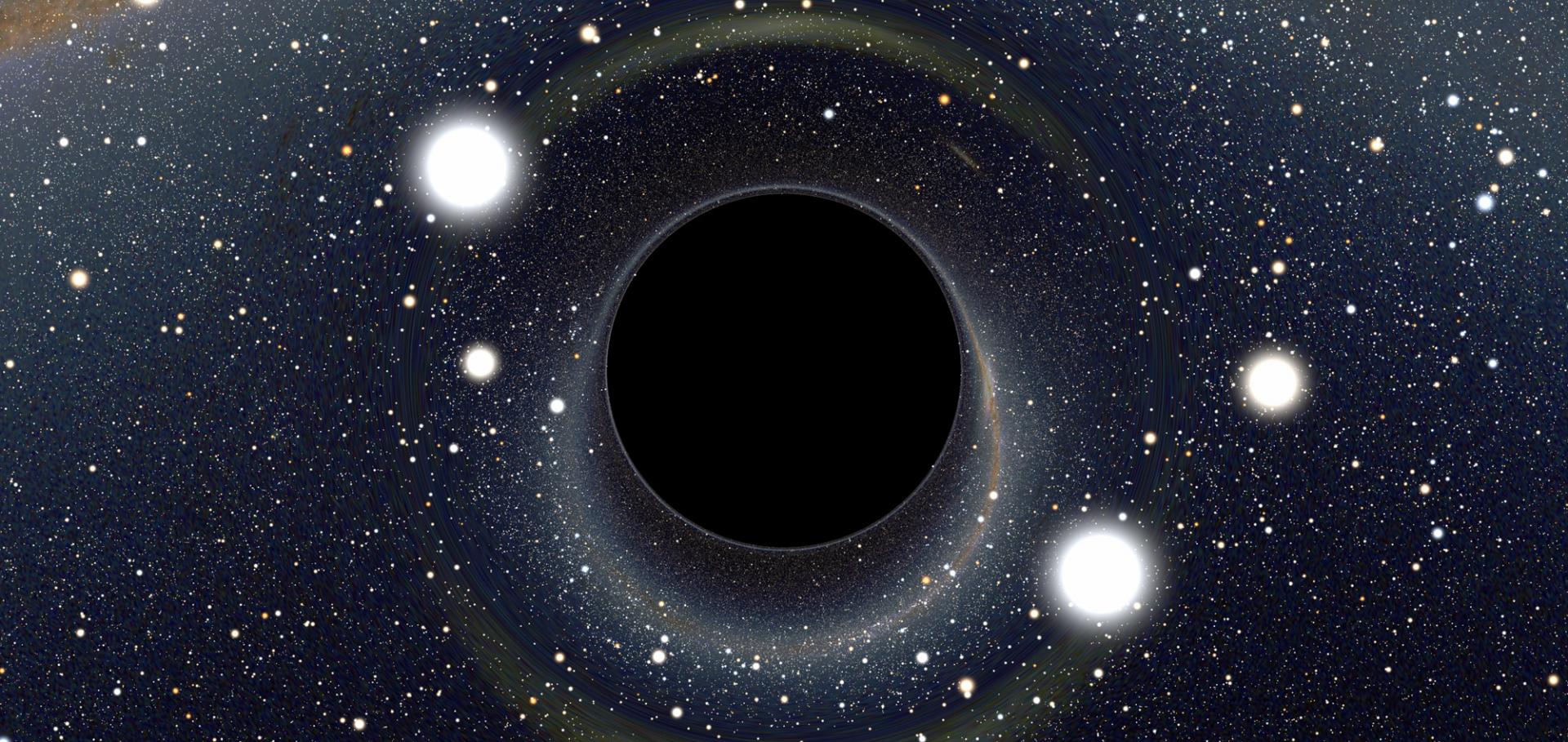
Black Hole

Lensing of space time around a black hole. At Oxford we study black holes observationally and theoretically on all size and time scales - it is some of our core work.

Credit: ALAIN RIAZUELO, IAP/UPMC/CNRS. CLICK HERE TO VIEW MORE IMAGES.

Professor Stephen Smartt CBE FRS MRIA

Professor of Astrophysics

Research theme

  • Astronomy and astrophysics

Sub department

  • Astrophysics

Research groups

  • Hintze Centre for Astrophysical Surveys
  • Pulsars, transients and relativistic astrophysics
  • Rubin-LSST
stephen.smartt@physics.ox.ac.uk
Telephone: 01865273405
Denys Wilkinson Building, room 714
  • About
  • Publications

Modelling the spectra of the kilonova AT2017gfo – I. The photospheric epochs

Monthly Notices of the Royal Astronomical Society Oxford University Press (OUP) 515:1 (2022) 631-651

Authors:

JH Gillanders, SJ Smartt, SA Sim, A Bauswein, S Goriely

Abstract:

ABSTRACT The kilonova (KN) associated with the binary neutron star (BNS) merger GW170817 is the only known electromagnetic counterpart to a gravitational wave source. Here we produce a sequence of radiative transfer models (using tardis) with updated atomic data, and compare them to accurately calibrated spectra. We use element compositions from nuclear network calculations based on a realistic hydrodynamical simulation of a BNS merger. We show that the blue spectrum at +1.4 d after merger requires a nucleosynthetic trajectory with a high electron fraction. Our best-fitting model is composed entirely of first r-process peak elements (Sr and Zr) and the strong absorption feature is reproduced well by Sr ii absorption. At this epoch, we set an upper limit on the lanthanide mass fraction of $X_{{\small LN}} \lesssim 5 \times 10^{-3}$. In contrast, all subsequent spectra from +2.4 to 6.4 d require the presence of a modest amount of lanthanide material ($X_{{\small LN}} \simeq 0.05^{+0.05}_{-0.02}$), produced by a trajectory with Ye = 0.29. This produces lanthanide-induced line blanketing below 6000 Å, and sufficient light r-process elements to explain the persistent strong feature at ∼0.7–1.0 $\mu$m (Sr ii). The composition gives good matches to the observed data, indicating that the strong blue flux deficit results in the near-infrared (NIR) excess. The disjoint in composition between the first epoch and all others indicates either ejecta stratification, or the presence of two distinct components of material. This further supports the ‘two-component’ KN model, and constrains the element composition from nucleosynthetic trajectories. The major uncertainties lie in availability of atomic data and the ionization state of the expanding material.
More details from the publisher
More details

SN 2020kyg and the rates of faint Iax supernovae from ATLAS

Monthly Notices of the Royal Astronomical Society Oxford University Press (OUP) 511:2 (2022) 2708-2731

Authors:

Shubham Srivastav, SJ Smartt, ME Huber, KC Chambers, CR Angus, T-W Chen, FP Callan, JH Gillanders, OR McBrien, SA Sim, M Fulton, J Hjorth, KW Smith, DR Young, K Auchettl, JP Anderson, G Pignata, TJL de Boer, C-C Lin, EA Magnier
More details from the publisher
More details

Modelling the spectra of the kilonova AT2017gfo -- I: The photospheric epochs

(2022)

Authors:

JH Gillanders, SJ Smartt, SA Sim, A Bauswein, S Goriely
More details from the publisher
Details from ArXiV

Optimization of the Observing Cadence for the Rubin Observatory Legacy Survey of Space and Time: A Pioneering Process of Community-focused Experimental Design

ASTROPHYSICAL JOURNAL SUPPLEMENT SERIES 258:1 (2022) ARTN 1

Authors:

Federica B Bianco, Zeljko Ivezic, R Lynne Jones, Melissa L Graham, Phil Marshall, Abhijit Saha, Michael A Strauss, Peter Yoachim, Tiago Ribeiro, Timo Anguita, AE Bauer, Franz E Bauer, Eric C Bellm, Robert D Blum, William N Brandt, Sarah Brough, Marcio Catelan, William I Clarkson, Andrew J Connolly, Eric Gawiser, John E Gizis, Renee Hlozek, Sugata Kaviraj, Charles T Liu, Michelle Lochner, Ashish A Mahabal, Rachel Mandelbaum, Peregrine McGehee, Eric H Jr Jr Neilsen, Knut AG Olsen, Hiranya V Peiris, Jason Rhodes, Gordon T Richards, Stephen Ridgway, Megan E Schwamb, Dan Scolnic, Ohad Shemmer, Colin T Slater, Anze Slosar, Stephen J Smartt, Jay Strader, Rachel Street, David E Trilling, Aprajita Verma, AK Vivas, Risa H Wechsler, Beth Willman
More details from the publisher
More details

SN 2018agk: A Prototypical Type Ia Supernova with a Smooth Power-law Rise in Kepler (K2)

The Astrophysical Journal American Astronomical Society 923:2 (2021) 167

Authors:

Qinan Wang, Armin Rest, Yossef Zenati, Ryan Ridden-Harper, Georgios Dimitriadis, Gautham Narayan, V Ashley Villar, Mark R Magee, Ryan J Foley, Edward J Shaya, Peter Garnavich, Lifan Wang, Lei Hu, Attila Bódi, Patrick Armstrong, Katie Auchettl, Thomas Barclay, Geert Barentsen, Zsófia Bognár, Joseph Brimacombe, Joanna Bulger, Jamison Burke, Peter Challis, Kenneth Chambers, David A Coulter, Géza Csörnyei, Borbála Cseh, Maxime Deckers, Jessie L Dotson, Lluís Galbany, Santiago González-Gaitán, Mariusz Gromadzki, Michael Gully-Santiago, Ottó Hanyecz, Christina Hedges, Daichi Hiramatsu, Griffin Hosseinzadeh, D Andrew Howell, Steve B Howell, Mark E Huber, Saurabh W Jha, David O Jones, Réka Könyves-Tóth, Csilla Kalup, Charles D Kilpatrick, Levente Kriskovics, Wenxiong Li, Thomas B Lowe, Steven Margheim, Curtis McCully, Ayan Mitra, Jose A Muñoz, Matt Nicholl, Jakob Nordin, András Pál, Yen-Chen Pan, Anthony L Piro, Sofia Rest, João Rino-Silvestre, César Rojas-Bravo, Krisztián Sárneczky, Matthew R Siebert, Stephen J Smartt, Ken Smith, Ádám Sódor, Maximilian D Stritzinger, Róbert Szabó, Róbert Szakáts, Brad E Tucker, József Vinkó, Xiaofeng Wang, J Craig Wheeler, David R Young, Alfredo Zenteno, KaiCheng Zhang, Gabriella Zsidi
More details from the publisher
More details

Pagination

  • First page First
  • Previous page Prev
  • …
  • Page 30
  • Page 31
  • Page 32
  • Page 33
  • Current page 34
  • Page 35
  • Page 36
  • Page 37
  • Page 38
  • …
  • Next page Next
  • Last page Last

Footer Menu

  • Contact us
  • Giving to the Dept of Physics
  • Work with us
  • Media

User account menu

  • Log in

Follow us

FIND US

Clarendon Laboratory,

Parks Road,

Oxford,

OX1 3PU

CONTACT US

Tel: +44(0)1865272200

University of Oxfrod logo Department Of Physics text logo
IOP Juno Champion logo Athena Swan Silver Award logo

© University of Oxford - Department of Physics

Cookies | Privacy policy | Accessibility statement

Built by: Versantus

  • Home
  • Research
  • Study
  • Engage
  • Our people
  • News & Comment
  • Events
  • Our facilities & services
  • About us
  • Giving to Physics
  • Current students
  • Staff intranet