

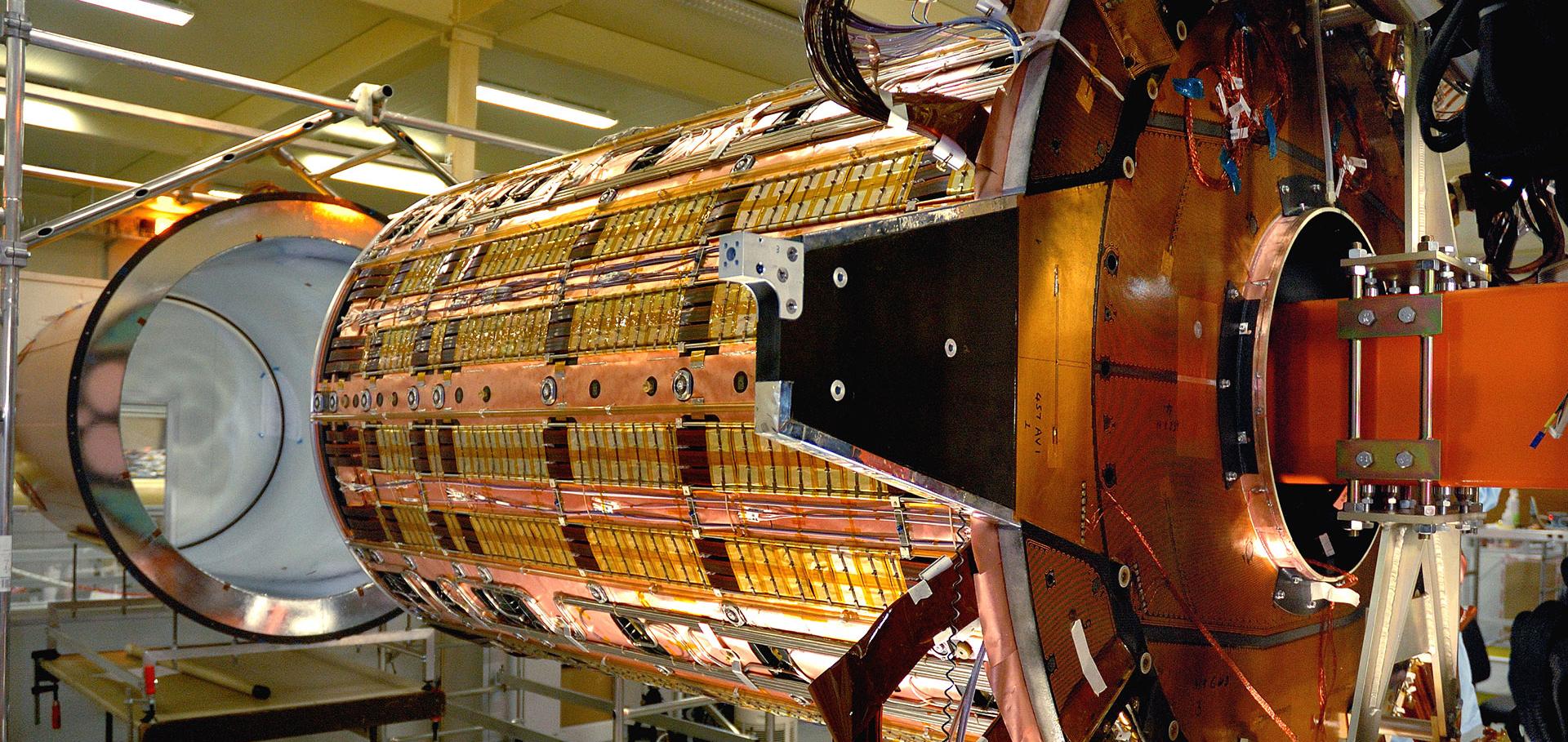

Status of construction and first tests of the CLEO III RICH
IEEE T NUCL SCI 45:3 (1998) 643-647
Abstract:
The CLEO collaboration is preparing a major upgrade of its present detector including a RICH detector for particle identification. This subdetector system follows the 'proximity focussing' design and uses Lithium Fluoride (LiF) crystal radiators and MWPCs as photon detectors. These chambers are filled with a CH4/TEA gas mixture and have a Calcium Fluoride (CaF2) crystal photon entrance window. Part of the radiator crystals will have the new 'sawtooth' geometry.We have constructed two of the 30 detector modules and tested these together with the first planar and 'sawtooth' radiator crystals in a muon halo beam at Fermilab. For the measurement of the Cherenkov angle we obtain a single photon measurement error of 13.5 mrad for the conventional planar radiator. With 14 detected photons we find a resolution per track of 4.5 mrad. In the first measurement ever of a 'sawtooth' radiator we achieve a resolution of 11.8 mrad for single photons and 4.8 mrad per track for 12.3 detected photons With a reduced geometric acceptance. These results fulfill CLEO III requirements.The CLEO III Ring Imaging Cherenkov detector
Nuclear Instruments and Methods in Physics Research Section A Accelerators Spectrometers Detectors and Associated Equipment 409:1-3 (1998) 375-378
Abstract:
The CLEO detector is undergoing major improvements in conjunction with a high luminosity upgrade of the CESR e+e- collider. A novel element is a state of the art particle identification system, based on a proximity focused Ring Imaging Cherenkov detector. This detector will provide an excellent hadron identification at all the momenta relevant to the study of the decays of B mesons produced at the Υ(4S) resonance. Some features unique to our design will be discussed together with some results achieved on individual components. © 1998 Elsevier Science B.V. All rights reserved.The CLEO III Ring Imaging Cherenkov detector
NUCL INSTRUM METH A 409:1-3 (1998) 375-378
Abstract:
The CLEO detector is undergoing major improvements in conjunction with a high luminosity upgrade of the CESR e(+)e(-) collider. A novel element is a state of the art particle identification system, based on a proximity focused Ring Imaging Cherenkov detector. This detector will provide an excellent hadron identification at all the momenta relevant to the study of the decays of B mesons produced at the Upsilon(4S) resonance. Some features unique to our design will be discussed together with some results achieved on individual components. (C) 1998 Elsevier Science B.V. All rights reserved.First search for CP violation in tau lepton decay
Physical Review Letters 81:18 (1998) 3823-3827
Abstract:
We have performed the first search for CP violation in tau lepton decay. CP violation in lepton decay does not occur in the minimal standard model but can occur in extensions such as the multi-Higgs doublet model. It appears as a characteristic difference between the τ− and τ+ decay angular distributions for the semileptonic decay modes such as τ− → K0 π− ν. We define an observable asymmetry to exploit this and find no evidence for any CP violation. © 1998 The American Physical Society.Flavor-specific inclusive B decays to charm
Physical Review Letters 80:6 (1998) 1150-1155