Home
Department Of Physics text logo
  • Research
    • Our research
    • Our research groups
    • Our research in action
    • Research funding support
    • Summer internships for undergraduates
  • Study
    • Undergraduates
    • Postgraduates
  • Engage
    • For young people
    • For teachers
    • For the public
    • For alumni
    • For business
  • Support
Menu
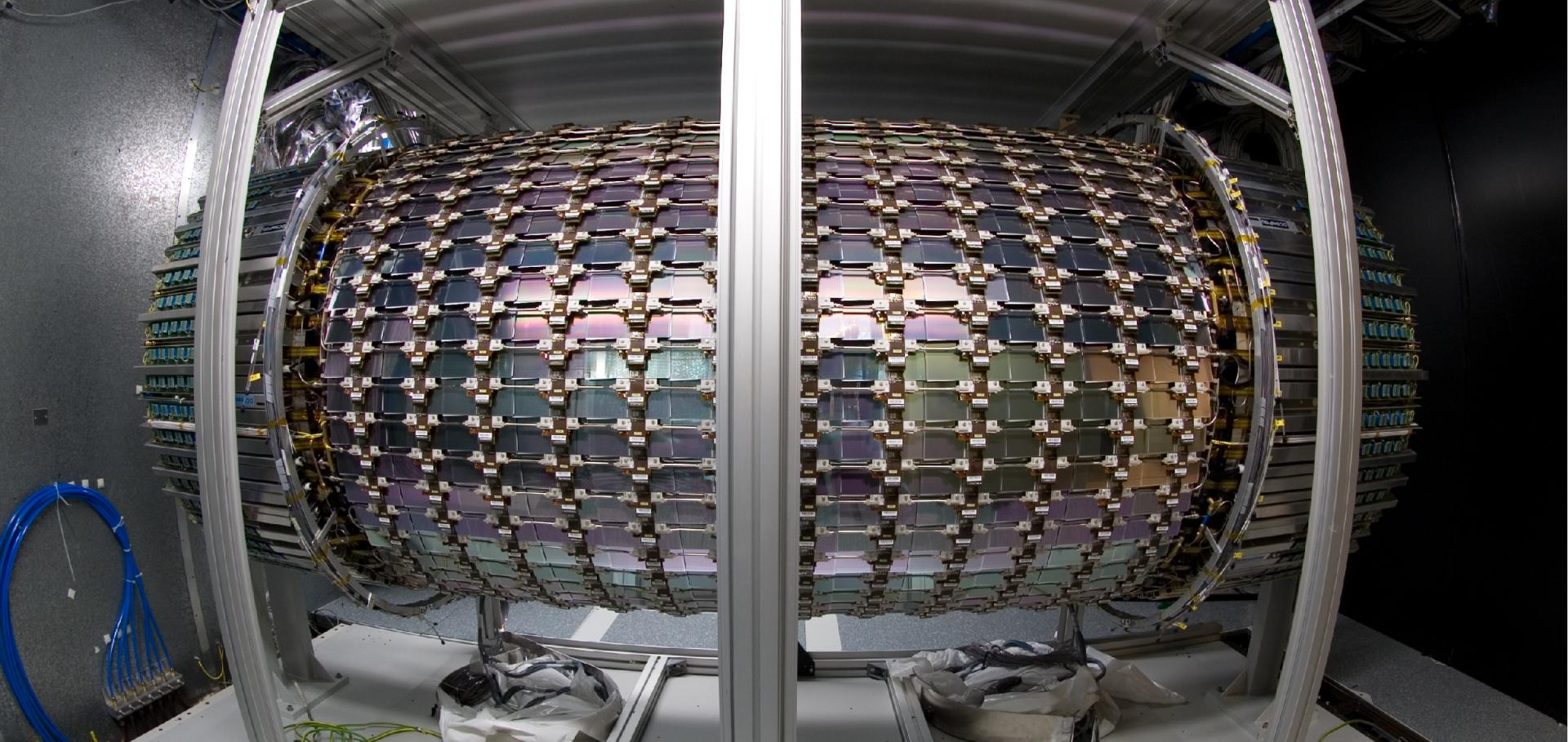
Largest layer of SCT barrel detector

The largest radius layer of the SCT barrel detector after all SCT modules had been mounted in a clean room in the physics department.

Professor Tony Weidberg

Emeritus Professor

Research theme

  • Fundamental particles and interactions

Sub department

  • Particle Physics

Research groups

  • ATLAS
Tony.Weidberg@physics.ox.ac.uk
Telephone: 01865 (2)73370
Denys Wilkinson Building, room 629
  • About
  • Publications

Radiation hard optical links for the ATLAS SCT and pixel detectors

(2001) 1246-1247

Authors:

JD Dowell, DG Charlton, RJ Homer, P Jovanovic, IR Kenyon, G Mahout, HR Shaylor, JA Wilson, IM Gregor, R Wastie, AR Weidberg, S Galagedera, MC Morrissey, J Troska, DJ White, A Rudge, ML Chu, SC Lee, PK Teng

Abstract:

A radiation hard optical readout system designed for the ATLAS Semiconductor Tracker (SCT) is described. Two independent versions of the front-end optical package housing two VCSEL emitters and an epitaxial Si PIN photodiode have been irradiated with neutron fluences over 10(15) n cm(-2), the level encountered in the ATLAS pixel detector. Environmental tests have been performed down to -20 degreesC. Extensive radiation and lifetime tests have also been carried out on the opto-electronic components and the front-end VCSEL driver and timing/ control ASICs. Bit error rate, cross-talk and single event upset measurements using irradiated devices show that the system meets the performance specification.
More details

Radiation hardness and lifetime studies of photodiodes for the optical readout of the ATLAS semiconductor tracker

NUCLEAR INSTRUMENTS & METHODS IN PHYSICS RESEARCH SECTION A-ACCELERATORS SPECTROMETERS DETECTORS AND ASSOCIATED EQUIPMENT 456:3 (2001) 300-309

Authors:

DG Charlton, JD Dowell, RJ Homer, P Jovanovic, IR Kenyon, G Mahout, HR Shaylor, A Sibley, JA Wilson, JH Bibby, IM Gregor, RL Wastie, AR Weidberg
More details from the publisher
More details

Radiation hardness studies of the front-end ASICs for the optical links of the ATLAS SemiConductor Tracker

NUCLEAR INSTRUMENTS & METHODS IN PHYSICS RESEARCH SECTION A-ACCELERATORS SPECTROMETERS DETECTORS AND ASSOCIATED EQUIPMENT 457:1-2 (2001) 369-377

Authors:

DJ White, JD Dowell, G Mahout, P Jovanovic, I Mandic, AR Weidberg
More details from the publisher

Status report of the ATLAS SCT optical links.

CERN REPORT 2001:5 (2001) 169-173

Authors:

GD Charlton, JD Dowell, RJ Homer, P Jovanovic, TJ McMahon, G Mahout, JA Wilson, N Kundu, RL Wastie, AR Weidberg, SB Galagedera, J Matheson, CP Macwaters, MC Morrissey, A Rudge, B Skubic, ML Chu, SC Lee, PK Teng, MJ Wang, P Yeh

Abstract:

The ATLAS SCT optical links system is reviewed. The assembly and testing of prototype opto-hamesses are described. Results are also given from a system test of the SCT barrel modules, including optical readout.
More details

System tests of radiation hard optical links for the ATLAS semiconductor tracker

Nuclear Instruments and Methods in Physics Research Section A Accelerators Spectrometers Detectors and Associated Equipment 443:2 (2000) 430-446

Authors:

DG Charlton, JD Dowell, RJ Homer, P Jovanovic, IR Kenyon, G Mahout, HR Shaylor, JA Wilson, A Rudge, J Fopma, I Mandic, RB Nickerson, P Shield, R Wastie, AR Weidberg, LO Eek, A Go, B Lund-Jensen, M Pearce, J Söderqvist, M Morrissey, DJ White

Abstract:

A prototype optical data and Timing, Trigger and Control transmission system based on LEDs and PIN-diodes has been constructed. The system would be suitable in terms of radiation hardness and radiation length for use in the ATLAS SemiConductor Tracker. Bit error rate measurements were performed for the data links and for the links distributing the Timing, Trigger and Control data from the counting room to the front-end modules. The effects of cross-talk between the emitters and receivers were investigated. The advantages of using Vertical Cavity Surface Emitting Lasers (VCSELs) instead of LEDs are discussed.
More details from the publisher

Pagination

  • First page First
  • Previous page Prev
  • …
  • Page 98
  • Page 99
  • Page 100
  • Page 101
  • Current page 102
  • Page 103
  • Page 104
  • Page 105
  • Page 106
  • …
  • Next page Next
  • Last page Last

Footer Menu

  • Contact us
  • Giving to the Dept of Physics
  • Work with us
  • Media

User account menu

  • Log in

Follow us

FIND US

Clarendon Laboratory,

Parks Road,

Oxford,

OX1 3PU

CONTACT US

Tel: +44(0)1865272200

University of Oxfrod logo Department Of Physics text logo
IOP Juno Champion logo Athena Swan Silver Award logo

© University of Oxford - Department of Physics

Cookies | Privacy policy | Accessibility statement

Built by: Versantus

  • Home
  • Research
  • Study
  • Engage
  • Our people
  • News & Comment
  • Events
  • Our facilities & services
  • About us
  • Giving to Physics
  • Current students
  • Staff intranet