Home
Department Of Physics text logo
  • Research
    • Our research
    • Our research groups
    • Our research in action
    • Research funding support
    • Summer internships for undergraduates
  • Study
    • Undergraduates
    • Postgraduates
  • Engage
    • For alumni
    • For business
    • For schools
    • For the public
  • Support
Menu
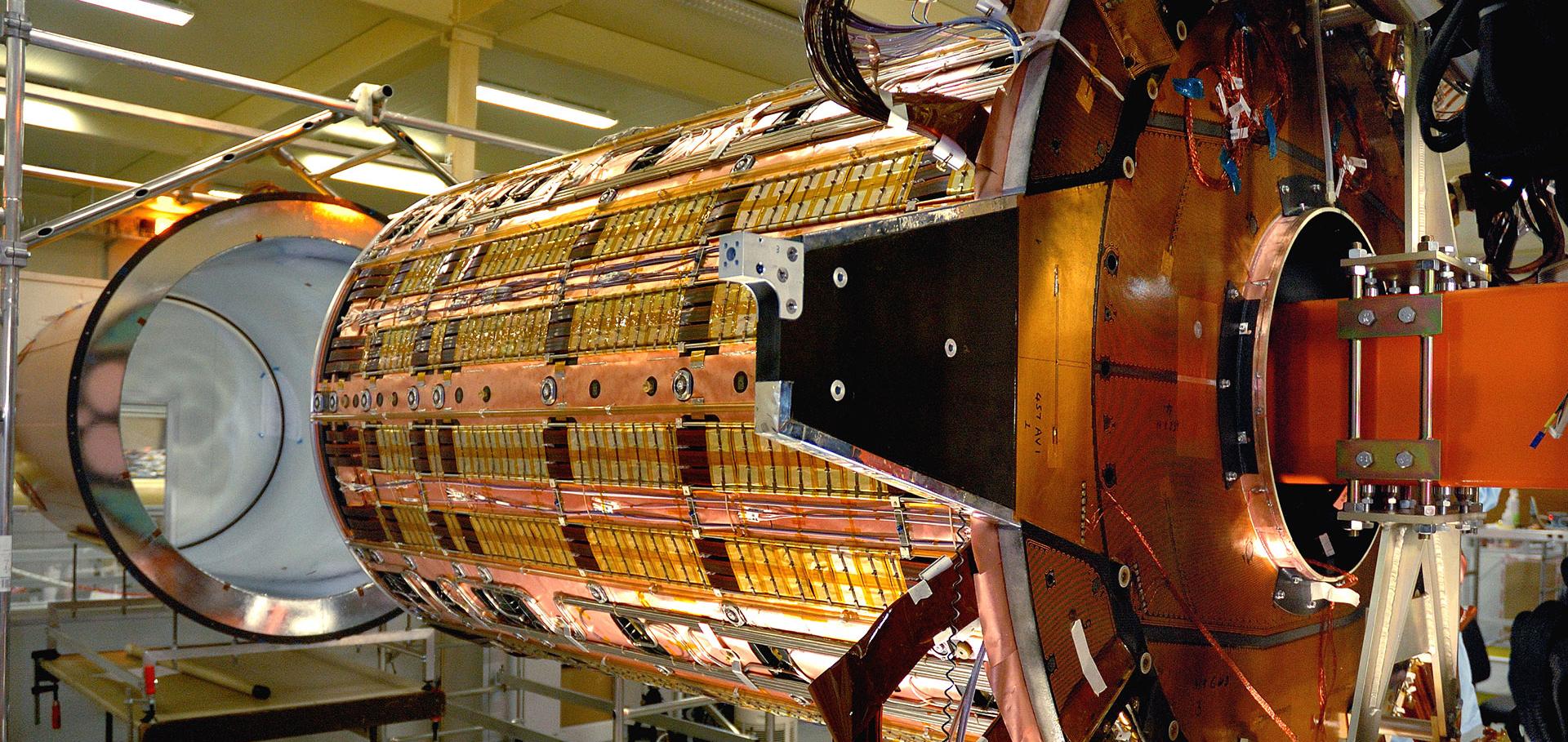
Insertion of STC into TRT at the Department of Physics, Oxford
Credit: CERN

Guy Wilkinson

Professor of Physics

Sub department

  • Particle Physics

Research groups

  • LHCb
Guy.Wilkinson@physics.ox.ac.uk
Telephone: 01865 (2)83110
Denys Wilkinson Building, room 608a
  • About
  • Publications

First observation of the decay $D^{0}\rightarrow K^{-}π^{+}μ^{+}μ^{-}$ in the $ρ^{0}$-$ω$ region of the dimuon mass spectrum

Physics Letters B Elsevier 757 (2016) 558-567

Authors:

R Aaij, C Beteta, B Adeva, M Adinolfi, A Affolder, Z Ajaltouni, S Akar, J Albrecht, A Alessio, M Alexander, S Ali, G Alkhazov, P Cartelle, S Amato, S Amerio, Y Amhis, L An, L Anderlini, J Anderson, G Andreassi, M Andreotti, JE Andrews, RB Appleby, OA Gutierrez, F Archilli, P d'Argent, A Artamonov, M Artuso, E Aslanides, G Auriemma, M Baalouch, S Bachmann, J Back, A Badalov, C Baesso, W Baldini, R Barlow, C Barschel, S Barsuk, W Barter, V Batozskaya, V Battista, A Bay, L Beaucourt, J Beddow, F Bedeschi, I Bediaga, L Bel, V Bellee

Abstract:

A study of the decay $D^{0}\rightarrow K^{-}\pi^{+}\mu^{+}\mu^{-}$ is performed using data collected by the LHCb detector in proton-proton collisions at a centre-of-mass energy of 8 TeV, corresponding to an integrated luminosity of 2.0 fb$^{-1}$. Decay candidates with muon pairs that have an invariant mass in the range 675--875 MeV$/c^2$ are considered. This region is dominated by the $\rho^{0}$ and $\omega$ resonances. The branching fraction in this range is measured to be ${\cal B}$($D^{0}\rightarrow K^{-}\pi^{+}\mu^{+}\mu^{-}$ ) = $( 4.17 \pm 0.12(stat) \pm 0.40(syst) )\times10^{-6}$. This is the first observation of the decay $D^{0}\rightarrow K^{-}\pi^{+}\mu^{+}\mu^{-}$. Its branching fraction is consistent with the value expected in the Standard Model.
More details from the publisher
Details from ORA
More details
Details from ArXiV
More details

First observation of D⁰-D⁰ oscillations in D⁰ → K⁺π⁻π⁺π⁻ decays and measurement of the associated coherence parameters.

Physical Review Letters American Physical Society 116:24 (2016) 241801

Authors:

Shu-Faye Cheung, Tim Evans, Paolo Gandini, Thomas Hadavizadeh, Neville Harnew, Donal Hill, Pawel G Jalocha, Malcolm John, Oliver J Lupton, Sneha S Malde, Anita K Nandi, Stig Topp-Jorgenson, Guy R Wilkinson

Abstract:

Charm meson oscillations are observed in a time-dependent analysis of the ratio of D⁰ → K⁺π⁻π⁺π⁻ to D⁰ → K⁻π⁺π⁻π⁺ decay rates, using data corresponding to an integrated luminosity of 3.0  fb^⁻1 recorded by the LHCb experiment. The measurements presented are sensitive to the phase-space averaged ratio of doubly Cabibbo-suppressed to Cabibbo-favored amplitudes rDK3π and the product of the coherence factor RDK3π and a charm mixing parameter y'K3π. The constraints measured are rDK3π=(5.67±0.12)×10^-2, which is the most precise determination to date, and RDK3π . y'K3π=(0.3 ± 1.8) × 10^-3, which provides useful input for determinations of the CP-violating phase γ in B^± → DK^±, D → K∓π^±π^∓π^± decays. The analysis also gives the most precise measurement of the D⁰ → K⁺π⁻π⁺π⁻ branching fraction, and the first observation of D0 - D0 oscillations in this decay mode, with a significance of 8.2 standard deviations.
More details from the publisher
Details from ORA
More details
More details
Details from ArXiV

Measurement of CP observables in B +/- → DK +/- and B +/- → Dπ +/- with two- and four-body D decays

Physics Letters B Elsevier 760 (2016) 117-131

Authors:

R Aaij, C Abellán Beteta, B Adeva, Thomas Evans, Paolo Gandini, Thomas Hadavizadeh, Neville Harnew, Donal Hill, Pawel G Jalocha, Malcolm JJ John, Sneha Malde, Anita K Nandi, Stig Topp-Jorgenson, Guy R Wilkinson

Abstract:

Measurements of CP observables in B± → DK± and B± → Dπ± decays are presented where the D meson is reconstructed in the final states K±π∓, π±K∓, K+K−, π+π−, K±π∓π+π−, π±K∓π+π− and π+π−π+π−. This analysis uses a sample of charged B mesons from pp collisions collected by the LHCb experiment in 2011 and 2012, corresponding to an integrated luminosity of 3.0 fb^−1. Various CP-violating effects are reported and together these measurements provide important input for the determination of the unitarity triangle angle γ. The analysis of the four-pion D decay mode is the first of its kind.
More details from the publisher
Details from ORA
More details
Details from ArXiV

Search for B+c decays to the ppπ+ final state

Physics Letters B Elsevier 759 (2016) 313-321

Authors:

Shu-Faye Cheung, Tim Evans, Paolo Gandini, Barak R Gruberg Cadzon, Thomas Hadavizadeh, Neville Harnew, Donal Hill, Pawel G Jalocha, Malcolm John, Oliver J Lupton, Sneha S Malde, Anita K Nandi, Stig Topp-Jorgenson, Guy R Wilkinson

Abstract:

A search for the decays of the B+c meson to ppπ+ is performed for the first time using a data sample corresponding to an integrated luminosity of 3.0 fb-1 collected by the LHCb experiment in pp collisions at centre-of-mass energies of 7 and 8 TeV. No signal is found and an upper limit, at 95% confidence level, is set, fc/fu × B(B+c → ppπ+) < 3.6×10^-8 in the kinematic region m(pp) < 2.85 GeV/c^2, pT(B) < 20 GeV/c and 2.0 < y(B) < 4.5, where B is the branching fraction and fc(fu) is the fragmentation fraction of the b quark into a Bc+ (B+) meson.
More details from the publisher
Details from ORA
More details
Details from ArXiV
More details

Observation of Λb0 → ψ(2S)pK− and Λb0→ J/ψ π+ π− pK- decays and a measurement of the Λb0 baryon mass

Journal of High Energy Physics Springer 2016:5 (2016) 132

Authors:

Shu-Faye Cheung, Tim Evans, Paolo Gandini, Thomas Hadavizadeh, Neville Harnew, Donal Hill, Pawel G Jalocha, Malcolm JJ John, Oliver J Lupton, Sneha S Malde, Anita K Nandi, Stig Topp-Joergenson, Guy R Wilkinson

Abstract:

The decays Λb0→ ψ(2S)pK− and Λb0→ J/ψπ+π−pK−are observed in a data sample corresponding to an integrated luminosity of 3 fb^−1, collected in proton-proton collisions at 7 and 8 TeV centre-of-mass energies by the LHCb detector. The ψ(2S) mesons are reconstructed through the decay modes ψ(2S) → μ+μ−and ψ(2S) → J/ψπ+π−. The branching fractions relative to that of Λb0→ J/ψpK−are measured to be ℬ(Λb0→ψ(2S)pK−)/ℬ(Λb0→J/ψpK−) = (20.70±0.76±0.46±0.37) × 10^−2, ℬ(Λb0→ψ(2S)pK−)/ℬ(Λb0→J/ψpK−) = (20.86±0.96±1.34)×10^−2 where the first uncertainties are statistical, the second are systematic and the third is related to the knowledge of J/ψ and ψ(2S) branching fractions. The mass of the Λb0baryon is measured to be M(Λb0) = 5619.65 ± 0.17 ± 0.17MeV/c2, where the uncertainties are statistical and systematic.
More details from the publisher
Details from ORA

Pagination

  • First page First
  • Previous page Prev
  • …
  • Page 106
  • Page 107
  • Page 108
  • Page 109
  • Current page 110
  • Page 111
  • Page 112
  • Page 113
  • Page 114
  • …
  • Next page Next
  • Last page Last

Footer Menu

  • Contact us
  • Giving to the Dept of Physics
  • Work with us
  • Media

User account menu

  • Log in

Follow us

FIND US

Clarendon Laboratory,

Parks Road,

Oxford,

OX1 3PU

CONTACT US

Tel: +44(0)1865272200

University of Oxfrod logo Department Of Physics text logo
IOP Juno Champion logo Athena Swan Silver Award logo

© University of Oxford - Department of Physics

Cookies | Privacy policy | Accessibility statement

Built by: Versantus

  • Home
  • Research
  • Study
  • Engage
  • Our people
  • News & Comment
  • Events
  • Our facilities & services
  • About us
  • Giving to Physics
  • Current students
  • Staff intranet