Home
Department Of Physics text logo
  • Research
    • Our research
    • Our research groups
    • Our research in action
    • Research funding support
    • Summer internships for undergraduates
  • Study
    • Undergraduates
    • Postgraduates
  • Engage
    • For young people
    • For teachers
    • For the public
    • For alumni
    • For business
  • Support
Menu
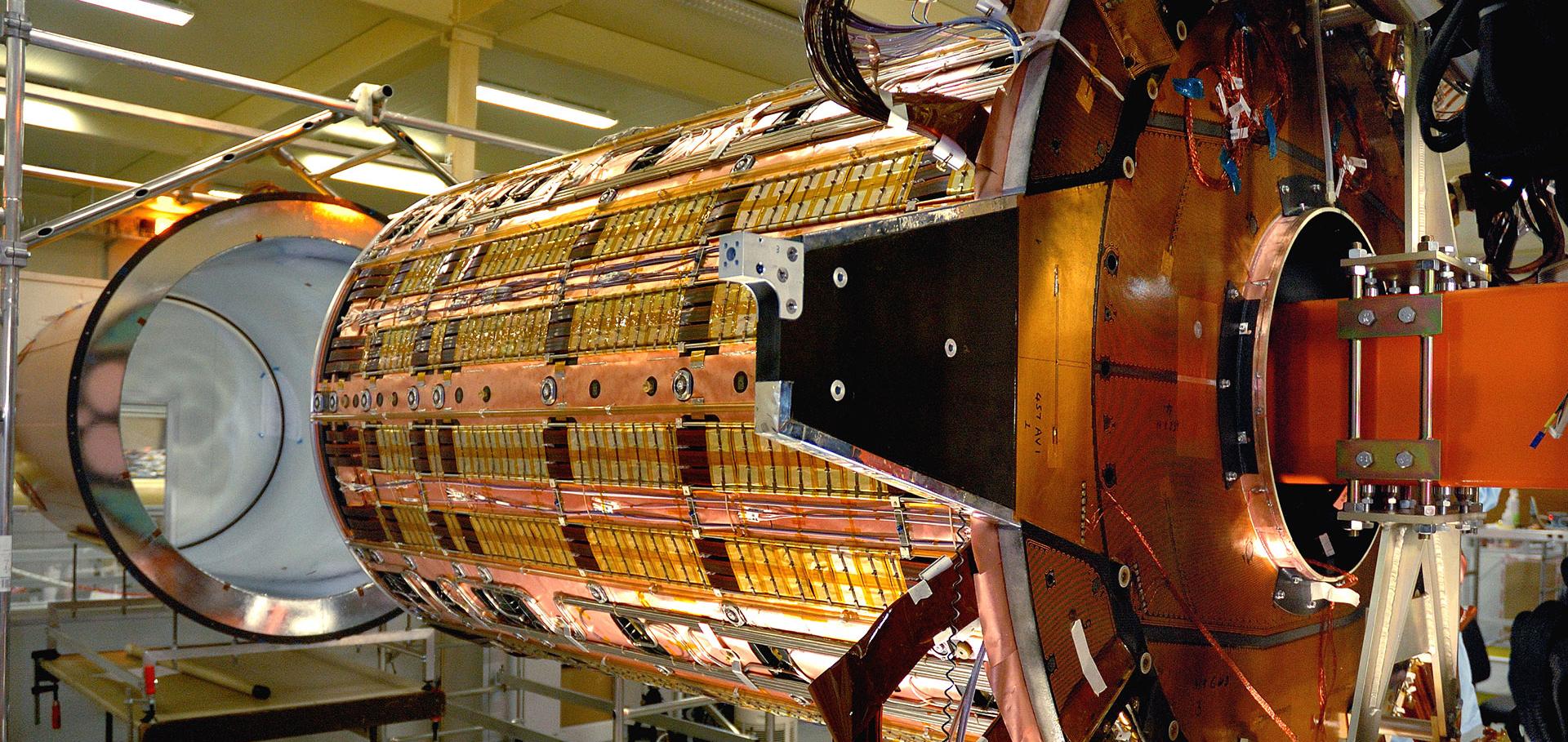
Insertion of STC into TRT at the Department of Physics, Oxford
Credit: CERN

Guy Wilkinson

Professor of Physics

Sub department

  • Particle Physics

Research groups

  • LHCb
Guy.Wilkinson@physics.ox.ac.uk
Telephone: 01865 (2)83110
Denys Wilkinson Building, room 608a
  • About
  • Publications

Search for CP violation in the Dalitz-plot analysis of D±→K+K- π±

Physical Review D - Particles, Fields, Gravitation and Cosmology 78:7 (2008)

Authors:

P Rubin, BI Eisenstein, I Karliner, S Mehrabyan, N Lowrey, M Selen, EJ White, J Wiss, RE Mitchell, MR Shepherd, D Besson, TK Pedlar, D Cronin-Hennessy, KY Gao, J Hietala, Y Kubota, T Klein, BW Lang, R Poling, AW Scott, P Zweber, S Dobbs, Z Metreveli, KK Seth, BJY Tan, A Tomaradze, J Libby, L Martin, A Powell, G Wilkinson, KM Ecklund, W Love, V Savinov, H Mendez, JY Ge, DH Miller, IPJ Shipsey, B Xin, GS Adams, D Hu, B Moziak, J Napolitano, Q He, J Insler, H Muramatsu, CS Park, EH Thorndike, F Yang, M Artuso, S Blusk, S Khalil, J Li, R Mountain, S Nisar, K Randrianarivony, N Sultana, T Skwarnicki, S Stone, JC Wang, LM Zhang, G Bonvicini, D Cinabro, M Dubrovin, A Lincoln, P Naik, J Rademacker, DM Asner, KW Edwards, J Reed, RA Briere, G Tatishvili, H Vogel, JL Rosner, JP Alexander, DG Cassel, JE Duboscq, R Ehrlich, L Fields, L Gibbons, R Gray, SW Gray, DL Hartill, BK Heltsley, D Hertz, JM Hunt, J Kandaswamy, DL Kreinick, VE Kuznetsov, J Ledoux, H Mahlke-Krüger, D Mohapatra, PUE Onyisi, JR Patterson, D Peterson, D Riley, A Ryd, AJ Sadoff, X Shi, S Stroiney, WM Sun

Abstract:

We report on a search for CP asymmetry in the singly Cabibbo-suppressed decay D+→K+K-π+ using a data sample of 818pb-1 accumulated with the CLEO-c detector on the ψ(3770) resonance. A Dalitz-plot analysis is used to determine the amplitudes of the intermediate states. We find no evidence for CP violation either in specific two-body amplitudes or integrated over the entire phase space. The CP asymmetry in the latter case is measured to be (-0.03±0.84±0.29)%. © 2008 The American Physical Society.
More details from the publisher

Observation of χcJ radiative decays to light vector mesons

Physical Review Letters 101:15 (2008)

Authors:

JV Bennett, RE Mitchell, MR Shepherd, D Besson, TK Pedlar, D Cronin-Hennessy, KY Gao, J Hietala, Y Kubota, T Klein, BW Lang, R Poling, AW Scott, P Zweber, S Dobbs, Z Metreveli, KK Seth, BJY Tan, A Tomaradze, J Libby, L Martin, A Powell, G Wilkinson, KM Ecklund, W Love, V Savinov, H Mendez, JY Ge, DH Miller, IPJ Shipsey, B Xin, GS Adams, D Hu, B Moziak, J Napolitano, Q He, J Insler, H Muramatsu, CS Park, EH Thorndike, F Yang, M Artuso, S Blusk, S Khalil, J Li, R Mountain, S Nisar, K Randrianarivony, N Sultana, T Skwarnicki, S Stone, JC Wang, LM Zhang, G Bonvicini, D Cinabro, M Dubrovin, A Lincoln, P Naik, J Rademacker, DM Asner, KW Edwards, J Reed, RA Briere, G Tatishvili, H Vogel, JL Rosner, JP Alexander, DG Cassel, JE Duboscq, R Ehrlich, L Fields, RS Galik, L Gibbons, R Gray, SW Gray, DL Hartill, BK Heltsley, D Hertz, JM Hunt, J Kandaswamy, DL Kreinick, VE Kuznetsov, J Ledoux, H Mahlke-Krüger, D Mohapatra, PUE Onyisi, JR Patterson, D Peterson, D Riley, A Ryd, AJ Sadoff, X Shi, S Stroiney, WM Sun, T Wilksen, SB Athar, R Patel, J Yelton, P Rubin, BI Eisenstein

Abstract:

Using a total of 2.74×10⁷ decays of the ψ(2S) collected with the CLEO-c detector, we present a study of χcJ→γV, where V=ρ0, ω, □. The transitions χc1→γρ0 and χc1→γω are observed with B(χc1→γρ0)=(2. 43±0.19±0.22)×10-4 and B(χc1→γω)=(8. 3±1.5±1.2)×10-5. In the χc1→γρ0 transition, the final state meson is dominantly longitudinally polarized. Upper limits on the branching fractions of other χcJ states to light vector mesons are presented. © 2008 The American Physical Society.
More details from the publisher

Precision measurement of B(D+→μ+ν) and the pseudoscalar decay constant fD+

Physical Review D - Particles, Fields, Gravitation and Cosmology 78:5 (2008)

Authors:

BI Eisenstein, I Karliner, S Mehrabyan, N Lowrey, M Selen, EJ White, J Wiss, RE Mitchell, MR Shepherd, D Besson, TK Pedlar, D Cronin-Hennessy, KY Gao, J Hietala, Y Kubota, T Klein, BW Lang, R Poling, AW Scott, P Zweber, S Dobbs, Z Metreveli, KK Seth, A Tomaradze, J Libby, L Martin, A Powell, G Wilkinson, KM Ecklund, W Love, V Savinov, H Mendez, JY Ge, DH Miller, IPJ Shipsey, B Xin, GS Adams, M Anderson, JP Cummings, I Danko, D Hu, B Moziak, J Napolitano, Q He, J Insler, H Muramatsu, CS Park, EH Thorndike, F Yang, M Artuso, S Blusk, S Khalil, J Li, N Menaa, R Mountain, S Nisar, K Randrianarivony, N Sultana, T Skwarnicki, S Stone, JC Wang, LM Zhang, G Bonvicini, D Cinabro, M Dubrovin, A Lincoln, P Naik, J Rademacker, DM Asner, KW Edwards, J Reed, RA Briere, T Ferguson, G Tatishvili, H Vogel, ME Watkins, JL Rosner, JP Alexander, DG Cassel, JE Duboscq, R Ehrlich, L Fields, RS Galik, L Gibbons, R Gray, SW Gray, DL Hartill, BK Heltsley, D Hertz, JM Hunt, J Kandaswamy, DL Kreinick, VE Kuznetsov, J Ledoux, H Mahlke-Krüger, D Mohapatra, PUE Onyisi, JR Patterson, D Peterson, D Riley

Abstract:

We measure the branching ratio of the purely leptonic decay of the D+ meson with unprecedented precision as B(D+→μ+ν)=(3.82±0. 32±0.09)×10-4, using 818pb-1 of data taken on the ψ(3770) resonance with the CLEO-c detector at the CESR collider. We use this determination to derive a value for the pseudoscalar decay constant fD+, combining with measurements of the D+ lifetime and assuming |Vcd|=|Vus|. We find fD+=(205.8±8.5±2.5)MeV. The decay rate asymmetry Γ(D+→μ+ν)-Γ(D-→μ-ν̄)Γ(D+→μ +ν)+Γ(D-→μ-ν̄)=0.08±0.08, consistent with no CP violation. We also set 90% confidence level upper limits on B(D+→τ+ν )<1.2×10⁻³ and B(D+→e+ν)<8.8×10⁻⁶. © 2008 The American Physical Society.
More details from the publisher

Dalitz plot analysis of the D+→K-π+π+ decay

Physical Review D - Particles, Fields, Gravitation and Cosmology 78:5 (2008)

Authors:

G Bonvicini, D Cinabro, M Dubrovin, A Lincoln, P Naik, J Rademacker, DM Asner, KW Edwards, J Reed, RA Briere, T Ferguson, G Tatishvili, H Vogel, ME Watkins, JL Rosner, JP Alexander, DG Cassel, JE Duboscq, R Ehrlich, L Fields, L Gibbons, R Gray, SW Gray, DL Hartill, BK Heltsley, D Hertz, JM Hunt, J Kandaswamy, DL Kreinick, VE Kuznetsov, J Ledoux, H Mahlke-Krüger, D Mohapatra, PUE Onyisi, JR Patterson, D Peterson, D Riley, A Ryd, AJ Sadoff, X Shi, S Stroiney, WM Sun, T Wilksen, SB Athar, R Patel, J Yelton, P Rubin, BI Eisenstein, I Karliner, S Mehrabyan, N Lowrey, M Selen, EJ White, J Wiss, RE Mitchell, MR Shepherd, D Besson, TK Pedlar, D Cronin-Hennessy, KY Gao, J Hietala, Y Kubota, T Klein, BW Lang, R Poling, AW Scott, P Zweber, S Dobbs, Z Metreveli, KK Seth, A Tomaradze, J Libby, A Powell, G Wilkinson, KM Ecklund, W Love, V Savinov, A Lopez, H Mendez, J Ramirez, JY Ge, DH Miller, IPJ Shipsey, B Xin, GS Adams, M Anderson, JP Cummings, I Danko, D Hu, B Moziak, J Napolitano, Q He, J Insler, H Muramatsu, CS Park, EH Thorndike, F Yang, M Artuso, S Blusk, S Khalil

Abstract:

We perform a Dalitz plot analysis of D+→K-π+π+ decay with the CLEO-c data set of 572pb-1 of e+e- collisions accumulated at the ψ(3770). This corresponds to 1.6×10⁶ D+D- pairs from which we select 140793 candidate events with a small background of 1.1%. We compare our results with previous measurements using the isobar model. We modify the isobar model with an improved description of some of the contributing resonances and get better agreement with our data. We also consider a quasi-model-independent approach and measure the magnitude and phase of the contributing Kπ S wave in the range of invariant masses from the threshold to the maximum in this decay. This gives an improved description of our data over the isobar model. Finally we allow for an isospin-two π+π+ S wave contribution and find that adding this to both the isobar model and the quasi-model-independent approach gives the best description of our data. © 2008 The American Physical Society.
More details from the publisher

Observation of J/ψ→3γ

Physical Review Letters 101:10 (2008)

Authors:

GS Adams, M Anderson, JP Cummings, I Danko, D Hu, B Moziak, J Napolitano, Q He, J Insler, H Muramatsu, CS Park, EH Thorndike, F Yang, M Artuso, S Blusk, S Khalil, J Li, R Mountain, S Nisar, K Randrianarivony, N Sultana, T Skwarnicki, S Stone, JC Wang, LM Zhang, G Bonvicini, D Cinabro, M Dubrovin, A Lincoln, P Naik, J Rademacker, DM Asner, KW Edwards, J Reed, RA Briere, T Ferguson, JSY Ma, G Tatishvili, H Vogel, ME Watkins, JL Rosner, JP Alexander, DG Cassel, JE Duboscq, R Ehrlich, L Fields, RS Galik, L Gibbons, R Gray, SW Gray, DL Hartill, BK Heltsley, D Hertz, JM Hunt, J Kandaswamy, DL Kreinick, VE Kuznetsov, J Ledoux, H Mahlke-Krüger, D Mohapatra, PUE Onyisi, JR Patterson, D Peterson, D Riley, A Ryd, AJ Sadoff, X Shi, S Stroiney, WM Sun, T Wilksen, SB Athar, R Patel, J Yelton, P Rubin, BI Eisenstein, I Karliner, S Mehrabyan, N Lowrey, M Selen, EJ White, J Wiss, RE Mitchell, MR Shepherd, D Besson, TK Pedlar, D Cronin-Hennessy, KY Gao, J Hietala, Y Kubota, T Klein, BW Lang, R Poling, AW Scott, P Zweber, S Dobbs, Z Metreveli, KK Seth, A Tomaradze, J Libby, A Powell

Abstract:

We report the first observation of the decay J/ψ→3γ. The signal has a statistical significance of 6σ and corresponds to a branching fraction of B(J/ψ→3γ)=(1.2±0.3±0.2)×10-5, in which the errors are statistical and systematic, respectively. The measurement uses ψ(2S)→π+π-J/ψ events acquired with the CLEO-c detector operating at the CESR e+e- collider. © 2008 The American Physical Society.
More details from the publisher

Pagination

  • First page First
  • Previous page Prev
  • …
  • Page 286
  • Page 287
  • Page 288
  • Page 289
  • Current page 290
  • Page 291
  • Page 292
  • Page 293
  • Page 294
  • …
  • Next page Next
  • Last page Last

Footer Menu

  • Contact us
  • Giving to the Dept of Physics
  • Work with us
  • Media

User account menu

  • Log in

Follow us

FIND US

Clarendon Laboratory,

Parks Road,

Oxford,

OX1 3PU

CONTACT US

Tel: +44(0)1865272200

University of Oxfrod logo Department Of Physics text logo
IOP Juno Champion logo Athena Swan Silver Award logo

© University of Oxford - Department of Physics

Cookies | Privacy policy | Accessibility statement

Built by: Versantus

  • Home
  • Research
  • Study
  • Engage
  • Our people
  • News & Comment
  • Events
  • Our facilities & services
  • About us
  • Giving to Physics
  • Current students
  • Staff intranet