

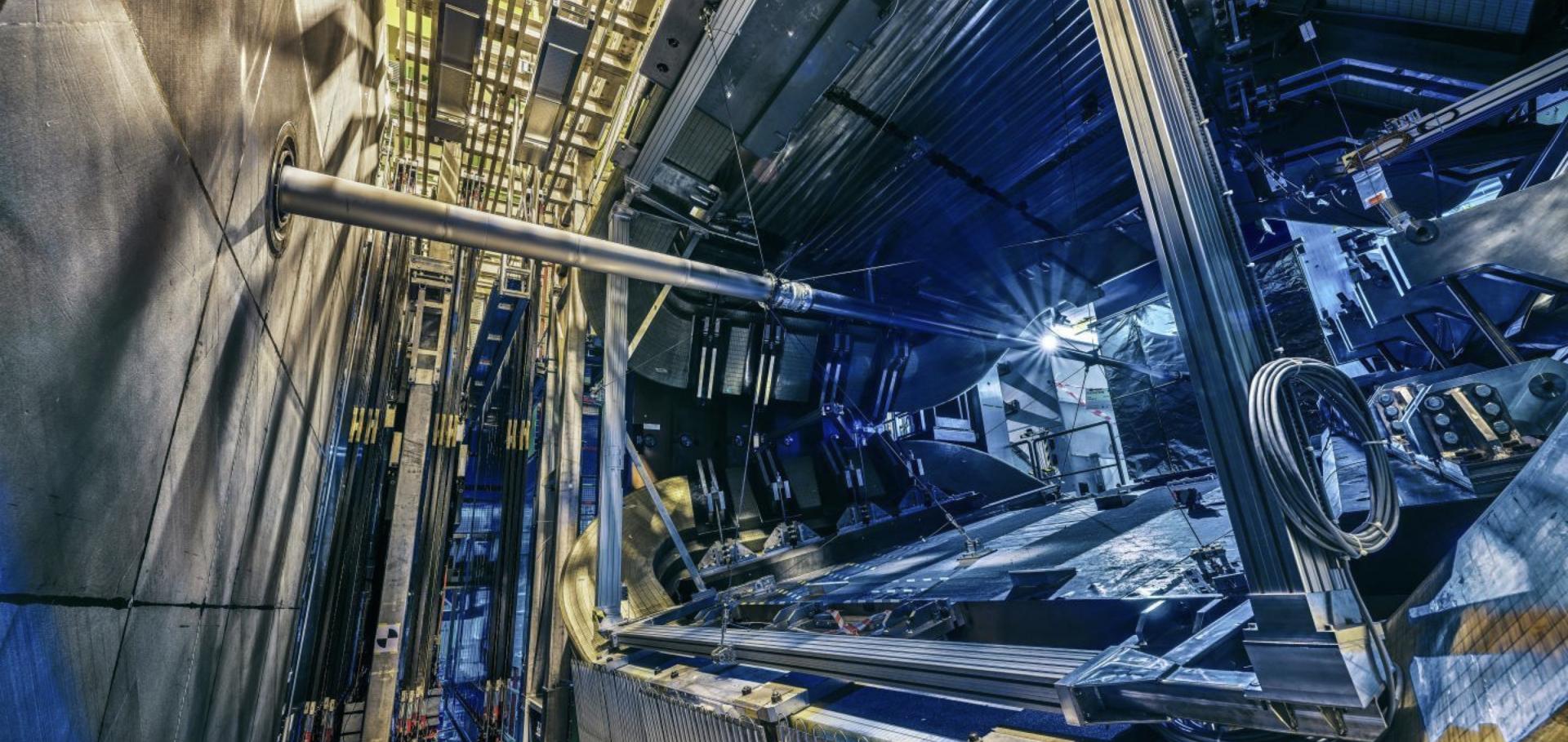
Measurement of Upsilon production in pp collisions at sqrt{s}=2.76 TeV
(2014)
Authors:
LHCb collaboration, R Aaij, B Adeva, M Adinolfi, A Affolder, Z Ajaltouni, J Albrecht, F Alessio, M Alexander, S Ali, G Alkhazov, P Alvarez Cartelle, AA Alves, S Amato, S Amerio, Y Amhis, L Anderlini, J Anderson, R Andreassen, M Andreotti, JE Andrews, RB Appleby, O Aquines Gutierrez, F Archilli, A Artamonov, M Artuso, E Aslanides, G Auriemma, M Baalouch, S Bachmann, JJ Back, A Badalov, V Balagura, W Baldini, RJ Barlow, C Barschel, S Barsuk, W Barter, V Batozskaya, Th Bauer, A Bay, J Beddow, F Bedeschi, I Bediaga, S Belogurov, K Belous, I Belyaev, E Ben-Haim, G Bencivenni, S Benson, J Benton, A Berezhnoy, R Bernet, M-O Bettler, M van Beuzekom, A Bien, S Bifani, T Bird, A Bizzeti, PM Bjørnstad, T Blake, F Blanc, J Blouw, S Blusk, V Bocci, A Bondar, N Bondar, W Bonivento, S Borghi, A Borgia, M Borsato, TJV Bowcock, E Bowen, C Bozzi, T Brambach, J van den Brand, J Bressieux, D Brett, M Britsch, T Britton, NH Brook, H Brown, A Bursche, G Busetto, J Buytaert, S Cadeddu, R Calabrese, O Callot, M Calvi, M Calvo Gomez, A Camboni, P Campana, D Campora Perez, A Carbone, G Carboni, R Cardinale, A Cardini, H Carranza-Mejia, L Carson, K Carvalho Akiba, G Casse, L Castillo Garcia, M Cattaneo, Ch Cauet, R Cenci, M Charles, Ph Charpentier, S-F Cheung, N Chiapolini, M Chrzaszcz, K Ciba, X Cid Vidal, G Ciezarek, PEL Clarke, M Clemencic, HV Cliff, J Closier, C Coca, V Coco, J Cogan, E Cogneras, P Collins, A Comerma-Montells, A Contu, A Cook, M Coombes, S Coquereau, G Corti, I Counts, B Couturier, GA Cowan, DC Craik, M Cruz Torres, S Cunliffe, R Currie, C D'Ambrosio, J Dalseno, P David, PNY David, A Davis, I De Bonis, K De Bruyn, S De Capua, M De Cian, JM De Miranda, L De Paula, W De Silva, P De Simone, D Decamp, M Deckenhoff, L Del Buono, N Déléage, D Derkach, O Deschamps, F Dettori, A Di Canto, H Dijkstra, S Donleavy, F Dordei, M Dorigo, P Dorosz, A Dosil Suárez, D Dossett, A Dovbnya, F Dupertuis, P Durante, R Dzhelyadin, A Dziurda, A Dzyuba, S Easo, U Egede, V Egorychev, S Eidelman, S Eisenhardt, U Eitschberger, R Ekelhof, L Eklund, I El Rifai, Ch Elsasser, S Esen, A Falabella, C Färber, C Farinelli, S Farry, D Ferguson, V Fernandez Albor, F Ferreira Rodrigues, M Ferro-Luzzi, S Filippov, M Fiore, M Fiorini, C Fitzpatrick, M Fontana, F Fontanelli, R Forty, O Francisco, M Frank, C Frei, M Frosini, J Fu, E Furfaro, A Gallas Torreira, D Galli, M Gandelman, P Gandini, Y Gao, J Garofoli, J Garra Tico, L Garrido, C Gaspar, R Gauld, E Gersabeck, M Gersabeck, T Gershon, Ph Ghez, A Gianelle, S Giani', V Gibson, L Giubega, VV Gligorov, C Göbel, D Golubkov, A Golutvin, A Gomes, H Gordon, M Grabalosa Gándara, R Graciani Diaz, LA Granado Cardoso, E Graugés, G Graziani, A Grecu, E Greening, S Gregson, P Griffith, L Grillo, O Grünberg, B Gui, E Gushchin, Yu Guz, T Gys, C Hadjivasiliou, G Haefeli, C Haen, TW Hafkenscheid, SC Haines, S Hall, B Hamilton, T Hampson, S Hansmann-Menzemer, N Harnew, ST Harnew, J Harrison, T Hartmann, J He, T Head, V Heijne, K Hennessy, P Henrard, L Henry, JA Hernando Morata, E van Herwijnen, M Heß, A Hicheur, D Hill, M Hoballah, C Hombach, W Hulsbergen, P Hunt, N Hussain, D Hutchcroft, D Hynds, V Iakovenko, M Idzik, P Ilten, R Jacobsson, A Jaeger, E Jans, P Jaton, A Jawahery, F Jing, M John, D Johnson, CR Jones, C Joram, B Jost, N Jurik, M Kaballo, S Kandybei, W Kanso, M Karacson, TM Karbach, M Kelsey, IR Kenyon, T Ketel, B Khanji, C Khurewathanakul, S Klaver, O Kochebina, I Komarov, RF Koopman, P Koppenburg, M Korolev, A Kozlinskiy, L Kravchuk, K Kreplin, M Kreps, G Krocker, P Krokovny, F Kruse, M Kucharczyk, V Kudryavtsev, K Kurek, T Kvaratskheliya, VN La Thi, D Lacarrere, G Lafferty, A Lai, D Lambert, RW Lambert, E Lanciotti, G Lanfranchi, C Langenbruch, T Latham, C Lazzeroni, R Le Gac, J van Leerdam, J-P Lees, R Lefèvre, A Leflat, J Lefrançois, S Leo, O Leroy, T Lesiak, B Leverington, Y Li, M Liles, R Lindner, C Linn, F Lionetto, B Liu, G Liu, S Lohn, I Longstaff, JH Lopes, N Lopez-March, P Lowdon, H Lu, D Lucchesi, J Luisier, H Luo, E Luppi, O Lupton, F Machefert, IV Machikhiliyan, F Maciuc, O Maev, S Malde, G Manca, G Mancinelli, M Manzali, J Maratas, U Marconi, P Marino, R Märki, J Marks, G Martellotti, A Martens, A Martín Sánchez, M Martinelli, D Martinez Santos, F Martinez Vidal, D Martins Tostes, A Massafferri, R Matev, Z Mathe, C Matteuzzi, A Mazurov, M McCann, J McCarthy, A McNab, R McNulty, B McSkelly, B Meadows, F Meier, M Meissner, M Merk, DA Milanes, M-N Minard, J Molina Rodriguez, S Monteil, D Moran, M Morandin, P Morawski, A Mordà, MJ Morello, R Mountain, F Muheim, K Müller, R Muresan, B Muryn, B Muster, P Naik, T Nakada, R Nandakumar, I Nasteva, M Needham, N Neri, S Neubert, N Neufeld, AD Nguyen, TD Nguyen, C Nguyen-Mau, M Nicol, V Niess, R Niet, N Nikitin, T Nikodem, A Novoselov, A Oblakowska-Mucha, V Obraztsov, S Oggero, S Ogilvy, O Okhrimenko, R Oldeman, G Onderwater, M Orlandea, JM Otalora Goicochea, P Owen, A Oyanguren, BK Pal, A Palano, F Palombo, M Palutan, J Panman, A Papanestis, M Pappagallo, L Pappalardo, C Parkes, CJ Parkinson, G Passaleva, GD Patel, M Patel, C Patrignani, C Pavel-Nicorescu, A Pazos Alvarez, A Pearce, A Pellegrino, G Penso, M Pepe Altarelli, S Perazzini, E Perez Trigo, P Perret, M Perrin-Terrin, L Pescatore, E Pesen, G Pessina, K Petridis, A Petrolini, E Picatoste Olloqui, B Pietrzyk, T Pilař, D Pinci, A Pistone, S Playfer, M Plo Casasus, F Polci, G Polok, A Poluektov, E Polycarpo, A Popov, D Popov, B Popovici, C Potterat, A Powell, J Prisciandaro, A Pritchard, C Prouve, V Pugatch, A Puig Navarro, G Punzi, W Qian, B Rachwal, JH Rademacker, B Rakotomiaramanana, M Rama, MS Rangel, I Raniuk, N Rauschmayr, G Raven, S Redford, S Reichert, MM Reid, AC dos Reis, S Ricciardi, A Richards, K Rinnert, V Rives Molina, DA Roa Romero, P Robbe, DA Roberts, AB Rodrigues, E Rodrigues, P Rodriguez Perez, S Roiser, V Romanovsky, A Romero Vidal, M Rotondo, J Rouvinet, T Ruf, F Ruffini, H Ruiz, P Ruiz Valls, G Sabatino, JJ Saborido Silva, N Sagidova, P Sail, B Saitta, V Salustino Guimaraes, B Sanmartin Sedes, R Santacesaria, C Santamarina Rios, E Santovetti, M Sapunov, A Sarti, C Satriano, A Satta, M Savrie, D Savrina, M Schiller, H Schindler, M Schlupp, M Schmelling, B Schmidt, O Schneider, A Schopper, M-H Schune, R Schwemmer, B Sciascia, A Sciubba, M Seco, A Semennikov, K Senderowska, I Sepp, N Serra, J Serrano, P Seyfert, M Shapkin, I Shapoval, Y Shcheglov, T Shears, L Shekhtman, O Shevchenko, V Shevchenko, A Shires, R Silva Coutinho, G Simi, M Sirendi, N Skidmore, T Skwarnicki, NA Smith, E Smith, E Smith, J Smith, M Smith, H Snoek, MD Sokoloff, FJP Soler, F Soomro, D Souza, B Souza De Paula, B Spaan, A Sparkes, F Spinella, P Spradlin, F Stagni, S Stahl, O Steinkamp, S Stevenson, S Stoica, S Stone, B Storaci, S Stracka, M Straticiuc, U Straumann, R Stroili, VK Subbiah, L Sun, W Sutcliffe, S Swientek, V Syropoulos, M Szczekowski, P Szczypka, D Szilard, T Szumlak, S T'Jampens, M Teklishyn, G Tellarini, E Teodorescu, F Teubert, C Thomas, E Thomas, J van Tilburg, V Tisserand, M Tobin, S Tolk, L Tomassetti, D Tonelli, S Topp-Joergensen, N Torr, E Tournefier, S Tourneur, MT Tran, M Tresch, A Tsaregorodtsev, P Tsopelas, N Tuning, M Ubeda Garcia, A Ukleja, A Ustyuzhanin, U Uwer, V Vagnoni, G Valenti, A Vallier, R Vazquez Gomez, P Vazquez Regueiro, C Vázquez Sierra, S Vecchi, JJ Velthuis, M Veltri, G Veneziano, M Vesterinen, B Viaud, D Vieira, X Vilasis-Cardona, A Vollhardt, D Volyanskyy, D Voong, A Vorobyev, V Vorobyev, C Voß, H Voss, JA de Vries, R Waldi, C Wallace, R Wallace, S Wandernoth, J Wang, DR Ward, NK Watson, AD Webber, D Websdale, M Whitehead, J Wicht, J Wiechczynski, D Wiedner, L Wiggers, G Wilkinson, MP Williams, M Williams, FF Wilson, J Wimberley, J Wishahi, W Wislicki, M Witek, G Wormser, SA Wotton, S Wright, S Wu, K Wyllie, Y Xie, Z Xing, Z Yang, X Yuan, O Yushchenko, M Zangoli, M Zavertyaev, F Zhang, L Zhang, WC Zhang, Y Zhang, A Zhelezov, A Zhokhov, L Zhong, A ZvyaginMeasurements of the $B^+$, $B^0$, $B_s^0$ meson and $\Lambda_b^0$ baryon lifetimes
(2014)
Authors:
LHCb collaboration, R Aaij, B Adeva, M Adinolfi, A Affolder, Z Ajaltouni, J Albrecht, F Alessio, M Alexander, S Ali, G Alkhazov, P Alvarez Cartelle, AA Alves, S Amato, S Amerio, Y Amhis, L Anderlini, J Anderson, R Andreassen, M Andreotti, JE Andrews, RB Appleby, O Aquines Gutierrez, F Archilli, A Artamonov, M Artuso, E Aslanides, G Auriemma, M Baalouch, S Bachmann, JJ Back, A Badalov, V Balagura, W Baldini, RJ Barlow, C Barschel, S Barsuk, W Barter, V Batozskaya, Th Bauer, A Bay, J Beddow, F Bedeschi, I Bediaga, S Belogurov, K Belous, I Belyaev, E Ben-Haim, G Bencivenni, S Benson, J Benton, A Berezhnoy, R Bernet, M-O Bettler, M van Beuzekom, A Bien, S Bifani, T Bird, A Bizzeti, PM Bjørnstad, T Blake, F Blanc, J Blouw, S Blusk, V Bocci, A Bondar, N Bondar, W Bonivento, S Borghi, A Borgia, M Borsato, TJV Bowcock, E Bowen, C Bozzi, T Brambach, J van den Brand, J Bressieux, D Brett, M Britsch, T Britton, NH Brook, H Brown, A Bursche, G Busetto, J Buytaert, S Cadeddu, R Calabrese, O Callot, M Calvi, M Calvo Gomez, A Camboni, P Campana, D Campora Perez, A Carbone, G Carboni, R Cardinale, A Cardini, H Carranza-Mejia, L Carson, K Carvalho Akiba, G Casse, L Castillo Garcia, M Cattaneo, Ch Cauet, R Cenci, M Charles, Ph Charpentier, S-F Cheung, N Chiapolini, M Chrzaszcz, K Ciba, X Cid Vidal, G Ciezarek, PEL Clarke, M Clemencic, HV Cliff, J Closier, C Coca, V Coco, J Cogan, E Cogneras, P Collins, A Comerma-Montells, A Contu, A Cook, M Coombes, S Coquereau, G Corti, I Counts, B Couturier, GA Cowan, DC Craik, M Cruz Torres, S Cunliffe, R Currie, C D'Ambrosio, J Dalseno, P David, PNY David, A Davis, I De Bonis, K De Bruyn, S De Capua, M De Cian, JM De Miranda, L De Paula, W De Silva, P De Simone, D Decamp, M Deckenhoff, L Del Buono, N Déléage, D Derkach, O Deschamps, F Dettori, A Di Canto, H Dijkstra, S Donleavy, F Dordei, M Dorigo, P Dorosz, A Dosil Suárez, D Dossett, A Dovbnya, F Dupertuis, P Durante, R Dzhelyadin, A Dziurda, A Dzyuba, S Easo, U Egede, V Egorychev, S Eidelman, S Eisenhardt, U Eitschberger, R Ekelhof, L Eklund, I El Rifai, Ch Elsasser, S Esen, A Falabella, C Färber, C Farinelli, S Farry, D Ferguson, V Fernandez Albor, F Ferreira Rodrigues, M Ferro-Luzzi, S Filippov, M Fiore, M Fiorini, C Fitzpatrick, M Fontana, F Fontanelli, R Forty, O Francisco, M Frank, C Frei, M Frosini, E Furfaro, A Gallas Torreira, D Galli, M Gandelman, P Gandini, Y Gao, J Garofoli, J Garra Tico, L Garrido, C Gaspar, R Gauld, E Gersabeck, M Gersabeck, T Gershon, Ph Ghez, A Gianelle, S Giani', V Gibson, L Giubega, VV Gligorov, C Göbel, D Golubkov, A Golutvin, A Gomes, H Gordon, M Grabalosa Gándara, R Graciani Diaz, LA Granado Cardoso, E Graugés, G Graziani, A Grecu, E Greening, S Gregson, P Griffith, L Grillo, O Grünberg, B Gui, E Gushchin, Yu Guz, T Gys, C Hadjivasiliou, G Haefeli, C Haen, TW Hafkenscheid, SC Haines, S Hall, B Hamilton, T Hampson, S Hansmann-Menzemer, N Harnew, ST Harnew, J Harrison, T Hartmann, J He, T Head, V Heijne, K Hennessy, P Henrard, JA Hernando Morata, E van Herwijnen, M Heß, A Hicheur, D Hill, M Hoballah, C Hombach, W Hulsbergen, P Hunt, N Hussain, D Hutchcroft, D Hynds, V Iakovenko, M Idzik, P Ilten, R Jacobsson, A Jaeger, E Jans, P Jaton, A Jawahery, F Jing, M John, D Johnson, CR Jones, C Joram, B Jost, N Jurik, M Kaballo, S Kandybei, W Kanso, M Karacson, TM Karbach, IR Kenyon, T Ketel, B Khanji, C Khurewathanakul, S Klaver, O Kochebina, I Komarov, RF Koopman, P Koppenburg, M Korolev, A Kozlinskiy, L Kravchuk, K Kreplin, M Kreps, G Krocker, P Krokovny, F Kruse, M Kucharczyk, V Kudryavtsev, K Kurek, T Kvaratskheliya, VN La Thi, D Lacarrere, G Lafferty, A Lai, D Lambert, RW Lambert, E Lanciotti, G Lanfranchi, C Langenbruch, T Latham, C Lazzeroni, R Le Gac, J van Leerdam, J-P Lees, R Lefèvre, A Leflat, J Lefrançois, S Leo, O Leroy, T Lesiak, B Leverington, Y Li, M Liles, R Lindner, C Linn, F Lionetto, B Liu, G Liu, S Lohn, I Longstaff, JH Lopes, N Lopez-March, P Lowdon, H Lu, D Lucchesi, J Luisier, H Luo, E Luppi, O Lupton, F Machefert, IV Machikhiliyan, F Maciuc, O Maev, S Malde, G Manca, G Mancinelli, M Manzali, J Maratas, U Marconi, P Marino, R Märki, J Marks, G Martellotti, A Martens, A Martín Sánchez, M Martinelli, D Martinez Santos, D Martins Tostes, A Massafferri, R Matev, Z Mathe, C Matteuzzi, A Mazurov, M McCann, J McCarthy, A McNab, R McNulty, B McSkelly, B Meadows, F Meier, M Meissner, M Merk, DA Milanes, M-N Minard, J Molina Rodriguez, S Monteil, D Moran, M Morandin, P Morawski, A Mordà, MJ Morello, R Mountain, F Muheim, K Müller, R Muresan, B Muryn, B Muster, P Naik, T Nakada, R Nandakumar, I Nasteva, M Needham, S Neubert, N Neufeld, AD Nguyen, TD Nguyen, C Nguyen-Mau, M Nicol, V Niess, R Niet, N Nikitin, T Nikodem, A Novoselov, A Oblakowska-Mucha, V Obraztsov, S Oggero, S Ogilvy, O Okhrimenko, R Oldeman, G Onderwater, M Orlandea, JM Otalora Goicochea, P Owen, A Oyanguren, BK Pal, A Palano, M Palutan, J Panman, A Papanestis, M Pappagallo, L Pappalardo, C Parkes, CJ Parkinson, G Passaleva, GD Patel, M Patel, C Patrignani, C Pavel-Nicorescu, A Pazos Alvarez, A Pearce, A Pellegrino, G Penso, M Pepe Altarelli, S Perazzini, E Perez Trigo, P Perret, M Perrin-Terrin, L Pescatore, E Pesen, G Pessina, K Petridis, A Petrolini, E Picatoste Olloqui, B Pietrzyk, T Pilař, D Pinci, A Pistone, S Playfer, M Plo Casasus, F Polci, G Polok, A Poluektov, E Polycarpo, A Popov, D Popov, B Popovici, C Potterat, A Powell, J Prisciandaro, A Pritchard, C Prouve, V Pugatch, A Puig Navarro, G Punzi, W Qian, B Rachwal, JH Rademacker, B Rakotomiaramanana, M Rama, MS Rangel, I Raniuk, N Rauschmayr, G Raven, S Redford, S Reichert, MM Reid, AC dos Reis, S Ricciardi, A Richards, K Rinnert, V Rives Molina, DA Roa Romero, P Robbe, DA Roberts, AB Rodrigues, E Rodrigues, P Rodriguez Perez, S Roiser, V Romanovsky, A Romero Vidal, M Rotondo, J Rouvinet, T Ruf, F Ruffini, H Ruiz, P Ruiz Valls, G Sabatino, JJ Saborido Silva, N Sagidova, P Sail, B Saitta, V Salustino Guimaraes, B Sanmartin Sedes, R Santacesaria, C Santamarina Rios, E Santovetti, M Sapunov, A Sarti, C Satriano, A Satta, M Savrie, D Savrina, M Schiller, H Schindler, M Schlupp, M Schmelling, B Schmidt, O Schneider, A Schopper, M-H Schune, R Schwemmer, B Sciascia, A Sciubba, M Seco, A Semennikov, K Senderowska, I Sepp, N Serra, J Serrano, P Seyfert, M Shapkin, I Shapoval, Y Shcheglov, T Shears, L Shekhtman, O Shevchenko, V Shevchenko, A Shires, R Silva Coutinho, G Simi, M Sirendi, N Skidmore, T Skwarnicki, NA Smith, E Smith, E Smith, J Smith, M Smith, H Snoek, MD Sokoloff, FJP Soler, F Soomro, D Souza, B Souza De Paula, B Spaan, A Sparkes, F Spinella, P Spradlin, F Stagni, S Stahl, O Steinkamp, S Stevenson, S Stoica, S Stone, B Storaci, S Stracka, M Straticiuc, U Straumann, R Stroili, VK Subbiah, L Sun, W Sutcliffe, S Swientek, V Syropoulos, M Szczekowski, P Szczypka, D Szilard, T Szumlak, S T'Jampens, M Teklishyn, G Tellarini, E Teodorescu, F Teubert, C Thomas, E Thomas, J van Tilburg, V Tisserand, M Tobin, S Tolk, L Tomassetti, D Tonelli, S Topp-Joergensen, N Torr, E Tournefier, S Tourneur, MT Tran, M Tresch, A Tsaregorodtsev, P Tsopelas, N Tuning, M Ubeda Garcia, A Ukleja, A Ustyuzhanin, U Uwer, V Vagnoni, G Valenti, A Vallier, R Vazquez Gomez, P Vazquez Regueiro, C Vázquez Sierra, S Vecchi, JJ Velthuis, M Veltri, G Veneziano, M Vesterinen, B Viaud, D Vieira, X Vilasis-Cardona, A Vollhardt, D Volyanskyy, D Voong, A Vorobyev, V Vorobyev, C Voß, H Voss, JA de Vries, R Waldi, C Wallace, R Wallace, S Wandernoth, J Wang, DR Ward, NK Watson, AD Webber, D Websdale, M Whitehead, J Wicht, J Wiechczynski, D Wiedner, L Wiggers, G Wilkinson, MP Williams, M Williams, FF Wilson, J Wimberley, J Wishahi, W Wislicki, M Witek, G Wormser, SA Wotton, S Wright, S Wu, K Wyllie, Y Xie, Z Xing, Z Yang, X Yuan, O Yushchenko, M Zangoli, M Zavertyaev, F Zhang, L Zhang, WC Zhang, Y Zhang, A Zhelezov, A Zhokhov, L Zhong, A ZvyaginSearches for $\Lambda^0_{b}$ and $\Xi^{0}_{b}$ decays to $K^0_{\rm S} p \pi^{-}$ and $K^0_{\rm S}p K^{-}$ final states with first observation of the $\Lambda^0_{b} \rightarrow K^0_{\rm S}p \pi^{-}$ decay
(2014)
Authors:
LHCb collaboration, R Aaij, B Adeva, M Adinolfi, A Affolder, Z Ajaltouni, J Albrecht, F Alessio, M Alexander, S Ali, G Alkhazov, P Alvarez Cartelle, AA Alves, S Amato, S Amerio, Y Amhis, L Anderlini, J Anderson, R Andreassen, M Andreotti, JE Andrews, RB Appleby, O Aquines Gutierrez, F Archilli, A Artamonov, M Artuso, E Aslanides, G Auriemma, M Baalouch, S Bachmann, JJ Back, A Badalov, V Balagura, W Baldini, RJ Barlow, C Barschel, S Barsuk, W Barter, V Batozskaya, Th Bauer, A Bay, J Beddow, F Bedeschi, I Bediaga, S Belogurov, K Belous, I Belyaev, E Ben-Haim, G Bencivenni, S Benson, J Benton, A Berezhnoy, R Bernet, M-O Bettler, M van Beuzekom, A Bien, S Bifani, T Bird, A Bizzeti, PM Bjørnstad, T Blake, F Blanc, J Blouw, S Blusk, V Bocci, A Bondar, N Bondar, W Bonivento, S Borghi, A Borgia, M Borsato, TJV Bowcock, E Bowen, C Bozzi, T Brambach, J van den Brand, J Bressieux, D Brett, M Britsch, T Britton, NH Brook, H Brown, A Bursche, G Busetto, J Buytaert, S Cadeddu, R Calabrese, O Callot, M Calvi, M Calvo Gomez, A Camboni, P Campana, D Campora Perez, A Carbone, G Carboni, R Cardinale, A Cardini, H Carranza-Mejia, L Carson, K Carvalho Akiba, G Casse, L Castillo Garcia, M Cattaneo, Ch Cauet, R Cenci, M Charles, Ph Charpentier, S-F Cheung, N Chiapolini, M Chrzaszcz, K Ciba, X Cid Vidal, G Ciezarek, PEL Clarke, M Clemencic, HV Cliff, J Closier, C Coca, V Coco, J Cogan, E Cogneras, P Collins, A Comerma-Montells, A Contu, A Cook, M Coombes, S Coquereau, G Corti, B Couturier, GA Cowan, DC Craik, M Cruz Torres, S Cunliffe, R Currie, C D'Ambrosio, J Dalseno, P David, PNY David, A Davis, I De Bonis, K De Bruyn, S De Capua, M De Cian, JM De Miranda, L De Paula, W De Silva, P De Simone, D Decamp, M Deckenhoff, L Del Buono, N Déléage, D Derkach, O Deschamps, F Dettori, A Di Canto, H Dijkstra, S Donleavy, F Dordei, P Dorosz, A Dosil Suárez, D Dossett, A Dovbnya, F Dupertuis, P Durante, R Dzhelyadin, A Dziurda, A Dzyuba, S Easo, U Egede, V Egorychev, S Eidelman, D van Eijk, S Eisenhardt, U Eitschberger, R Ekelhof, L Eklund, I El Rifai, Ch Elsasser, A Falabella, C Färber, C Farinelli, S Farry, D Ferguson, V Fernandez Albor, F Ferreira Rodrigues, M Ferro-Luzzi, S Filippov, M Fiore, M Fiorini, C Fitzpatrick, M Fontana, F Fontanelli, R Forty, O Francisco, M Frank, C Frei, M Frosini, E Furfaro, A Gallas Torreira, D Galli, M Gandelman, P Gandini, Y Gao, J Garofoli, P Garosi, J Garra Tico, L Garrido, C Gaspar, R Gauld, E Gersabeck, M Gersabeck, T Gershon, Ph Ghez, A Gianelle, V Gibson, L Giubega, VV Gligorov, C Göbel, D Golubkov, A Golutvin, A Gomes, H Gordon, M Grabalosa Gándara, R Graciani Diaz, LA Granado Cardoso, E Graugés, G Graziani, A Grecu, E Greening, S Gregson, P Griffith, L Grillo, O Grünberg, B Gui, E Gushchin, Yu Guz, T Gys, C Hadjivasiliou, G Haefeli, C Haen, TW Hafkenscheid, SC Haines, S Hall, B Hamilton, T Hampson, S Hansmann-Menzemer, N Harnew, ST Harnew, J Harrison, T Hartmann, J He, T Head, V Heijne, K Hennessy, P Henrard, JA Hernando Morata, E van Herwijnen, M Heß, A Hicheur, D Hill, M Hoballah, C Hombach, W Hulsbergen, P Hunt, T Huse, N Hussain, D Hutchcroft, D Hynds, V Iakovenko, M Idzik, P Ilten, R Jacobsson, A Jaeger, E Jans, P Jaton, A Jawahery, F Jing, M John, D Johnson, CR Jones, C Joram, B Jost, N Jurik, M Kaballo, S Kandybei, W Kanso, M Karacson, TM Karbach, IR Kenyon, T Ketel, B Khanji, S Klaver, O Kochebina, I Komarov, RF Koopman, P Koppenburg, M Korolev, A Kozlinskiy, L Kravchuk, K Kreplin, M Kreps, G Krocker, P Krokovny, F Kruse, M Kucharczyk, V Kudryavtsev, K Kurek, T Kvaratskheliya, VN La Thi, D Lacarrere, G Lafferty, A Lai, D Lambert, RW Lambert, E Lanciotti, G Lanfranchi, C Langenbruch, T Latham, C Lazzeroni, R Le Gac, J van Leerdam, J-P Lees, R Lefèvre, A Leflat, J Lefrançois, S Leo, O Leroy, T Lesiak, B Leverington, Y Li, M Liles, R Lindner, C Linn, F Lionetto, B Liu, G Liu, S Lohn, I Longstaff, JH Lopes, N Lopez-March, P Lowdon, H Lu, D Lucchesi, J Luisier, H Luo, E Luppi, O Lupton, F Machefert, IV Machikhiliyan, F Maciuc, O Maev, S Malde, G Manca, G Mancinelli, J Maratas, U Marconi, P Marino, R Märki, J Marks, G Martellotti, A Martens, A Martín Sánchez, M Martinelli, D Martinez Santos, D Martins Tostes, A Massafferri, R Matev, Z Mathe, C Matteuzzi, A Mazurov, M McCann, J McCarthy, A McNab, R McNulty, B McSkelly, B Meadows, F Meier, M Meissner, M Merk, DA Milanes, M-N Minard, J Molina Rodriguez, S Monteil, D Moran, M Morandin, P Morawski, A Mordà, MJ Morello, R Mountain, I Mous, F Muheim, K Müller, R Muresan, B Muryn, B Muster, P Naik, T Nakada, R Nandakumar, I Nasteva, M Needham, S Neubert, N Neufeld, AD Nguyen, TD Nguyen, C Nguyen-Mau, M Nicol, V Niess, R Niet, N Nikitin, T Nikodem, A Novoselov, A Oblakowska-Mucha, V Obraztsov, S Oggero, S Ogilvy, O Okhrimenko, R Oldeman, G Onderwater, M Orlandea, JM Otalora Goicochea, P Owen, A Oyanguren, BK Pal, A Palano, M Palutan, J Panman, A Papanestis, M Pappagallo, L Pappalardo, C Parkes, CJ Parkinson, G Passaleva, GD Patel, M Patel, C Patrignani, C Pavel-Nicorescu, A Pazos Alvarez, A Pearce, A Pellegrino, G Penso, M Pepe Altarelli, S Perazzini, E Perez Trigo, P Perret, M Perrin-Terrin, L Pescatore, E Pesen, G Pessina, K Petridis, A Petrolini, E Picatoste Olloqui, B Pietrzyk, T Pilař, D Pinci, A Pistone, S Playfer, M Plo Casasus, F Polci, G Polok, A Poluektov, E Polycarpo, A Popov, D Popov, B Popovici, C Potterat, A Powell, J Prisciandaro, A Pritchard, C Prouve, V Pugatch, A Puig Navarro, G Punzi, W Qian, B Rachwal, JH Rademacker, B Rakotomiaramanana, M Rama, MS Rangel, I Raniuk, N Rauschmayr, G Raven, S Redford, S Reichert, MM Reid, AC dos Reis, S Ricciardi, A Richards, K Rinnert, V Rives Molina, DA Roa Romero, P Robbe, DA Roberts, AB Rodrigues, E Rodrigues, P Rodriguez Perez, S Roiser, V Romanovsky, A Romero Vidal, M Rotondo, J Rouvinet, T Ruf, F Ruffini, H Ruiz, P Ruiz Valls, G Sabatino, JJ Saborido Silva, N Sagidova, P Sail, B Saitta, V Salustino Guimaraes, B Sanmartin Sedes, R Santacesaria, C Santamarina Rios, E Santovetti, M Sapunov, A Sarti, C Satriano, A Satta, M Savrie, D Savrina, M Schiller, H Schindler, M Schlupp, M Schmelling, B Schmidt, O Schneider, A Schopper, M-H Schune, R Schwemmer, B Sciascia, A Sciubba, M Seco, A Semennikov, K Senderowska, I Sepp, N Serra, J Serrano, P Seyfert, M Shapkin, I Shapoval, Y Shcheglov, T Shears, L Shekhtman, O Shevchenko, V Shevchenko, A Shires, R Silva Coutinho, G Simi, M Sirendi, N Skidmore, T Skwarnicki, NA Smith, E Smith, E Smith, J Smith, M Smith, H Snoek, MD Sokoloff, FJP Soler, F Soomro, D Souza, B Souza De Paula, B Spaan, A Sparkes, P Spradlin, F Stagni, S Stahl, O Steinkamp, S Stevenson, S Stoica, S Stone, B Storaci, S Stracka, M Straticiuc, U Straumann, R Stroili, VK Subbiah, L Sun, W Sutcliffe, S Swientek, V Syropoulos, M Szczekowski, P Szczypka, D Szilard, T Szumlak, S T'Jampens, M Teklishyn, G Tellarini, E Teodorescu, F Teubert, C Thomas, E Thomas, J van Tilburg, V Tisserand, M Tobin, S Tolk, L Tomassetti, D Tonelli, S Topp-Joergensen, N Torr, E Tournefier, S Tourneur, MT Tran, M Tresch, A Tsaregorodtsev, P Tsopelas, N Tuning, M Ubeda Garcia, A Ukleja, A Ustyuzhanin, U Uwer, V Vagnoni, G Valenti, A Vallier, R Vazquez Gomez, P Vazquez Regueiro, C Vázquez Sierra, S Vecchi, JJ Velthuis, M Veltri, G Veneziano, M Vesterinen, B Viaud, D Vieira, X Vilasis-Cardona, A Vollhardt, D Volyanskyy, D Voong, A Vorobyev, V Vorobyev, C Voß, H Voss, JA de Vries, R Waldi, C Wallace, R Wallace, S Wandernoth, J Wang, DR Ward, NK Watson, AD Webber, D Websdale, M Whitehead, J Wicht, J Wiechczynski, D Wiedner, L Wiggers, G Wilkinson, MP Williams, M Williams, FF Wilson, J Wimberley, J Wishahi, W Wislicki, M Witek, G Wormser, SA Wotton, S Wright, S Wu, K Wyllie, Y Xie, Z Xing, Z Yang, X Yuan, O Yushchenko, M Zangoli, M Zavertyaev, F Zhang, L Zhang, WC Zhang, Y Zhang, A Zhelezov, A Zhokhov, L Zhong, A ZvyaginDevelopment of precision Time-Of-Flight electronics for LHCb TORCH
Journal of Instrumentation 9:2 (2014)
Authors:
R Gao, R Cardinale, LC Garcia, T Keri, T Gys, N Harnew, J Fopma, R Forty, C Frei, D PiedigrossiAbstract:
The TORCH detector is proposed for the low-momentum particle identification upgrade of the LHCb experiment. It combines Time-Of-Flight and Cherenkov techniques to achieve positive π/K/p separation up to 10 GeV/c. This requires a timing resolution of 70 ps for single photons. This paper reports on the electronics developed for such measurements, using commercial Micro Channel Plate (MCP) devices and custom ASICs (NINO and HPTDC). The intrinsic timing resolution of the electronics measured with electrical test pulses is 40 ps. With the MCP photon detector and a pulsed laser, a resolution of 90 ps has been recorded in laboratory tests and 130 ps in test beams. © CERN 2014.Molecular genetic evidence for overlap between general cognitive ability and risk for schizophrenia: a report from the Cognitive Genomics consorTium (COGENT)
Molecular Psychiatry Springer Nature 19:2 (2014) 168-174