

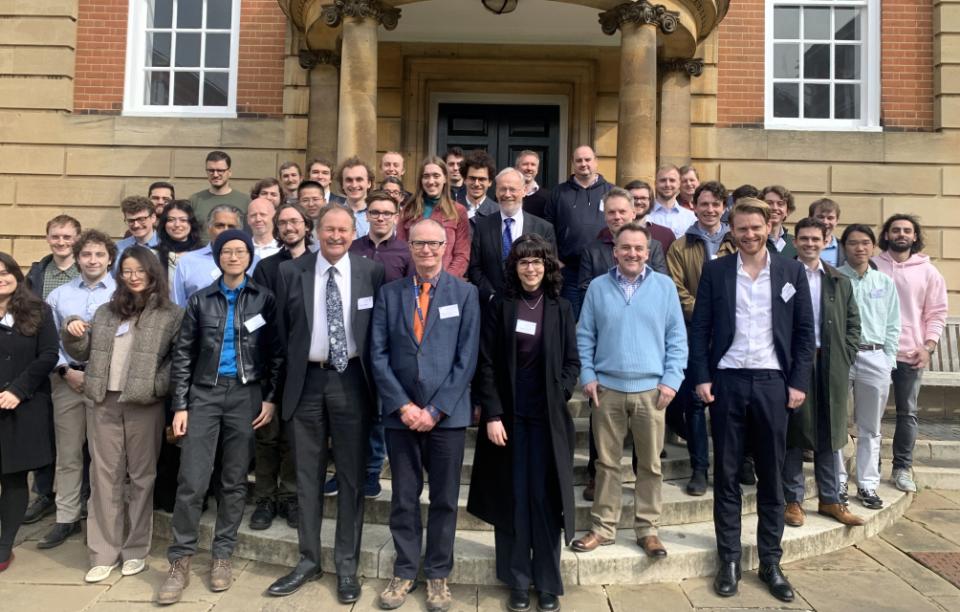
The annual meeting of the Oxford Centre for High Energy Density Science (OxCHEDS) took place on the 23rd-24th March at Lady Margaret Hall, Oxford. The two-day event featured a programme of scientific talks covering the spectrum of high-energy-density science.
The meeting was attended by 48 researchers, split between the University of Oxford and AWE, Aldermaston. The programme was divided into five sessions covering: Dynamically compressed solids, Electronic structure and dynamics, Transport and fusion science, Extreme and exotic physics, and Modelling and machine-learning techniques. The format presented many opportunities for discussion, reinforcing existing relationships, making new contacts, and thoughts of future collaborative work. An excellent conference dinner was held on the Monday evening within Lady Margaret Hall.
The opening session was led by OxCHEDS Director Prof Justin Wark with the talk 'Femtosecond diffraction studies of the transition to an overdriven shock in tantalum', and included three presentations delving deeper into this theme by Dr Patrick Heighway, OxCHEDS Coordinator, and OxCHEDS-funded DPhil researchers Domenic Peake and Thomas Stevens.
OxCHEDS Research Fellow Dr Archie Bott and his research group presented talks relevant to his previous year's Orion-laser academic access campaign. Archie gave an overview talk 'Suppression of parallel heat fluxes by kinetic instabilities in magnetised inertial-confinement plasmas'; Thomas Vincent presented results from their Orion campaign 'Experimental measurements of suppressed thermal conduction in weakly collisional, magnetised plasma'; and Louis Kemp spoke in 'Modelling transport in weakly collisional plasmas using thermodynamic theory'.
There were further talks by OxCHEDS Academic and AWE William Penney Fellow Prof Peter Norreys ('Low-convergence-ratio implosion studies for Inertial Fusion Energy') and OxCHEDS PDRA Dr Robin Timmis ('Efficiency-optimised relativistic plasma harmonics for extreme fields', work now published in Nature).
Researchers from AWE presented several papers: 'First results from the Orion Rayleigh-Taylor strength experimental platform demonstrating coaxial VISAR and short-pulse radiography measurements' by Phillip Thomas; 'Development and characterisation of an LED-based autocorrelator for precision short-pulse timing' by Joe Greaves; 'Uncertainty quantification for high-temperature iron EoS using Gaussian process methods' by Adam Wardlow; and 'Atomistic simulations and mobility law for screw dislocations in Ta' by Susanna Whitlock.
Thanks go to Dr Mila Fitzgerald for taking charge of the final preparations for the meeting, to Profs Justin Wark and Gianluca Gregori for arranging the venue for the event, and all attendees from both Oxford and AWE. We look forward to next year's meeting!