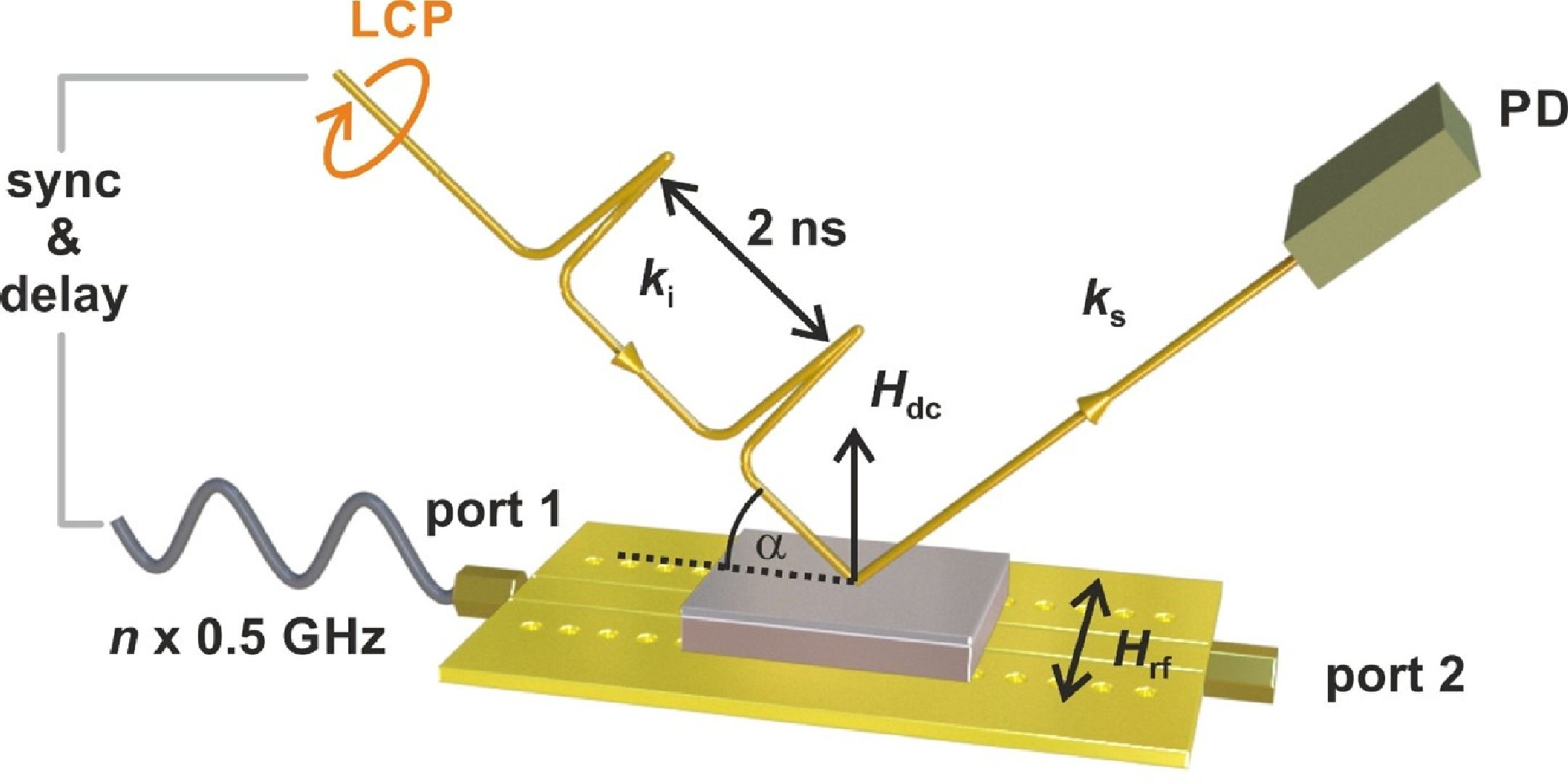
A groundbreaking study led by Shilei Zhang, Thorsten Hesjedal and Gerrit van der Laan (ShanghaiTech University, Oxford and Diamond), published in Nature Physics, explores how certain types of magnetic materials can send and receive signals wirelessly. When a special type of magnet called a "helimagnet," which has a unique spiral-like arrangement of its magnetic moments, is excited by microwaves, it can send out signals that make another nearby ordinary ferromagnet move in sync, resembling an interlocking gear mechanism.
In magnetic crystals with a helical ground state, spin waves called helimagnons propagate along the spiral order. Spin-wave communication seeks to replace charge currents with low-power magnetic signals in the future. In a simple three-layer stack of Cu2OSeO3, Pt and NiFe, the research team from ShanghaiTech, Oxford and Diamond has shown that these waves can cross the spacer and drive the remote ferromagnet to process in step. The coupling is wireless, i.e., across the Pt spacer without direct exchange contact and instead mediated by the oscillating dipolar field. It is also mode selective, so choosing the helimagnon mode sets the phase relation. At gigahertz frequencies the NiFe response is phase locked to the helimagnet with a fixed offset that preserves the helix chirality. This establishes a straightforward route to controlling one magnetic layer with the spin-wave dynamics of another.
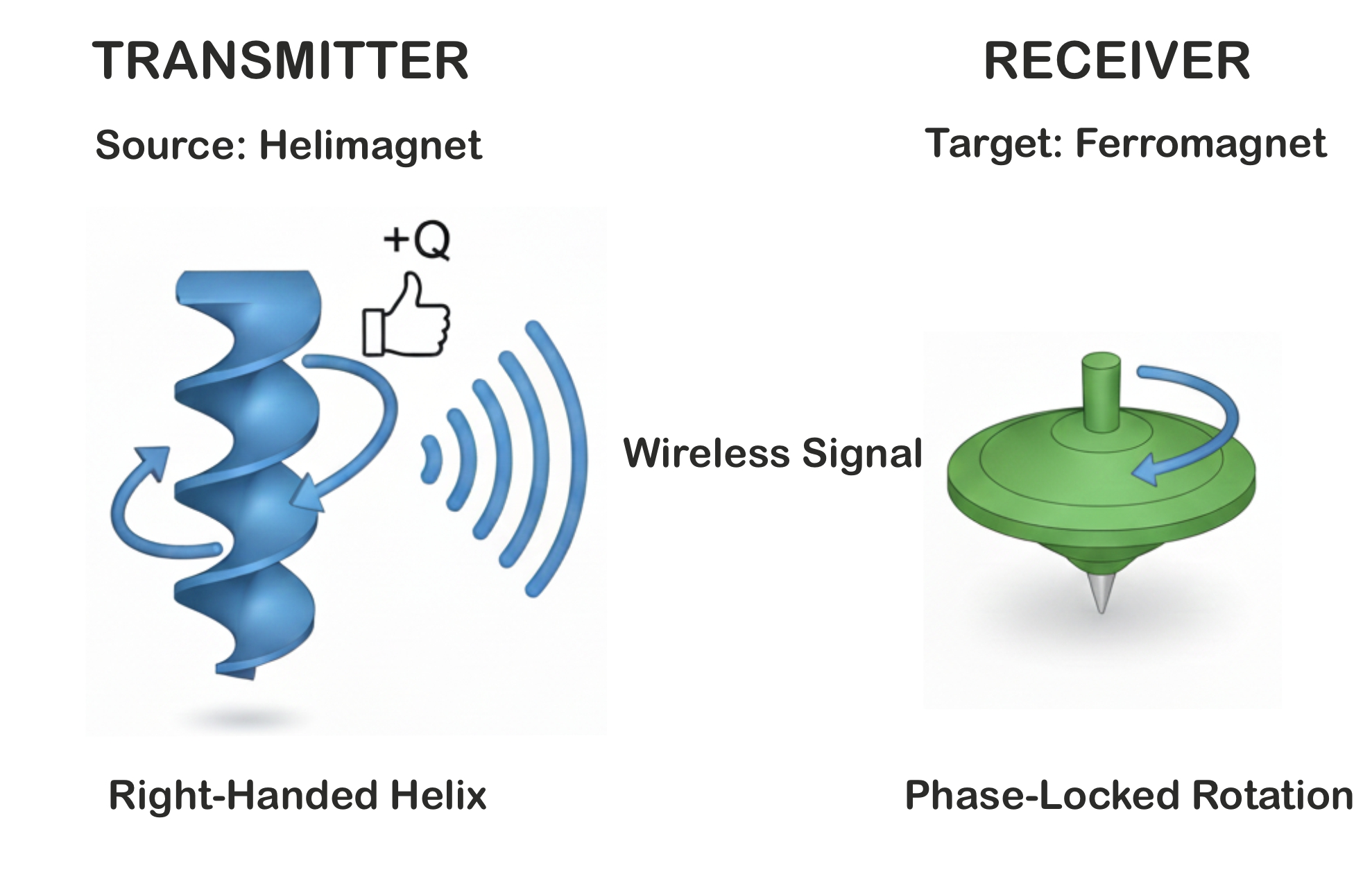
Using time-resolved resonant elastic x-ray scattering (REXS) at Diamond’s BLADE (I10) beamline, the team tracked the element-specific spin motion in both layers with picosecond resolution (Figure 1). Microwaves excited helimagnons in Cu2OSeO3, and pump-probe measurements at the Cu and Fe L3 edge resonances recorded how the Cu2OSeO3 and NiFe moments evolved through an oscillation cycle. The NiFe response resembled conventional ferromagnetic resonance, yet its precession was phase-locked to a selected helimagnon mode in the helimagnet, with a nearly constant phase offset that preserved the helix chirality. Selecting the +Q or −Q mode reversed the sign of this phase relation. The combination of element selectivity and timing allowed a vector reconstruction of the motion in each layer and a direct comparison of their phases, as illustrated by the five snapshots in Figure 2.