

Public open event
Is this event for you?
This event is for adults and young people aged 14+ who are curious about how physics shapes the world around them. No prior knowledge is needed; just bring your curiosity and questions!
About the event
At the Department of Physics, our research spans everything from the tiniest particles to the vastness of the cosmos. But it doesn’t stay locked in notebooks, hard drives, or dense academic papers, we turn it into real-world impact.
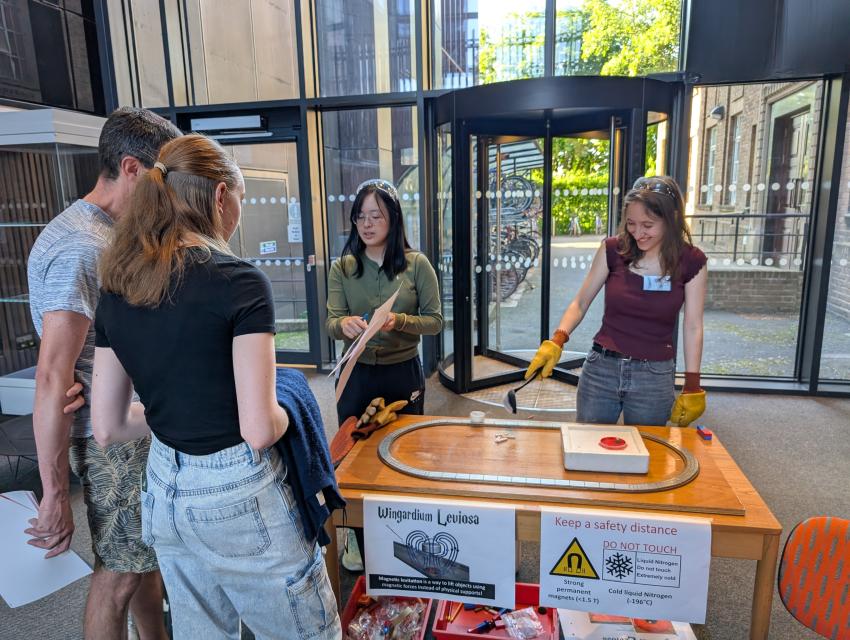
For one evening each year, we open our doors to show how our research moves from the lab into everyday life. The event includes short talks, hands-on stalls, and guided lab tours, giving you multiple ways to explore and engage.
Explore our laboratories and see cutting-edge science in action, from next-generation solar cells to quantum computers. Hear directly from researchers as they share how their work becomes new technologies, and take part in interactive stalls, live demonstrations, and Q&A sessions. It’s your chance to dive deeper, ask questions, and discover how physics is shaping your future.
Research areas
During the evening, you’ll encounter a wide range of topics through talks, stalls and tours, such as:
- Quantum computing
- Solar cells
- Virus detection
- Climate science
- Quantum materials
- Particle accelerators
Plus, don’t miss our Quantum Zone, led by students from our new MSc in Quantum Technologies.
Talks
7:00pm: Can climate models tell me whether my house will flood? (Dr Kristian Strommen) Climate models are the main tool in climate science, but what are they, what information do they give us, and how do we work with them? I'll try to answer these questions from one particular angle, namely the question of flood risks in the UK and how these might change in the future.
7:40pm: Optics for Health (Dr Elliot Bentine) Can physics help save lives? In this talk, physicist Elliot Bentine will detail how his work in the atomic and laser physics labs of Oxford Physics led to the invention of new medical devices for measuring lung and heart health.
8:20pm: Plasma physics and the pursuit of fusion power (James Edmiston): Energy consumption per capita is closely linked to quality of life. As such, the demand for power has shaped much of the innovation, politics and conflict of the previous century. With consumption expected to triple by 2050 and concerns mounting about continued carbon dioxide emissions, scalable and sustainable power is more needed than ever. Nuclear fusion has long been hailed as the ‘holy grail’ of clean energy. In principle, it could power the world for billions of years without any of the drawbacks associated with nuclear fission (such as long-lived radioactive waste, reactor meltdowns and weapons proliferation). However, the physics and engineering challenges involved are formidable. In this talk we will discuss the exotic state of matter required for fusion reactions, the myriad of proposed devices and the technical challenges that remain.
Feedback from previous events
"I really liked learning about how physics is being applied in different ways, such as how it is being used to create 3D images of historical buildings that have been destroyed from photographs"
"it's really interesting to see the way they are doing the experiments in the labs"
"My favourite part was seeing how different technologies are used and adapted to different situations, because this opened my eyes to the wide range of topics physics can apply to"
Bookings
Booking closed.
Join our mailing list for regular updates.