Home
Department Of Physics text logo
  • Research
    • Our research
    • Our research groups
    • Our research in action
    • Research funding support
    • Summer internships for undergraduates
  • Study
    • Undergraduates
    • Postgraduates
  • Engage
    • For young people
    • For teachers
    • For the public
    • For alumni
    • For business
  • Support
Menu
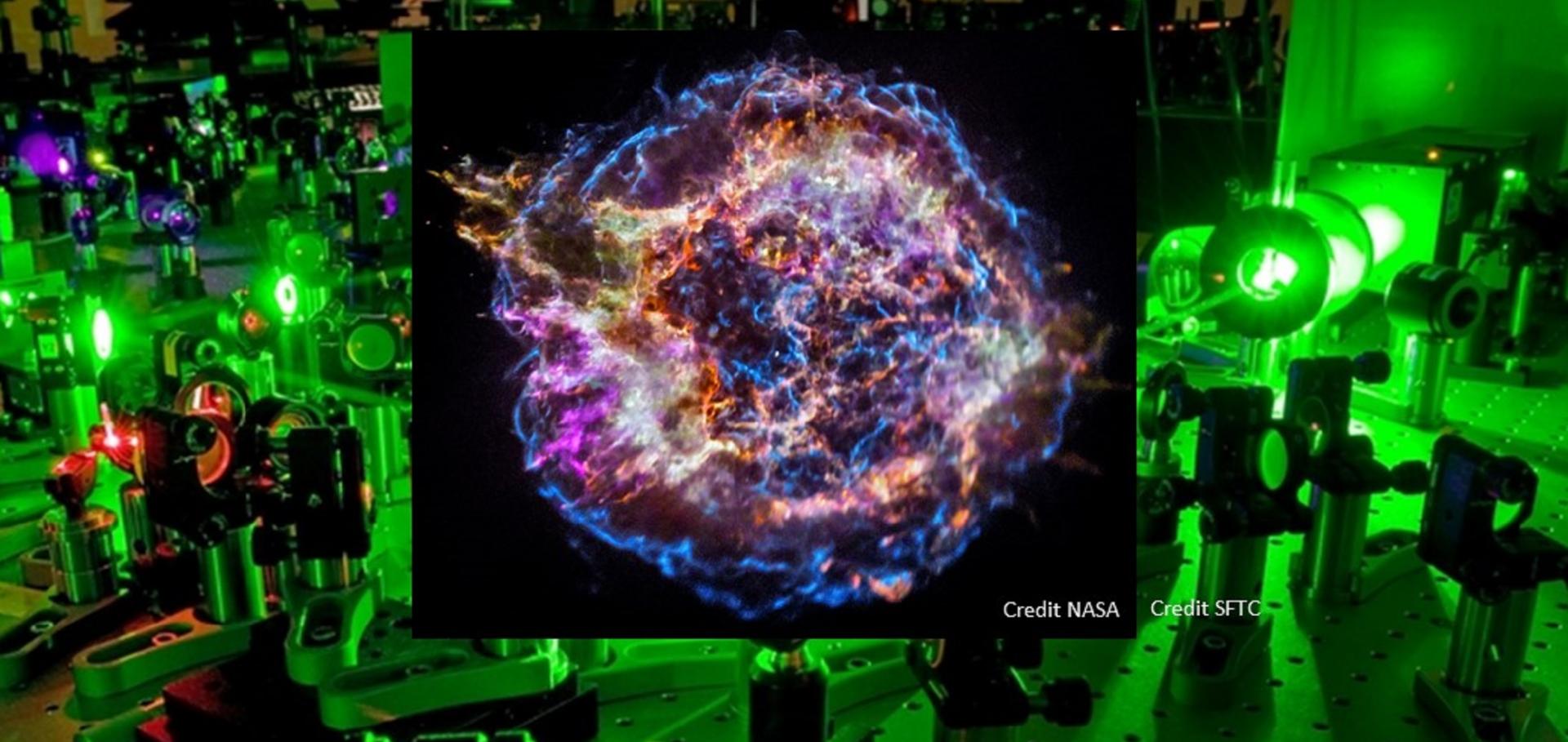
A CHANDRA image of the supernova remnant Cas A superimposed on the Gemini laser at the UK Central Laser Facility

The plasma physics of supernova remnants in astrophysics is similar to plasma physics of solids irradiated with powerful lasers in the laboratory.

Credit: 1) The Royal Society (personal photo) 2) NASA/CXC/MIT/UMass Amherst/M.D.Stage et al. (Cas A) 3) STFC (laser)

Tony Bell FRS

Academic Visitor

Research theme

  • Particle astrophysics & cosmology
  • Plasma physics

Sub department

  • Atomic and Laser Physics
Tony.Bell@physics.ox.ac.uk
Telephone: 01865 (2)72210
Clarendon Laboratory, room 316.4
  • About
  • Publications

Amplification of perpendicular and parallel magnetic fields by cosmic ray currents

MONTHLY NOTICES OF THE ROYAL ASTRONOMICAL SOCIETY 469:2 (2017) 1849-1860

Authors:

JH Matthews, AR Bell, KM Blundell, AT Araudo
More details from the publisher
Details from ORA
More details
Details from ArXiV
More details

Numerical modeling of laser-driven experiments aiming to demonstrate magnetic field amplification via turbulent dynamo

PHYSICS OF PLASMAS 24:4 (2017) ARTN 041404

Authors:

P Tzeferacos, A Rigby, A Bott, AR Bell, R Bingham, A Casner, F Cattaneo, EM Churazov, J Emig, N Flocke, F Fiuza, CB Forest, J Foster, C Graziani, J Katz, M Koenig, C-K Li, J Meinecke, R Petrasso, H-S Park, BA Remington, JS Ross, D Ryu, D Ryutov, K Weide, TG White, B Reville, F Miniati, AA Schekochihin, DH Froula, G Gregori, DQ Lamb
More details from the publisher
Details from ORA
More details
Details from ArXiV
More details

Evidence that the maximum electron energy in hotspots of FR II galaxies is not determined by synchrotron cooling

Monthly Notices of the Royal Astronomical Society (2016) stw1204-stw1204

Authors:

AT Araudo, AR Bell, A Crilly, KM Blundell
More details from the publisher
Details from ORA
More details
Details from ArXiV

Contemporary particle-in-cell approach to laser-plasma modelling

Plasma Physics and Controlled Fusion IOP Publishing 57:11 (2015) 113001

Authors:

TD Arber, K Bennett, CS Brady, A Lawrence-Douglas, MG Ramsay, NJ Sircombe, P Gillies, RG Evans, H Schmitz, AR Bell, CP Ridgers
More details from the publisher

Developed turbulence and nonlinear amplification of magnetic fields in laboratory and astrophysical plasmas.

Proceedings of the National Academy of Sciences of the United States of America National Academy of Sciences 112:27 (2015) 8211-8215

Authors:

Jena Meinecke, Petros Tzeferacos, Anthony R Bell, Robert Bingham, Rob J Clarke, Eugene M Churazov, Robert Crowston, Hugo Doyle, R Paul Drake, Rob Heathcote, Michel Koenig, Yasuhiro Kuramitsu, Carolyn C Kuranz, Daniel Lee, Michael J MacDonald, Chris D Murphy, Margaret M Notley, Hye-Sook Park, Alexander Pelka, Alessandra Ravasio, Brian Reville, Youichi Sakawa, Willow C Wan, Nigel C Woolsey, Roman Yurchak

Abstract:

The visible matter in the universe is turbulent and magnetized. Turbulence in galaxy clusters is produced by mergers and by jets of the central galaxies and believed responsible for the amplification of magnetic fields. We report on experiments looking at the collision of two laser-produced plasma clouds, mimicking, in the laboratory, a cluster merger event. By measuring the spectrum of the density fluctuations, we infer developed, Kolmogorov-like turbulence. From spectral line broadening, we estimate a level of turbulence consistent with turbulent heating balancing radiative cooling, as it likely does in galaxy clusters. We show that the magnetic field is amplified by turbulent motions, reaching a nonlinear regime that is a precursor to turbulent dynamo. Thus, our experiment provides a promising platform for understanding the structure of turbulence and the amplification of magnetic fields in the universe.
More details from the publisher
Details from ORA
More details
More details

Pagination

  • First page First
  • Previous page Prev
  • Page 1
  • Page 2
  • Page 3
  • Current page 4
  • Page 5
  • Page 6
  • Page 7
  • Page 8
  • Page 9
  • …
  • Next page Next
  • Last page Last

Footer Menu

  • Contact us
  • Giving to the Dept of Physics
  • Work with us
  • Media

User account menu

  • Log in

Follow us

FIND US

Clarendon Laboratory,

Parks Road,

Oxford,

OX1 3PU

CONTACT US

Tel: +44(0)1865272200

University of Oxfrod logo Department Of Physics text logo
IOP Juno Champion logo Athena Swan Silver Award logo

© University of Oxford - Department of Physics

Cookies | Privacy policy | Accessibility statement

Built by: Versantus

  • Home
  • Research
  • Study
  • Engage
  • Our people
  • News & Comment
  • Events
  • Our facilities & services
  • About us
  • Giving to Physics
  • Current students
  • Staff intranet